Claude Haiku 5.5: Fast and Economical Model from Anthropic
By Tim APIPedia, Tim Engineering APIPedia · Published · Updated · 5 min read
The Claude Haiku 5.5 is Anthropic's fastest and cheapest Claude model: 90% more economical than the Haiku 4.5, 1 million tokens in context, and scores close to the Sonnet 5.5.
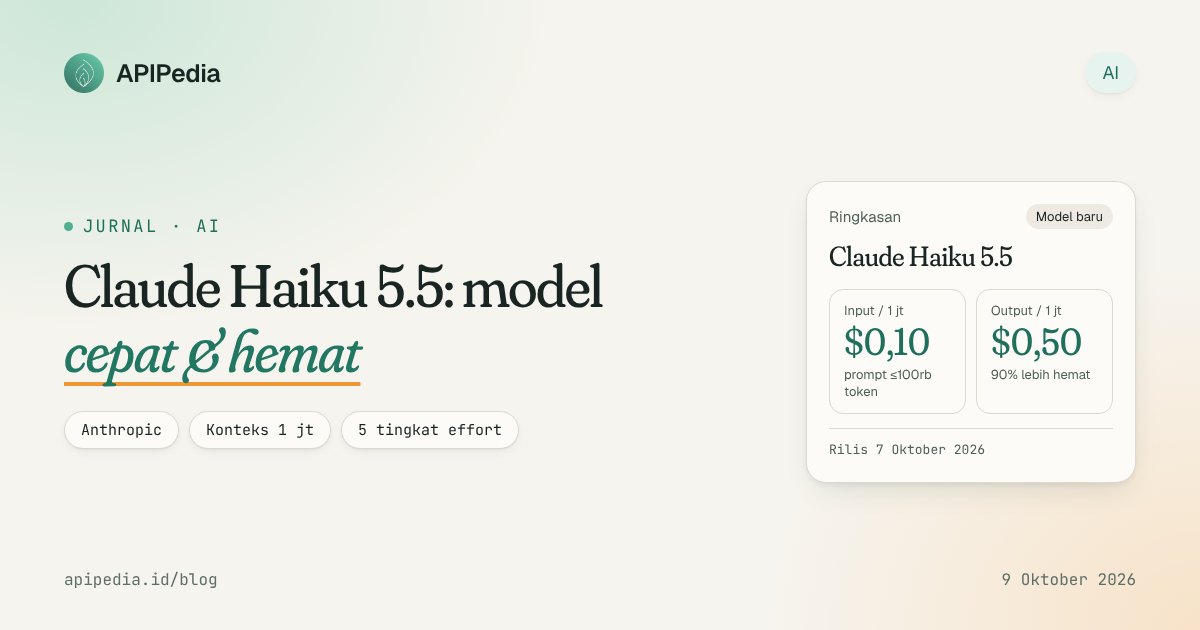
The Claude Haiku 5.5 was released by Anthropic on October 7, 2026 as the fastest and cheapest Claude model so far, with an average cost of about 75% less than the Haiku 4.5 ( Anthropic).
What is Claude Haiku 5.5?
Haiku is Anthropic's line of small models for fast, high-volume work. The Haiku 5.5 replaces the Haiku 4.5 released about a year earlier, and is the third model in the Claude 5.5 generation after the Opus 5.5 and Sonnet 5.5 ( 9to5Mac).
| Model | Position in Claude's line |
|---|---|
| Fables/Mythos | The highest level, for long and autonomous work |
| Opus 5.5 | The go-to for heavy reasoning and complex coding |
| Sonnet 5.5 | Clearly defined daily work |
| Haiku 5.5 | Tasks are fast, repetitive, and cost-effective |
Anthropic designed it for tasks such as summarization, context compaction, database querying, and classification. This model is also suitable as a subagent that helps Opus 5.5 or Sonnet 5.5 in coding work.
Key features and capabilities
Haiku 5.5 is the first Haiku to have effort settings, so users can choose between cost savings or higher intelligence.
- Five levels of effort. Low, Medium, High, Xhigh, and Max ( Android Authority). Thinking is adaptive and active by default, but can be turned off at low to high levels ( OpenRouter).
- Context 1 million tokens, maximum output 128,000 tokens, with text and image input.
- Anthropic's fastest model at standard speeds, making it suitable for live customer service and browser use. Opus models in Fast Mode remain faster.
- Computer use and browser use. Along with this release, Claude's Python and TypeScript SDKs received beta support for computer use and browser use.
- New tokenizer, similar to Sonnet 5.5 and Opus 5.5, which uses slightly more tokens per task.
Early customers report real results. HubSpot said Haiku 5.5 scored the highest they've ever seen in their CRM tests (92.8%). Box reports a score 11 points higher than Haiku 4.5 with about half the latency ( Anthropic).
Performance and benchmarks
The Haiku 5.5 jumped ahead of the Haiku 4.5 and came close to the Sonnet 5.5 in some tests. The figures below were published by Anthropic ( Anthropic).
| Benchmarks | Haiku 5.5 | Haiku 4.5 | Sonnet 5.5 (reference) |
|---|---|---|---|
| GDPval-AA v2.1 (professional work, Elo score) | 1620 | 735 | 1840 |
| OSWorld 2.1 (computer use, offline subset) | 72.4% | 15.7% | 83.9% |
| Humanity's Last Exam (with tools) | 57.4% | 18.7% | 64.5% |
| Terminal-Bench 4.0 (agentic coding) | 39.2% | 0.0% | 70.6% |
| FrontierCode 1.1 | 46.4% | — | 52.1% |
| Chartography (visual reasoning) | 46.4% | 6.4% | 61.6% |
Independent measurements from Artificial Analysis gave Haiku 5.5 (effort Max) an Intelligence Index score of 43.4 and 32.8% in Terminal-Bench 4.0 ( OpenRouter).
Anthropic itself warns of its limits: for complex agent coding tasks like Terminal-Bench, Sonnet 5.5 and Opus 5.5 remain better choices. Haiku's Terminal-Bench scores also depend heavily on effort, around 39% on Max and around 20% on Medium ( VentureBeat).
Price, access and availability
For prompts up to 100,000 tokens, Haiku 5.5 is 90% cheaper than Haiku 4.5: $0.10 per 1 million input tokens and $0.50 per 1 million output tokens. Prices are in US dollars per 1 million tokens ( Anthropic).
| Cost type | Haiku 5.5 (≤100k tokens) | Haiku 5.5 (>100k tokens) | Haiku 4.5 | Sonnet 5.5 |
|---|---|---|---|---|
| Inputs | $0.10 | $0.50 | $1.00 | $2.00 |
| Outputs | $0.50 | $2.50 | $5.00 | $10.00 |
| Cache read | $0.01 | $0.05 | $0.10 | $0.10 |
| Cache write | $0.125 | $0.625 | $1.25 | $2.50 |
About 90% of requests to Haiku 4.5 are under 100,000 tokens, so most users will enjoy the cheapest rates. After factoring in the new tokenizer, Anthropic estimates average savings of around 75%.
How to access:
- Claude Platform (API): Model ID
claude-haiku-5-5. - Cloud: Amazon Bedrock, Google Cloud, and Microsoft Azure ( AWS).
- Bonus for customers: Max and Team users get new monthly API credits, $100 for Max 5x, $200 for Max 20x, and up to $500 for Team.
Who it is suitable for, limitations, and conclusions
Haiku 5.5 is best suited for teams that perform many small, repetitive tasks and need low costs and fast response.
Suitable for:
- Document summarization, classification, and extraction of large volumes of data.
- Customer service chatbots that require fast responses.
- Subagents in a multi-agent system, for example, pull a single number from a financial report while the larger model constructs the presentation.
- Low-cost browser and computer automation.
Limitations:
- Still lags behind Sonnet 5.5 and Opus 5.5 for complex agent coding.
- Rates increase fivefold for prompts above 100,000 tokens.
- Cybersecurity safeguards continue to block penetration testing; organizations that need broader access must register for the Cyber Verification Program.
Conclusion: The Haiku 5.5 is a huge leap forward for the small model class. With a price equal to the GPT-6 Luna and scores close to the Sonnet in some tests, this model deserves to be the top choice for high-volume work.
Source
Topics: #anthropic #claude haiku 5.5 #ai #llm #model bahasa
${c.about}
Tim APIPedia — Tim Engineering APIPedia
Tim engineering di balik APIPedia yang membangun dan memelihara API data Indonesia - ongkir, OCR KTP, data wilayah, BMKG, hingga server MCP - dan menulis panduan integrasinya dari pengalaman langsung.