Consecutive Technology Disruptions in the US: 6 Incidents in 6 Days, What's the Cause?
By Tim APIPedia, Tim Engineering APIPedia · Published · 11 min read
Six major intrusions hit the US on November 12–17, 2026. Intelligence officials said they were not cyberattacks. Here is the official cause and lesson.
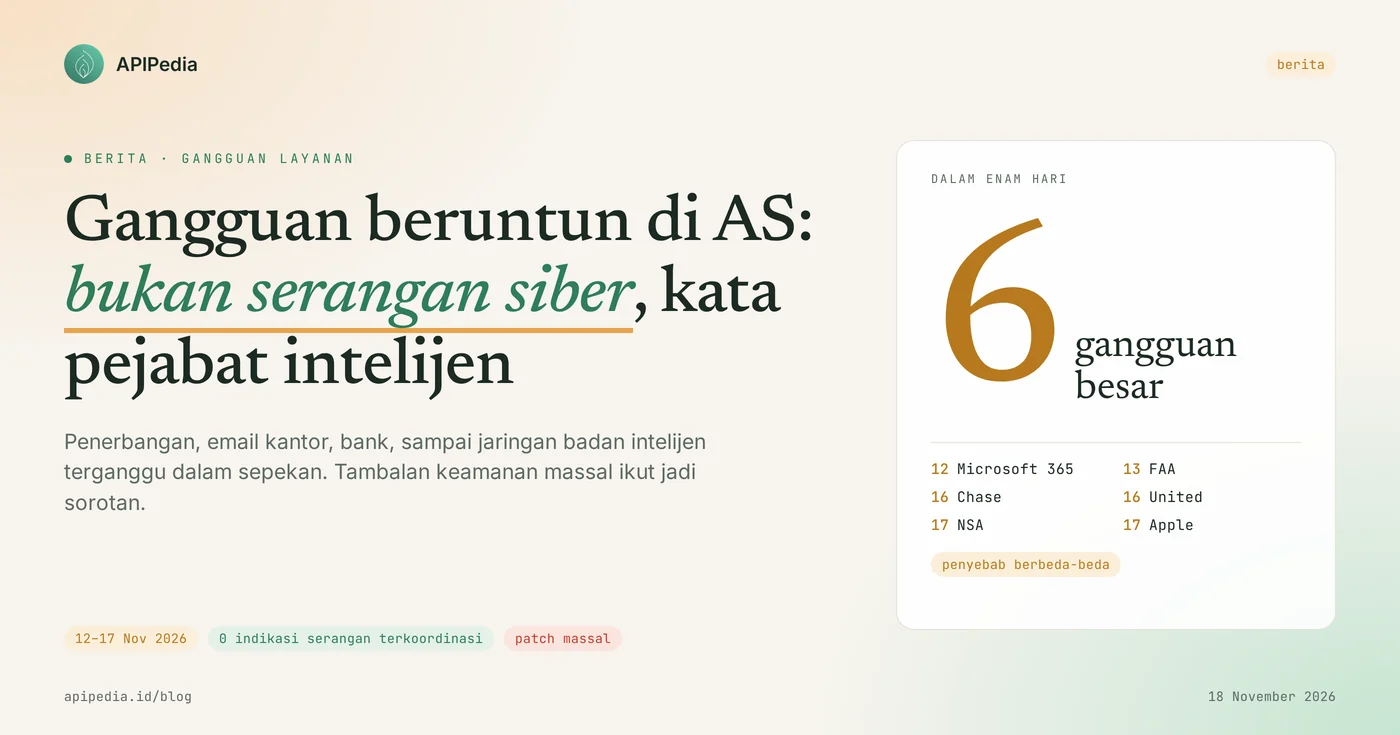
Six major technology disruptions occurred in the United States in six days, November 12–17, 2026: Microsoft 365, FAA aviation systems, JPMorgan Chase, United Airlines, NSA network, and Apple services. The US Director of National Intelligence said there was no indication of a coordinated cyber attack, and each side gave different technical explanations.
This series is important for readers in Indonesia for two reasons. Some disrupted services are used here, and one explanation that emerges, namely systems that fail to restart after being patched, is a risk every IT team faces. This article summarizes what happened, what's confirmed, what's still conjecture, and what you need to prepare for.
Quick summary
| Items | Details |
|---|---|
| When | Thursday 12 to Tuesday 17 November 2026 |
| The disturbed one | Microsoft 365, FAA (aviation), JPMorgan Chase, United Airlines, NSA network, Apple services |
| Cyber attack? | There was no indication of a coordinated attack or state actor, according to the US Director of National Intelligence |
| Reason | Various: old bugs, routers during network migration, software bugs, internal updates, and maintenance accompanied by patching PHP gaps |
| Which is still a guess | That the wave of patching of AI-discovered loopholes is a common trigger outside the NSA case |
| Impact on Indonesia | Directly on Microsoft 365 users and Apple services; indirectly as a patch management lesson |
What will be disrupted on November 12–17, 2026?
There were six incidents reported by news agencies and confirmed by related parties. The order is as follows.
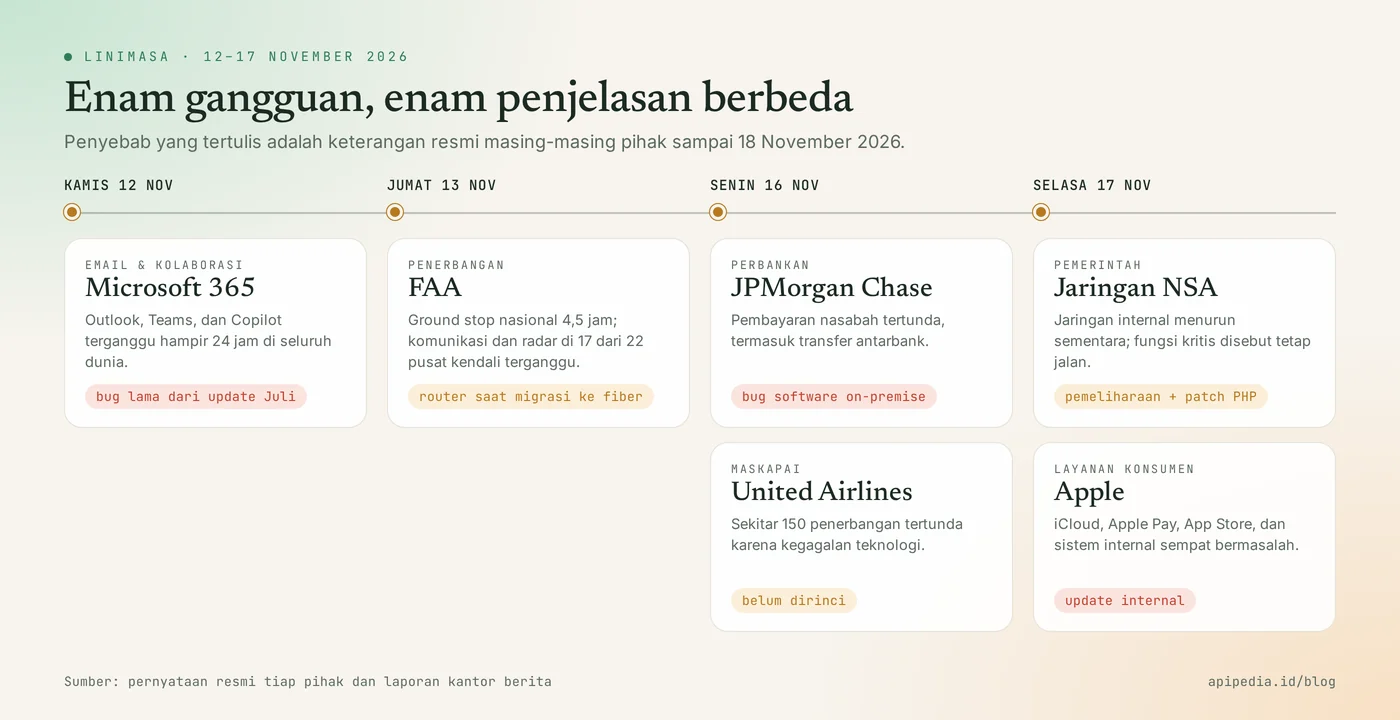
| Date | Party | Impact | Official explanation |
|---|---|---|---|
| Nov. 12–13 | Microsoft 365 | Outlook, Exchange Online, Teams, and Copilot were disrupted for nearly 24 hours worldwide | Bug in the network gateway server introduced via the July update |
| Nov. 13 | FAA | The national departure stop (ground stop) is around 4.5 hours; communications and radar at 17 of 22 control centers were disrupted | Excessive connection requests from a router during a copper to fiber migration job; The root of the problem is still being investigated |
| Nov. 16 | JPMorgan Chase | Customer payments are delayed, including transfers involving other banks | A software bug in an on-premise hardware system, not a cyber incident |
| Nov. 16 | United Airlines | About 150 flights were delayed | Technology failure; Detailed causes have not been explained |
| Nov. 17 | NSA | The internal network experiences a temporary decline; critical functions are said to remain running | Routine maintenance; The Director of National Intelligence linked it to patching the PHP loophole |
| Nov. 17 | Apple | iCloud, Apple Pay, App Store and internal systems had problems | Internal updates, not cyber attacks |
For readers in Indonesia, the Microsoft 365 disruption started at around 23.20 WIB on Thursday 12 November and only recovered around 23.10 WIB the next day. The FAA ground stop ends Saturday, November 14 at around 08.15 WIB.
Is this a cyber attack?
No, according to US intelligence officials. Director of National Intelligence Jay Clayton said in a television interview on November 17 that his party had seen no signs of coordinated cyberattacks or state-sponsored activity. Secretary of State Marco Rubio called the incidents disturbing but not related.
Statements from affected parties are in line with that. Microsoft, Chase, and Apple each said their outages were not the result of an attack. FAA administrators said there was no evidence of an AI connection, and investigators were still examining the router involved.
Not all parties were satisfied with that explanation. Several senators from both parties questioned whether the streak was purely coincidental and asked the government to provide a more complete explanation. As of this writing on November 18, 2026, there is no public evidence to suggest an attack.
What causes each disorder?
The causes are different in each case, and only some of them have been explained technically. The most detailed explanation comes from Microsoft.
Microsoft 365: a bug that's been sleeping since July
Microsoft's initial report mentioned three things converging at the same time:
- Latent bug. A network gateway server update in July brought a flaw that ran without problems for more than three months, but could overwhelm the server in certain traffic patterns.
- Additional traffic. About 15 hours before the outage, Teams automatically moved to the network infrastructure used by Exchange Online.
- Reduced capacity. Nearly 14% of gateway server capacity is down due to other issues.
As a result, in less than two hours the flaw appeared across the entire server fleet. At its lowest point, more than 80% of gateway servers were unresponsive. Microsoft admitted load testing didn't catch this bug because the hardware in the lab was less powerful than production. The complete chronology is in our article about Microsoft 365 global downtime.
NSA: system does not restart after patching
The NSA case is the only one publicly linked to a security patch. The agency's official statement said the reduction was temporary during routine maintenance. Clayton added that the outage occurred following the patching of a PHP flaw discovered with the help of AI last month. According to him, some systems did not restart as expected after being patched, and handover between systems did not run properly.
The vulnerability in question is PHP2Shell, a fix for which was released October 21, 2026. We have discussed technical details and a secure version in the PHP2Shell guide.
FAA, Chase, United, and Apple
The other four cases have shorter explanations. The FAA traced the problem to a router sending excessive connection requests during copper-to-fiber cable migration work, and the root cause is still being investigated. Chase cited a software bug in the on-premise system. Apple calls it an internal update. United has not specified the cause.
Is it true that patching gaps discovered by AI was the trigger?
This is partly true, but the evidence only exists for one case. This is a section that needs to be read carefully, so we separate fact from conjecture.
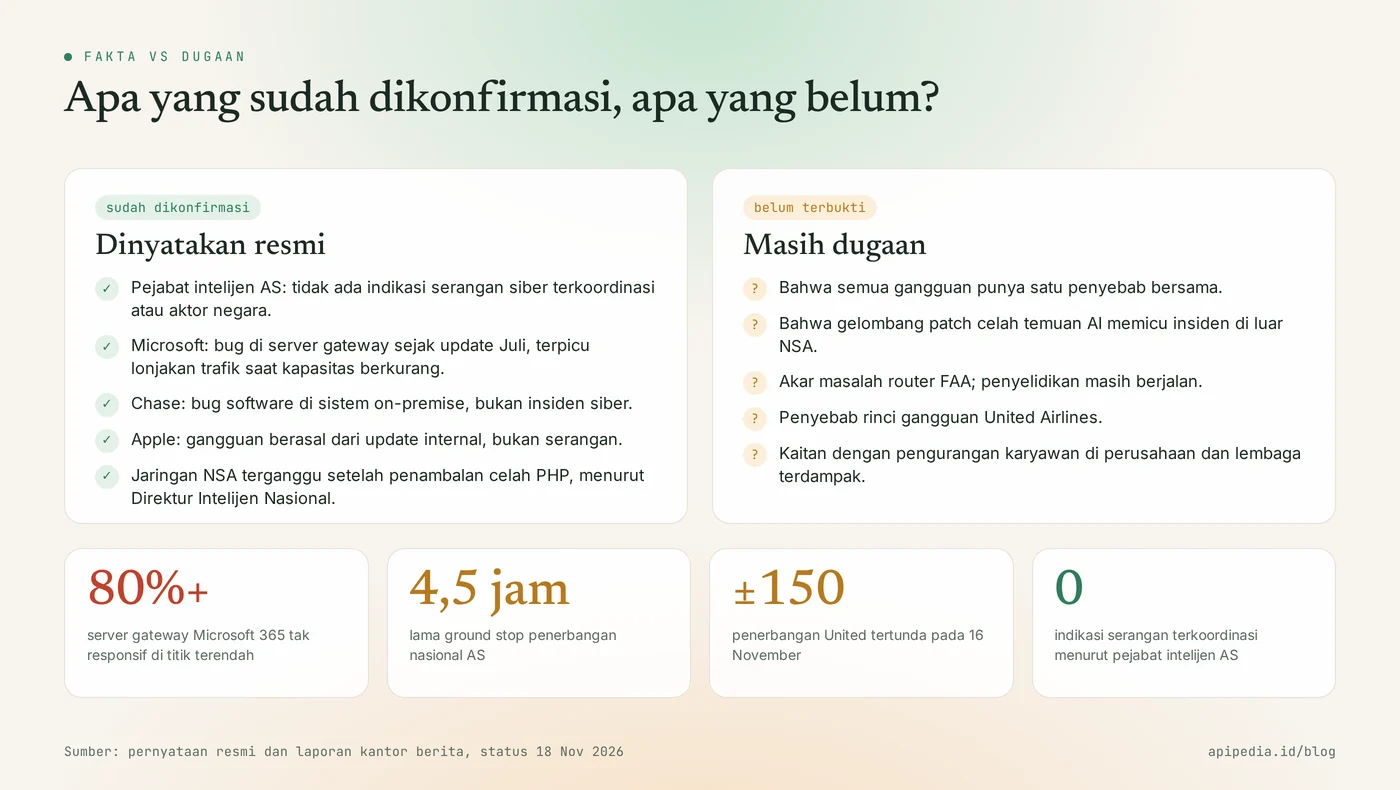
Fact: Clayton says patching is now happening on a much larger scale than before, and some systems are not returning to normal after being patched. He attributes this to the ability of the latest AI models to find previously unknown gaps. A US senator also said the discovery of AI-based vulnerabilities forced organizations to patch many systems at once.
What hasn't been proven: the link has only been publicly stated to NSA interference. Microsoft, Chase and Apple cited other technical causes, and the FAA denied any link to AI. There is news based on anonymous sources that mentions patches as a common trigger, but this has not been confirmed by the affected parties.
Our analysis: the most plausible explanation at this time is several separate failures that happened to be close together, with one weak common thread, namely changes to the production system. Almost all cases are triggered by a change: an update, network migration, maintenance, or patch.
There is also a broader context. Insurance company Marsh noted that its clients reported 105 cyber incidents in the last two weeks of October, more than double the 48 incidents in the last two weeks of May. Experts quoted by the news agency also cited a reduction in experienced staff as a factor in thinning the safety margin, but there was no evidence that it caused this week's disruption.
Why is this important for developers and IT admins?
Because the failure pattern is common and can occur in any sized system. Three lessons are clear from this series:
- Patching is a production change. Security patches remain mandatory, but systems that are shut down for patching must be proven to be able to turn on again and reconnect to other systems.
- Bugs can lie dormant for months. Microsoft's case shows that defects from July only emerged in November when traffic rose and capacity fell simultaneously.
- Failover can be a trigger. Automatic traffic redirection saves one service but overloads another service until it collapses.
What impact will it have on readers in Indonesia?
The direct impact is limited to the global services used here, while the indirect impact is broader.
- Microsoft 365 users in Indonesia were also affected on November 13, right during morning working hours.
- Apple service users may experience iCloud or App Store disruption on November 17–18 Indonesian time. Apple did not specify the affected areas.
- FAA, Chase, United, and NSA interference is US domestic. There have been no reports of direct impact on services in Indonesia.
- IT teams that are patching PHP2Shell need to pay attention to the NSA case, because the same type of patch is being or has just been installed on many servers in Indonesia.
There has been no statement from the Indonesian regulator regarding this series of disturbances.
What needs to be done now?
Keep patching, but treat each patch as a release with a fallback plan. Our recommended order:
- Don't delay critical patches. The risk of being breached via a loophole that has already been exploited is greater than the risk of interference while patching.
- Test in production-like staging. Match the version, configuration, and hardware class as much as possible.
- Patch gradually. Start from one server or one zone, monitor, then continue. Don't patch the entire fleet at once.
- Test the restart process, not just the patch. Make sure the service is back up, connected to the database, queue, and other services that depend on it.
- Set up rollback. Save a snapshot or previous version of the package and write down the steps before starting.
- Leave spare capacity. Calculate whether the remaining servers can handle the load when some are shut down.
- Limit the domino effect in integration. Use timeouts, cascading retries, and queues to prevent your application from crashing when upstream services fail.
Example of a gradual patching pattern on a server behind a load balancer:
# 1. Keluarkan satu server dari load balancer, lalu snapshot
# 2. Pasang patch dan restart layanan
sudo apt-get update && sudo apt-get install --only-upgrade php8.3-fpm
sudo systemctl restart php8.3-fpm

# 3. Pastikan layanan hidup dan aplikasi sehat sebelum lanjut
systemctl is-active php8.3-fpm
curl -fsS -o /dev/null -w "%{http_code}\n" http://127.0.0.1/healthz

# 4. Kembalikan ke load balancer, pantau 15-30 menit,
#    baru ulangi untuk server berikutnya
Match the package name and health check address to your system. The point is in step 3: don't move on to the next server before the first server is proven to be healthy.
Frequently asked questions
Are these disorders related?
There is no evidence yet that all six have one cause. US officials said the incidents were unrelated, and each side gave different technical explanations. A link to the new security patch was revealed in the NSA case.
Will services in Indonesia be disrupted?
Directly affected are global services, especially Microsoft 365 on November 13 and some Apple services on November 17 US time. The FAA, Chase, United, and NSA intrusions occurred within the US.
Is it better to delay security patches so they don't go down?
No. Delaying patches for vulnerabilities that have already been exploited is even riskier. What needs to change is the method: test first, patch gradually, and prepare for rollback.
What does AI have to do with this disruption?
According to US intelligence officials, the latest AI models are increasingly able to find security gaps, so the volume of patches is increasing. This is an indirect explanation and has only been linked to the NSA case. Microsoft and the FAA said their outage was not related to AI.
Have all services been restored?
Microsoft, FAA, Chase, United, and Apple have reported service is back up and running. The NSA network reportedly returned to normal status on Tuesday evening local time, but its full restoration has not been publicly confirmed.
To strengthen your integration when upstream services have problems, also read how idempotency keys work so that retries don't duplicate transactions and the meaning of rate limits and error 429.
Source
- Fox Business: Director of National Intelligence Jay Clayton interview, November 17, 2026 (direct statement)
- Reuters via The Korea Herald: Tech outage wave reaches US government
- BleepingComputer: summary of Microsoft's initial report on Microsoft 365 outage
- TechCrunch: Google statement and summary of this week's outages
- Implicator: US Tech Outages: FAA, Microsoft, NSA, Apple and AI Patching
Topics: #berita #gangguan layanan #cloud #patch management #keamanan #admin it
About the author
Tim APIPedia — Tim Engineering APIPedia
Tim engineering di balik APIPedia yang membangun dan memelihara API data Indonesia - ongkir, OCR KTP, data wilayah, BMKG, hingga server MCP - dan menulis panduan integrasinya dari pengalaman langsung.