GPT-6: What You Need to Know
By Tim APIPedia, Tim Engineering APIPedia · Published · Updated · 5 min read
GPT-6 comes as a family of three models — Astra, Sol, and Luna — from OpenAI, with a context of ~1 million tokens and a starting price of $0.10 per million input tokens.
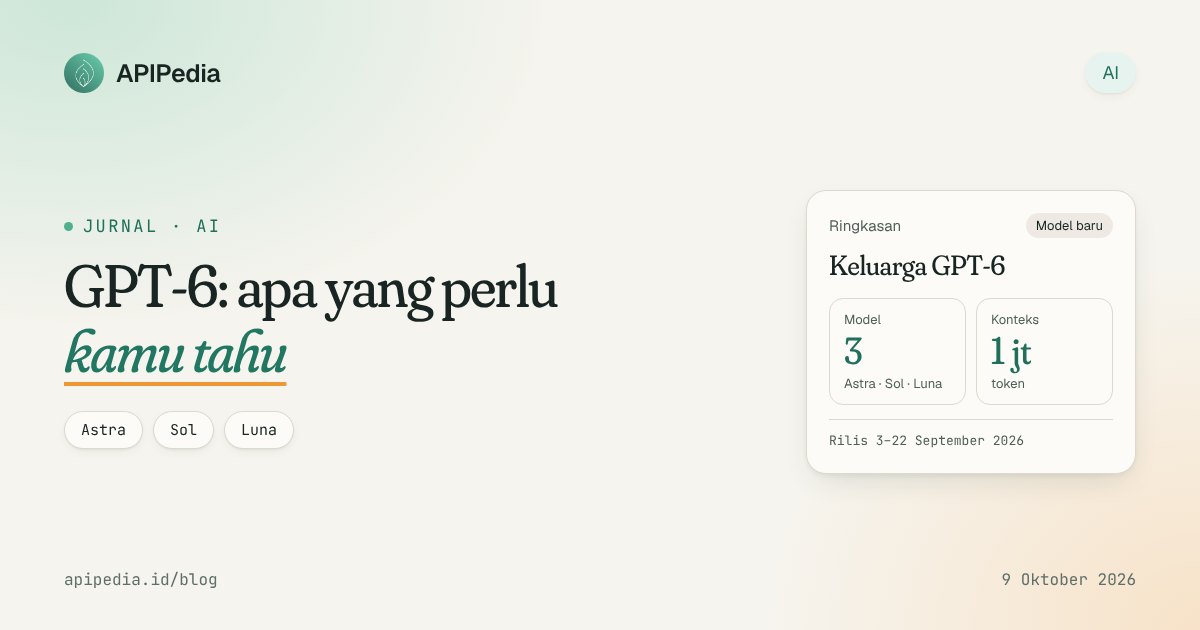
GPT-6 is officially here: OpenAI released the GPT-6 Astra on September 3, 2026, followed by the GPT-6 Sol and GPT-6 Luna on September 22, 2026. Rather than one model, the GPT-6 is a family of three models with different prices and capabilities.
What is GPT-6?
GPT-6 is the latest generation of large language models (LLM) from OpenAI, the successor to GPT-5.6. The name "Astra" that has been circulating as a rumor for months turns out to be GPT-6 itself, not a separate model ( Wikipedia).
The launch was delayed. In August 2026 OpenAI slowed the release because an internal evaluation showed Astra passed the company's "Critical" cybersecurity threshold. This means that the model is capable of finding and exploiting security gaps independently ( Yotta Labs).
| Model | Release date | Position |
|---|---|---|
| GPT-6 Astra | 3 Sep 2026 (preview), 4 Sep 2026 (public) | The most powerful model, for the toughest jobs |
| GPT-6 Sol | Sep 22, 2026 | Middle class: complex coding and agent workflows |
| GPT-6 Luna | Sep 22, 2026 | Economy class: high volume fast assignments |
On October 7, 2026, OpenAI also began bringing Sol and Luna to ChatGPT's daily chat mode, complete with a new feature called Intelligent UI ( 9to5Mac).
Key features and capabilities
GPT-6 is positioned as a model for working, not just chatting: the main focus is computer use (operating the computer and browser) and software engineering.
- Very long context. Astra holds approximately 1.05 million context tokens and writes up to 128,000 output tokens, with a knowledge deadline of April 30, 2026 ( Yotta Labs).
- Input text and images. Audio and video are not yet supported at launch.
- Five levels of reasoning. API users can choose low, medium, high, xhigh, or max.
- Agents and tools. Supports web search, file search, code interpreter, shell, computer use, and MCP.
- New reasoning architecture. Astra uses the "recurrent depth" or looped transformers technique. This technique is more efficient, but makes some of the model's thinking processes difficult to observe, and has raised concerns among AI security experts ( Wikipedia).
- OpenAI's largest training ever. For the first time OpenAI trained a model on more than 100,000 GPUs at the Stargate, Texas site.
In ChatGPT, GPT-6 brings Intelligent UI: answers can combine text, visuals, and interactive elements such as calculators or games. ChatGPT can also start answering while continuing to think, so users don't have to wait for the entire reasoning process to complete ( 9to5Mac).
Benchmarks and performance
According to official OpenAI figures, Astra's biggest spikes were in terminal tasks, computer usage, mathematics and cybersecurity. All numbers below come from OpenAI itself and have not been independently replicated at launch ( Yotta Labs).
| Benchmarks | GPT-6 Astra | GPT-5.6 Sol (predecessor) |
|---|---|---|
| Terminal-Bench 4.0 | 57.9% | 37.3% |
| OSWorld 2.0 (computer use) | 72.6% | 65.7% |
| DeepSWE v1.1 (coding) | 74.1% | 72.7% |
| FrontierMath Tier 4 | 97.6% | 83.0% |
| GPQA Diamond | 96.0% | 94.6% |
| ARC-AGI-2 | 95.0% | 92.5% |
| Level of hallucinations (the lower the better) | 4.2% | 12.2% |
For the cheaper models, OpenAI reports GPT-6 Sol achieved 68.8% on DeepSWE v1.1 and Luna 66.6%. In AutomationBench (cross-application business workflow), Sol with xhigh reasoning is said to outperform Claude Opus 5 with a cost per task of only around 9%. This is also the vendor's claim, so it's best to retest it on your own workload ( VKTR).
Price, access and availability
The price range of the GPT-6 family is very wide: Astra is 100 times more expensive than Luna for output. API prices below are in US dollars per 1 million tokens, for prompts up to 272,000 input tokens.
| Model | API ID | Inputs | Outputs | Cached input |
|---|---|---|---|---|
| GPT-6 Astra | gpt-6-astra | $10 | $50 | $1 |
| GPT-6 Sol | gpt-6-sol | $2 | $10 | $0.20 |
| GPT-6 Luna | gpt-6-luna | $0.10 | $0.50 | $0.01 |
Source: Yotta Labs (Astra), VKTR (Sol, Luna), eesel (Luna cache). The price of Sol and Luna is 50% cheaper than the promotional price of GPT-5.6. Prompts above 272,000 tokens are subject to higher long context rates.
In ChatGPT:
- Plus, Pro, Business, Enterprise, Edu: access Astra (appears as GPT-6 Pro on select plans), Sol, and Luna. Enterprise admins must enable it first.
- Free and Go: got Luna, rolling out to chat mode from October 8, 2026 ( 9to5Mac).
- Developer: via OpenAI API, also available on Amazon Bedrock for Astra.
Advantages, limitations, and conclusions
GPT-6 is a big leap for agent and coding tasks, but Astra is expensive and tightly constrained in the cybersecurity area.
Excess
- OpenAI's highest scores so far were in coding, math, and computer usage.
- Hallucinations fell sharply: 4.2% in Astra versus 12.2% in its predecessor.
- Choice of three price levels, from the very cheap Luna to the Astra for the toughest jobs.
- Context of around 1 million tokens for a large document or codebase.
Limitations
- Astra is expensive: $50 per 1 million tokens output, 2.5 times GPT-5.6 Sol.
- The public version rejects advanced cyber tasks such as writing exploits; looser access only for verified organizations via the Daybreak program.
- The recurrent depth technique makes the model's reasoning more difficult to monitor.
- The benchmark is still an OpenAI claim and has not been tested by many independent parties.
Conclusion: choose Astra for the most difficult agency and engineering work, Sol for everyday coding at a reasonable cost, and Luna for high-volume tasks that require savings.
Source
Topics: #openai #gpt-6 #astra #ai #llm
${c.about}
Tim APIPedia — Tim Engineering APIPedia
Tim engineering di balik APIPedia yang membangun dan memelihara API data Indonesia - ongkir, OCR KTP, data wilayah, BMKG, hingga server MCP - dan menulis panduan integrasinya dari pengalaman langsung.