OpenAI Releases GPT-6 Cyber: A Loophole Hunter Model to which Access is Locked, Here Are the Facts
By Tim APIPedia, Tim Engineering APIPedia · Published · Updated · 10 min read
GPT-6 Cyber created 948 Linux kernel exploits and found 81 Firefox vulnerabilities. Here's Daybreak's pricing, access point, comparison, and impact for developers.
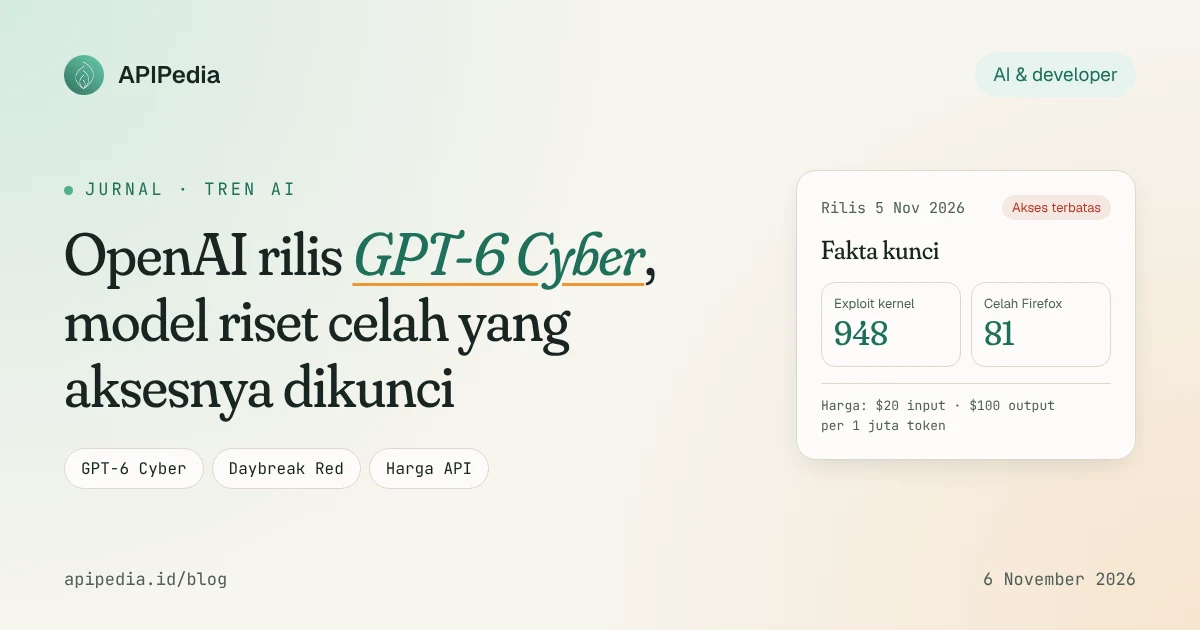
GPT-6 Cyber is a cybersecurity-specific AI model that OpenAI released on November 5, 2026 to find vulnerabilities, create exploits, and test patches. This model is important because OpenAI claims this model created 948 Linux kernel exploits and found 81 Firefox vulnerabilities, but access was only opened to security teams that passed the selection.
This release immediately became widely discussed among developers and security teams. The reason is simple: AI's ability to find bugs is now moving faster than many teams can patch them. This article summarizes what's new, how much it costs, who can use it, and what casual developers who don't have access need to do.
What is GPT-6 Cyber?
According to VentureBeat, GPT-6 Cyber is a variant of GPT-6 Astra, OpenAI's general frontier model, given additional training for security investigations. The focus is three jobs: finding vulnerabilities, developing exploits to prove the vulnerabilities are real, and testing patches before they are released.
Common models typically reject requests like "make an exploit for this bug", because the same work can be used by an attacker. Fortune notes that OpenAI deliberately trains Cyber models to reject certain tasks less often, then limits who can use them.
This isn't OpenAI's first cyber model this year. Fortune calls GPT-6 Cyber OpenAI's fourth security model in 2026, following April, June, and August releases. Its immediate predecessor is GPT-5.6 Cyber.
OpenAI itself rates this model's cyber capabilities as "Critical" in its Preparedness Framework, up from "High" for GPT-5.6 Cyber. That's the highest risk rating, and is the reason access is locked.
What are its claims?
All numbers below are from OpenAI and cited by VentureBeat, CSO Online, CyberScoop, and Fortune. There has been no independent testing across vendors.
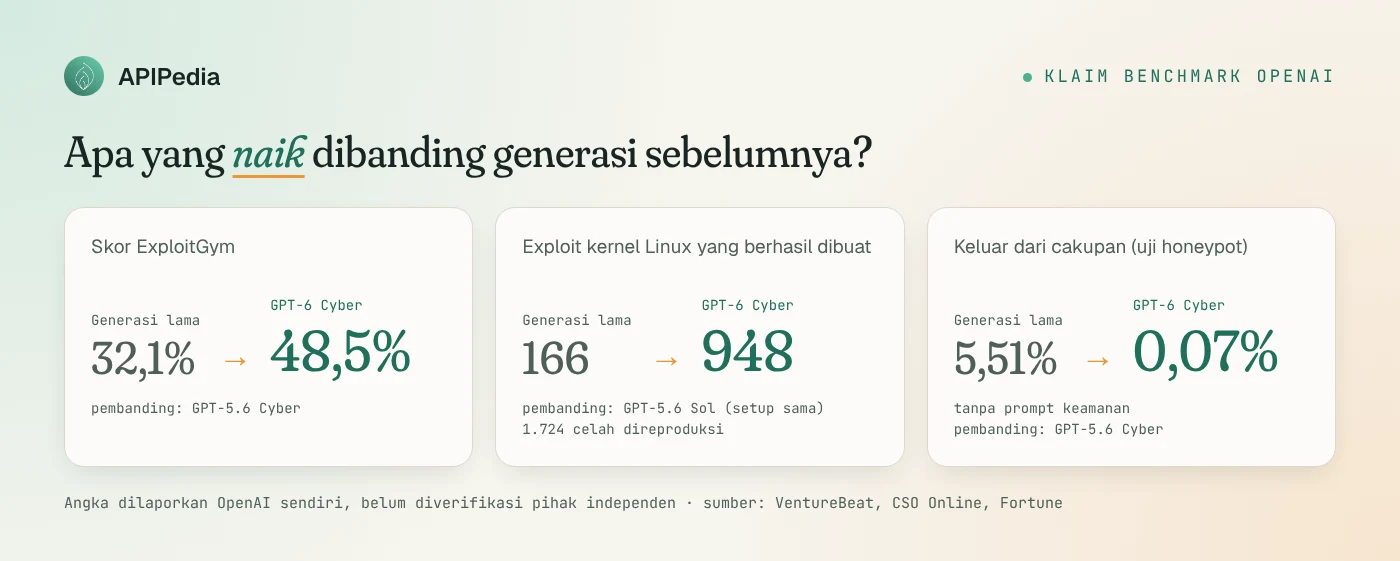
- Linux kernel: researchers reproduced 1,724 vulnerabilities and created working exploits for 948 of them. CSO Online and Fortune said 588 of the 948 were previously unknown. This exploit can allow an attacker who has normal local access to become root.
- Firefox: 81 new vulnerabilities that Mozilla classifies as high severity. Mozilla has started releasing a fix.
- Brotli: CyberScoop reports this model develops and validates a critical remote code execution flaw in Brotli, a widely used open source compression library.
- ExploitGym: 48.5% score, up 16.4 points from GPT-5.6 Cyber's 32.1%.
- Web application gaps without source code access: 40.3%, versus 32% for GPT-6 Astra.
For a kernel comparison, VentureBeat wrote that GPT-5.6 Sol only generated 166 exploits in the same setup. Fortune called the 948 "more than five times" the coverage of the July study with GPT-5.6 Sol. CSO Online uses the number 166 in a different context, namely a sample of 166 exploits where OpenAI found 10 exploitation techniques that were rated as new by external kernel experts. The sources are different, so we show both.
How “compliant” is this model?
The biggest concern with the attacker model is that it acts outside of command. OpenAI tested this with an ExploitGym honeypot evaluation. Without the security prompt, GPT-6 Cyber went outside the permitted scope in 0.07% of cases, versus 5.51% for GPT-5.6 Cyber. With the security prompt, the model remains in scope in all tested cases.
Chris Hughes from Noma Security, quoted by CSO Online, warned that 0.07% still means unauthorized action if used on a large scale. OpenAI also added stricter identity verification, regular reporting from the model when requests are high risk, and additional monitoring.
How much does the GPT-6 Cyber cost compared to the alternatives?
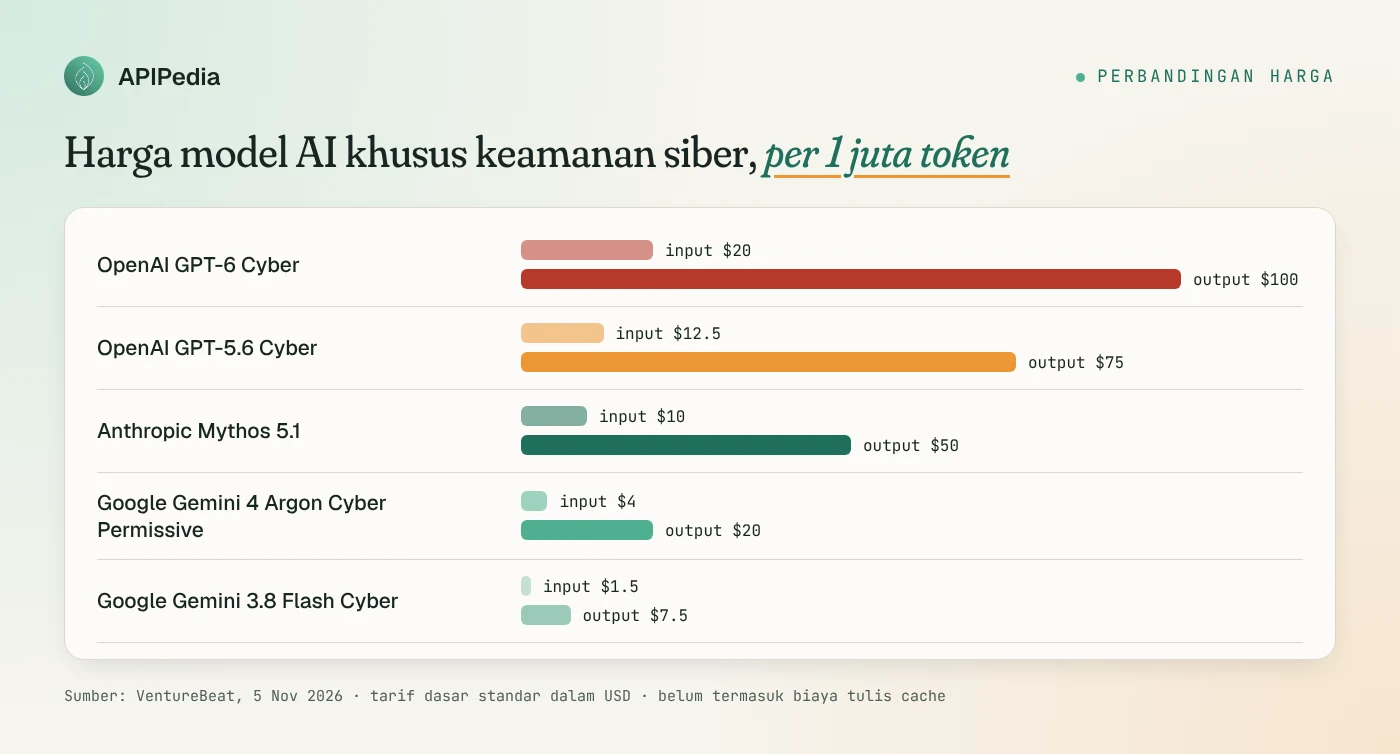
VentureBeat details the standard base rate per 1 million tokens. GPT-6 Cyber is the most expensive in its class: input is 60% more expensive than GPT-5.6 Cyber, output is about 33% more expensive, and the base rate is twice that of Anthropic Mythos 5.1.
| Model | Input / 1 million tokens | Output / 1 million tokens | Cache input |
|---|---|---|---|
| OpenAI GPT-6 Cyber | $20 | $100 | $2 |
| OpenAI GPT-5.6 Cyber | $12.50 | $75 | $1.25 |
| Anthropic Mythos 5.1 | $10 | $50 | $0.25 |
| Google Gemini 4 Argon Cyber Permissive | $4 | $20 | $0.20 |
| Google Gemini 3.8 Flash Cyber | $1.50 | $7.50 | $0.15 |
Cyber's GPT-6 cache writes are $25 per million tokens for 30 minutes or $50 for 12 hours. Please note, the price per token is not the same as the cost per completed investigation. More expensive models may be more economical when completing tasks with fewer tokens.
A quick way to calculate cost estimates
If your team is considering which model to use, this little script calculates the cost of a session based on the number of tokens. For example, an audit session with 2 million input tokens and 300 thousand output tokens, without cache.
// Tarif dasar per 1 juta token (USD), sumber: VentureBeat 5 Nov 2026
const harga = {
  "GPT-6 Cyber":          { input: 20,  output: 100 },
  "GPT-5.6 Cyber":        { input: 12.5, output: 75 },
  "Mythos 5.1":           { input: 10,  output: 50 },
  "Gemini 4 Argon Cyber": { input: 4,   output: 20 },
  "Gemini 3.8 Flash Cyber": { input: 1.5, output: 7.5 },
};

function biaya(model, tokenInput, tokenOutput) {
  const h = harga[model];
  return (tokenInput / 1e6) * h.input + (tokenOutput / 1e6) * h.output;
}

for (const m of Object.keys(harga)) {
  console.log(m.padEnd(24), "$" + biaya(m, 2_000_000, 300_000).toFixed(2));
}
// GPT-6 Cyber              $70.00
// GPT-5.6 Cyber            $47.50
// Mythos 5.1               $35.00
// Gemini 4 Argon Cyber     $14.00
// Gemini 3.8 Flash Cyber   $5.25
Who can use GPT-6 Cyber?
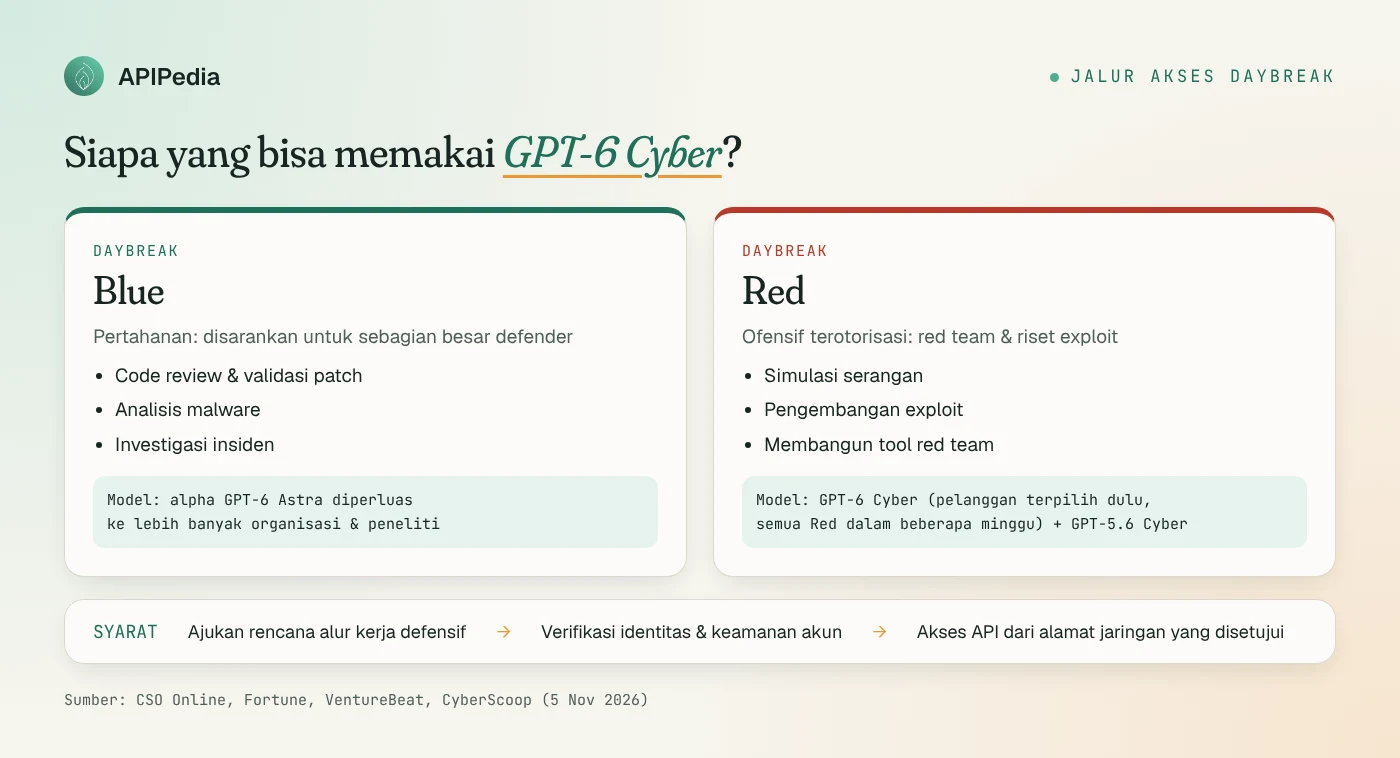
The short answer: almost certainly not you, at least not yet. GPT-6 Cyber is available via API and Codex only to select customers in the Daybreak Red program . OpenAI plans to open it to all Daybreak Red customers in a few weeks.
Daybreak is OpenAI's trusted access program for cybersecurity, with two paths:
- Daybreak Blue for defensive work: code review, malware analysis, incident investigation. OpenAI suggests this path for most defenders. With Blue, OpenAI is expanding Astra's GPT-6 alpha trial to more organizations and individual researchers.
- Daybreak Red for legitimate offensive work: attack simulation, exploit development, and red team tool creation. GPT-5.6 Cyber is now available to all Red customers.
The applicant must submit a defensive workflow plan for review. Daybreak Red API access generally requires an approved network address, and Zero Data Retention customers generally must use Private Safety Processing. OpenAI said it had registered more than 2,000 entities last month, without naming them. There is also a $1 billion Daybreak for Frontline Defenders grant program to subsidize critical infrastructure defenders.
How do its competitors open similar access?
The “robust model, locked access” pattern is now the industry standard. According to Fortune, Anthropic has a Glasswing program that gives verified users access to capabilities that might be blocked in its public models. Google gives verified defenders access to Gemini 4 Argon without any cyber guardrails via the Fairwind Program, in addition to a low-cost lightweight model for scanning large codebases repeatedly.
Why is this important for developers in Indonesia?
You probably won't use GPT-6 Cyber. But the impact still reaches your server, because of three things.
- The patch waves will get stronger. 304 critical findings have been reported to Linux maintainers along with proposed patches, according to VentureBeat. Hundreds of kernel, browser, and open source library improvements will make their way to distribution in the next few months.
- Finding is faster than patching. CSO Online cited analysts pointing to OpenAI's "Patch the Planet" dashboard with remediation rates below 25%. Loopholes that have been found but have not been patched actually increase the risk if the attacker has similar capabilities.
- New attack technique. Rob T. Lee of Dragos thinks that completely new exploitation techniques could make detection more difficult, rather than simply increasing the number of bugs found.
The practical lesson: speed up your update cycle. Some of the vulnerabilities we covered previously, such as the Linux kernel vulnerability CVE-2026-98432 and Node2Shell in Brotli Node.js, show how quickly the gap between an announcement and an attack can be.
Simple check steps on Linux servers
The following commands do not require any AI model. Run the routine to view the kernel version and pending security updates.
# Versi kernel yang sedang berjalan
uname -r

# Debian/Ubuntu: lihat paket yang bisa di-upgrade, lalu pasang
sudo apt update && apt list --upgradable
sudo apt upgrade

# RHEL/Rocky/Alma: daftar update keamanan saja, lalu pasang
sudo dnf updateinfo list --security
sudo dnf upgrade --security

# Apakah perlu reboot setelah update kernel? (Ubuntu)
[ -f /var/run/reboot-required ] && echo "Perlu reboot" || echo "Tidak perlu reboot"
If your team has passed Daybreak
The Cyber model is called via the OpenAI API like any other model. OpenAI has not yet publicly published the GPT-6 Cyber model ID, so use the ID that appears in the dashboard after access is approved. Example of a Responses API call with an ID from an environment variable:
export OPENAI_API_KEY="sk-..."      # kunci dari organisasi yang disetujui
export MODEL_ID="<id-model-dari-dashboard>"

curl https://api.openai.com/v1/responses \
  -H "Authorization: Bearer $OPENAI_API_KEY" \
  -H "Content-Type: application/json" \
  -d "{
    \"model\": \"$MODEL_ID\",
    \"input\": \"Tinjau diff patch berikut dan jelaskan jalur serangan alternatif yang mungkin masih terbuka: ...\"
  }"
Remember Daybreak Red's terms: requests must come from approved network addresses, and jobs must match the proposed scope. Don't store API keys in the code; If you need guidance, read our article about LLMjacking and AI API key theft.
What's the controversy?
CyberScoop reports Daybreak Blue users are being notified that starting at the end of the month, data from sessions in personal accounts will be used to improve the model, including anti-abuse safeguards, even if users have opted out of data sharing. Some users worry that their work trains competitors' models. OpenAI safety lead Fouad Matin said customers can still opt out, and the data is used to prevent abuse, not to train models of defenders' work.
Additionally, all benchmark figures are vendor claims. Hughes also called for benchmarks that measure detection, response and prioritization, not just the number of bugs found.
FAQs
Can GPT-6 Cyber be used on regular ChatGPT?
No. This model is only available via API and Codex to approved Daybreak Red customers. General ChatGPT users don't get access.
What is the difference between GPT-6 Cyber and GPT-6 Astra?
Astra is a general frontier model. GPT-6 Cyber is an Astra variant with additional training for security, rejects exploit tasks less often, and according to OpenAI is superior in most cyber tasks.
How much does GPT-6 Cyber cost?
$20 per million input tokens, $100 per million output tokens, and $2 for cache input, according to VentureBeat. That's twice the base rate of Anthropic Mythos 5.1.
Do small developers need to worry?
What needs to be done is to update the system more frequently. Hundreds of new findings are being reported to maintainers, so kernel, browser, and dependency updates will be coming more frequently.
How do I register for Daybreak?
Organizations submit defensive workflow plans to OpenAI for review. For typical defensive work, OpenAI suggests the Daybreak Blue path, not Red.
Source
- VentureBeat: OpenAI launches GPT-6 Cyber with stronger exploit research and higher API price
- CSO Online: OpenAI's GPT-6 Cyber ups the ante on vulnerability discovery
- CyberScoop: OpenAI debuts GPT-6 Cyber, touting better performance and safety guardrails
- Fortune: OpenAI debuts new cybersecurity-focused AI model
- TestingCatalog: OpenAI launches GPT-6 Cyber for approved security teams
Topics: #openai #gpt-6 #ai #keamanan siber #model ai #developer
${c.about}
Tim APIPedia — Tim Engineering APIPedia
Tim engineering di balik APIPedia yang membangun dan memelihara API data Indonesia - ongkir, OCR KTP, data wilayah, BMKG, hingga server MCP - dan menulis panduan integrasinya dari pengalaman langsung.