GPT-6 vs Claude Haiku 5.5: Which is Right for You?
By Tim APIPedia, Tim Engineering APIPedia · Published · Updated · 5 min read
GPT-6 Luna and Claude Haiku 5.5 cost the same. Which wins in the budget class, and when is the large GPT-6 Astra or Sol model worth choosing?
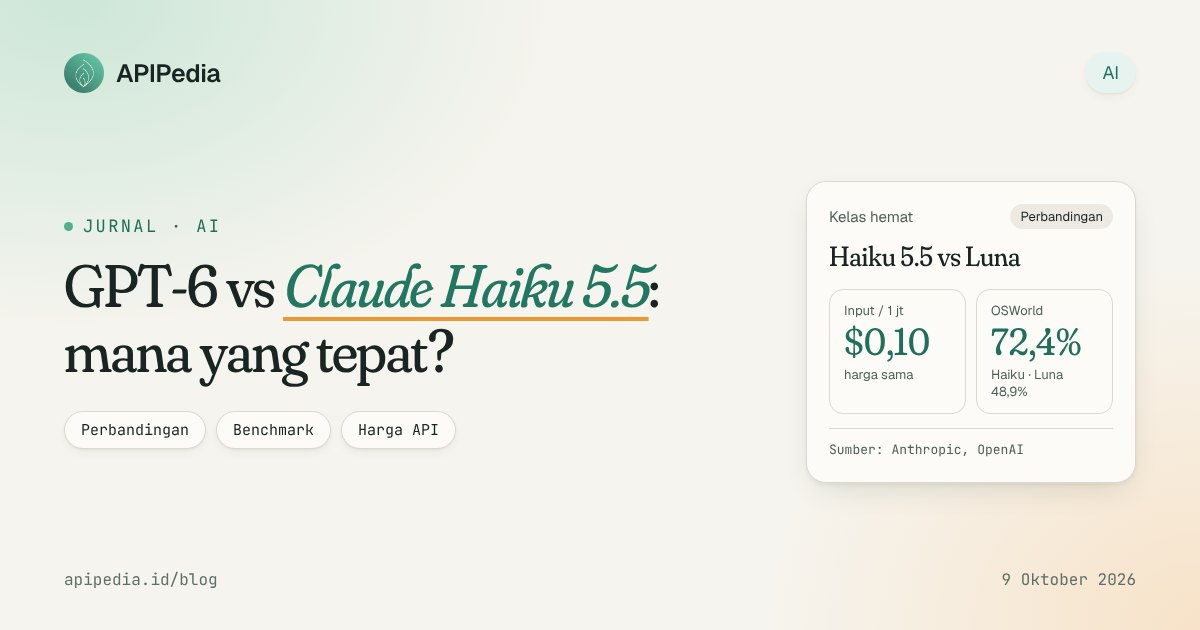
GPT-6 and Claude Haiku 5.5 are not classmates: GPT-6 is a family of three models from OpenAI, while Haiku 5.5 is Anthropic's small model. The Haiku 5.5's direct opponent is the GPT-6 Luna, which costs exactly the same.
Why do the comparisons need to be sorted?
The GPT-6 family consists of Astra (most powerful), Sol (medium), and Luna (frugal). The Haiku 5.5 is designed for fast, high-volume tasks, so comparing it to the Astra is like comparing an automatic motorbike to a truck. Both are useful, but for different jobs.
This article therefore focuses on two questions:
- Haiku 5.5 vs GPT-6 Luna: which is better in the budget class?
- Haiku 5.5 vs GPT-6 Astra and Sol: when is a small model enough, and when is a large model necessary?
These two small models were released close together: Luna on September 22, 2026 and Haiku 5.5 on October 7, 2026 ( VKTR, Anthropic).
Side by side specifications
On paper, Haiku 5.5 and Luna are almost twins: the same base price, context of around 1 million tokens, and maximum output of 128,000 tokens.
| Aspect | Claude Haiku 5.5 | GPT-6 Luna | GPT-6 Sol | GPT-6 Astra |
|---|---|---|---|---|
| Release | Oct 7, 2026 | Sep 22, 2026 | Sep 22, 2026 | Sep 3, 2026 |
| API ID | claude-haiku-5-5 | gpt-6-luna | gpt-6-sol | gpt-6-astra |
| Input / 1 million tokens | $0.10 | $0.10 | $2 | $10 |
| Output / 1 million tokens | $0.50 | $0.50 | $10 | $50 |
| Cache read / 1M tokens | $0.01 | $0.01 | $0.20 | $1 |
| Cheap tariff limits | Prompt ≤100k tokens | Prompt ≤272k tokens | Prompt ≤272k tokens | Prompt ≤272k tokens |
| Long prompt rate (in/out) | $0.50 / $2.50 | $0.20 / $0.75 | $4 / $15 | $20 / $75 |
| Context | 1 million tokens | 1.05 million tokens | 1.05 million tokens | 1.05 million tokens |
| Effort level | 5 (Low–Max) | 5 (low–max) | 5 (low–max) | 5 (low–max) |
| Platforms | Claude Platform, AWS, Google Cloud, Azure | OpenAI API, ChatGPT | OpenAI API, ChatGPT | OpenAI API, ChatGPT, AWS |
Sources: Anthropic, OpenRouter, eesel, AlternativeTo, Yotta Labs.
An important difference is in the length of the prompt. Haiku went up to expensive rates starting at 100,000 tokens, while Luna only went above 272,000 tokens and the increase was smaller.
Intelligence and performance
In the economy class, Haiku 5.5 outperformed GPT-6 Luna in all six benchmarks published by Anthropic, with the largest margins in computer use and terminal coding.
| Benchmarks | Haiku 5.5 | GPT-6 Luna | Difference |
|---|---|---|---|
| OSWorld 2.1 (computer use) | 72.4% | 48.9% | +23.5 points |
| Terminal-Bench 4.0 (agentic coding) | 39.2% | 16.4% | +22.8 points |
| Chartography (visual reasoning) | 46.4% | 29.1% | +17.3 points |
| FrontierCode 1.1 | 46.4% | 42.4% | +4.0 points |
| GDPval-AA v2.1 (professional work, Elo) | 1620 | 1437 | +183 |
| AA-Briefcase v1.1 (Elo) | 1578 | 1336 | +242 |
Source: Anthropic. Important note: this table was created by Anthropic, so it makes sense to choose tests that favor Haiku. On the other hand, OpenAI reports Luna scored 66.6% on DeepSWE v1.1, an unpublished test for Haiku 5.5 ( VKTR).
Against the large GPT-6 model, Haiku clearly loses. On Terminal-Bench 4.0, Astra scored 57.9% versus Haiku 5.5's 39.2% ( Yotta Labs). Astra is also claimed to excel in research-level mathematics and cyber security, areas that are not Haiku's targets. Anthropic itself suggests Sonnet or Opus for complex agent coding.
Speed, price and cost efficiency
Haiku 5.5 and Luna are both 20 times cheaper than GPT-6 Sol and 100 times cheaper than Astra. Example monthly workload of 100 million input tokens and 20 million output tokens (short prompt, no cache):
| Model | Input costs | Output costs | Total per month |
|---|---|---|---|
| Claude Haiku 5.5 | $10 | $10 | $20 |
| GPT-6 Luna | $10 | $10 | $20 |
| GPT-6 Sol | $200 | $200 | $400 |
| GPT-6 Astra | $1,000 | $1,000 | $2,000 |
Calculated from the official rates in the specifications section. Actual costs may vary because each model uses a different tokenizer and generates a different number of tokens per task.
Speed. Anthropic calls the Haiku 5.5 its fastest model at standard speeds. OpenRouter data shows a throughput of around 94–176 tokens per second depending on the provider ( OpenRouter). OpenAI positions Luna for low-latency tasks, but there are no equivalent speed numbers to compare directly yet.
Things that are often missed:
- For prompts of 100,000–272,000 tokens, Luna is much cheaper because Haiku already has long prompt rates ($0.50/$2.50).
- High scores often require high effort. Haiku's Terminal-Bench score is around 39% on Max, but around 20% on Medium, and high effort means more tokens ( VentureBeat).
Recommendation: which one to choose?
For high-volume light duty with short prompts, the Haiku 5.5 is a more powerful choice at the same price as the Luna. For the toughest jobs, GPT-6 Astra or Sol are in a different class.
| Need | Recommended options | Reason |
|---|---|---|
| Summary, classification, bulk data extraction | Claude Haiku 5.5 | Scores higher than Luna at the same price |
| Cheap browser or computer automation | Claude Haiku 5.5 | Deeply ahead at OSWorld (72.4% vs 48.9%) |
| Fast customer service chatbot | Claude Haiku 5.5 or GPT-6 Luna | Both are cheap; test latency on your own system |
| Long documents 100k–272k tokens | GPT-6 Luna | Staying at low rates, Haiku has gone up 5x |
| Already using the ChatGPT/OpenAI ecosystem | GPT-6 Luna or Sol | Easier integration, Luna is free on ChatGPT |
| Coding complex agents, everyday | GPT-6 Sol (or Claude Sonnet/Opus) | Small models are not enough for heavy multi-step tasks |
| Research, advanced mathematics, the most difficult agents | GPT-6 Astra | Top score, worth the price |
Practical advice: don't rely on vendor benchmarks alone. Test 50–100 examples of real tasks on both models, note accuracy, speed, and cost per task, then decide. Many teams also use both: small model for volume, large model for difficult cases.
Source
Topics: #openai #anthropic #gpt-6 #claude haiku 5.5 #perbandingan
${c.about}
Tim APIPedia — Tim Engineering APIPedia
Tim engineering di balik APIPedia yang membangun dan memelihara API data Indonesia - ongkir, OCR KTP, data wilayah, BMKG, hingga server MCP - dan menulis panduan integrasinya dari pengalaman langsung.