The $6.3 Billion Binance Hack: Timeline, Alleged North Korea, and Lessons for DevOps
By Tim APIPedia, Tim Engineering APIPedia · Published · Updated · 10 min read
The biggest crypto theft in history started with an engineer's laptop. Here's a chronology, varying numbers, myths vs. facts, and lessons for DevOps.
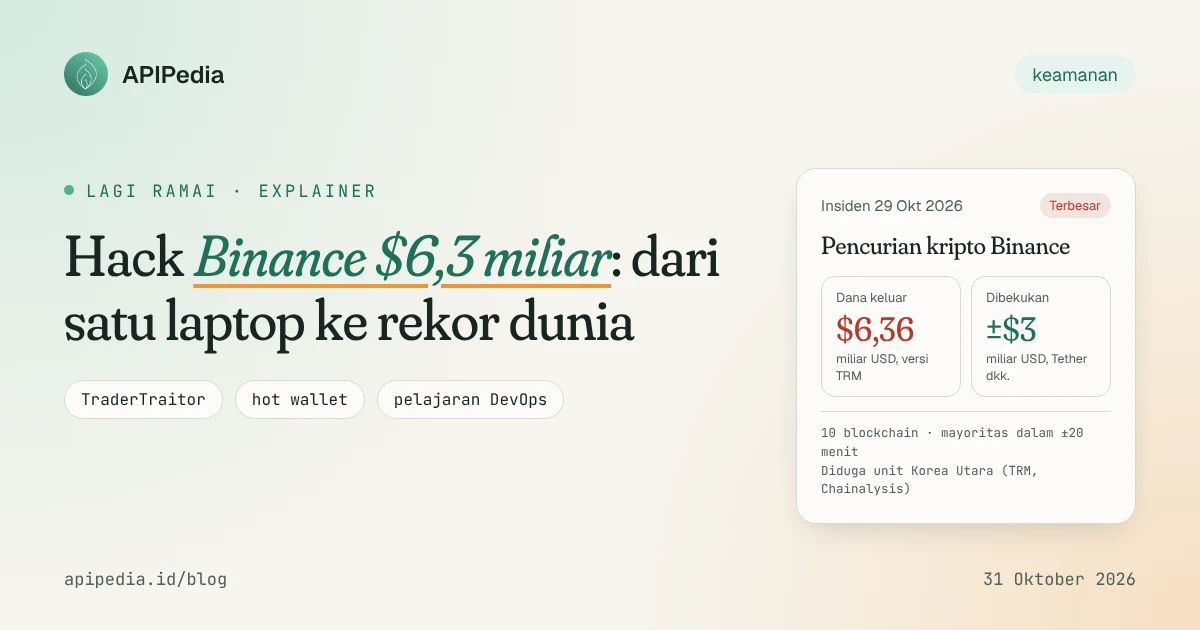
The October 2026 Binance hack was an estimated $6.3 billion worth of crypto theft from the world's largest crypto exchange, which a blockchain analytics firm said was likely carried out by a North Korean hacking unit. This is the largest crypto theft record in history, and the initial entry point was thought to be just an engineer's laptop.
Since Thursday evening (October 29, 2026), this incident has dominated technology and financial news. This article summarizes what is known, why the numbers differ, how similar attacks typically work, and practical lessons for developers and DevOps teams in Indonesia.
What happened?
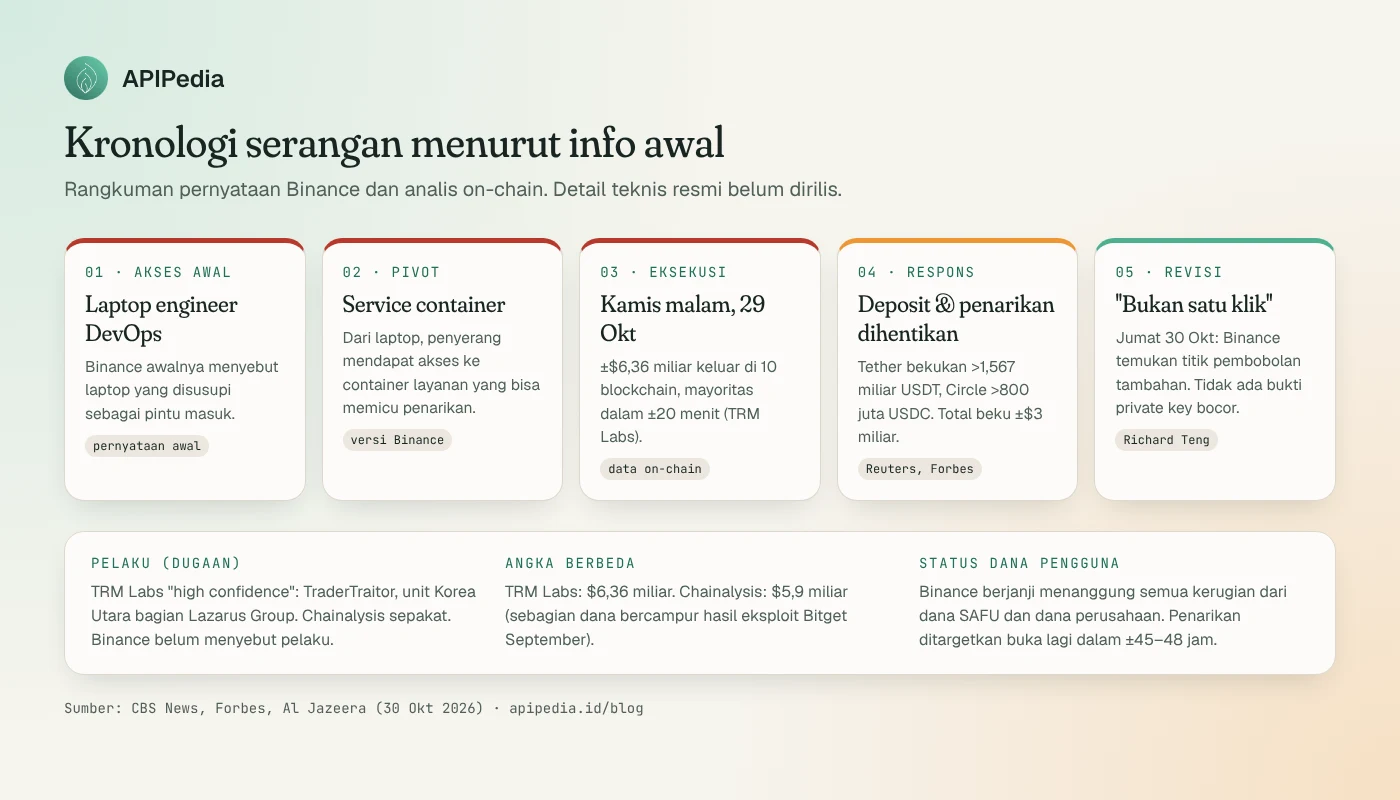
According to TRM Labs, attackers moved about $6.36 billion out of Binance wallets across 10 blockchains, most of it in just about 20 minutes. Binance then halted deposits and withdrawals, while the stablecoin issuer moved quickly to freeze funds.
Some key facts reported by CBS News, Forbes, and Al Jazeera on October 30:
- Binance initially cited a DevOps engineer's compromised laptop as the entry point. The laptop gave access to a service container that allowed unauthorized withdrawals.
- On Friday (October 30), Binance said it discovered additional breach points. CEO Richard Teng insisted this was "not a one-click stunt" and the investigation has not blamed any specific individuals.
- Binance admitted that it had found no evidence of a wallet private key leak. Technical details will be released once the investigation is complete.
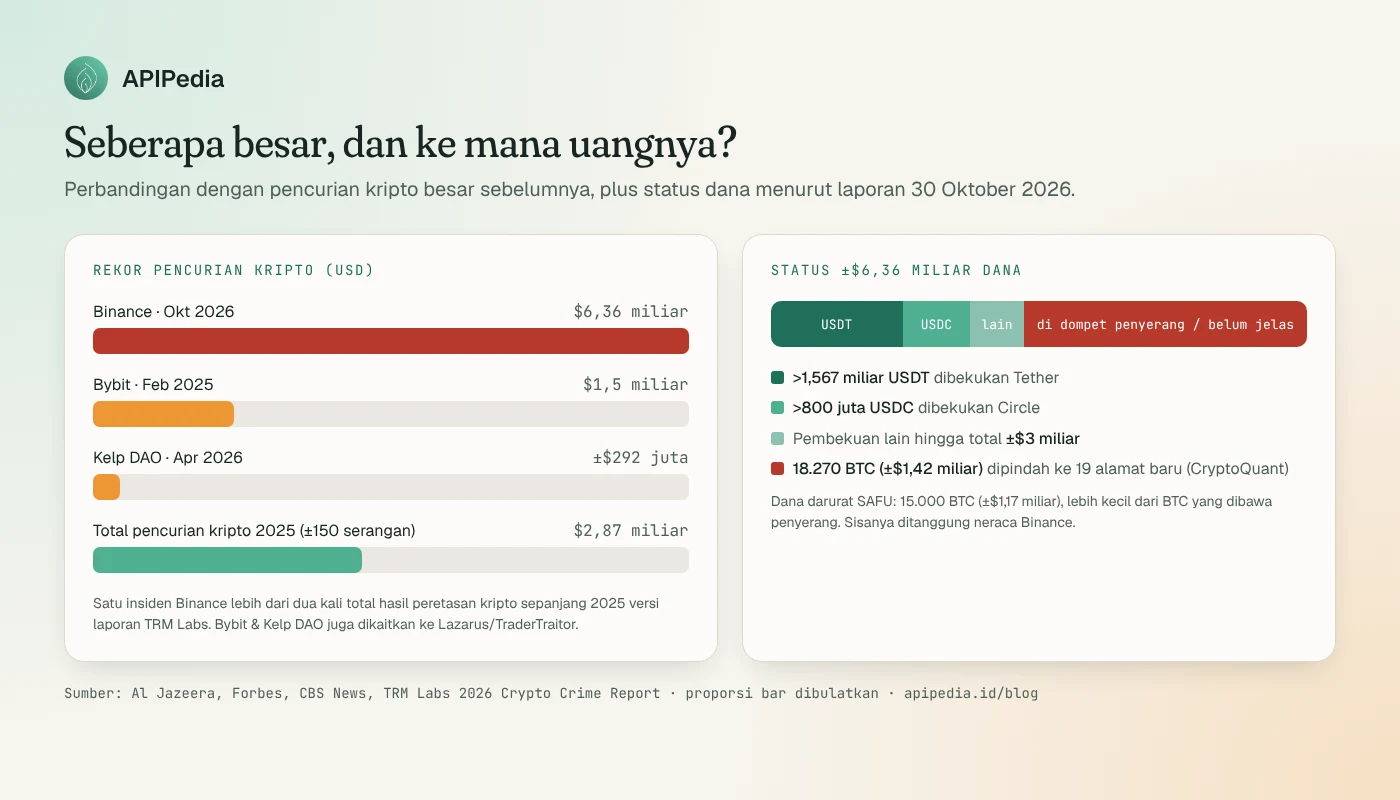
- About $3 billion was frozen, including more than 1.567 billion USDT by Tether and more than 800 million USDC by Circle.
- Binance promises to cover all user losses from SAFU funds and company funds, and targets withdrawals to reopen in around 45 to 48 hours.
Why is it so busy?
- The scale is unprecedented. The previous record was the Bybit breach in February 2025 worth $1.5 billion. The Binance incident is more than four times that number, and more than twice the total of crypto thefts for 2025 ($2.87 billion from nearly 150 attacks according to a TRM Labs report).
- The victim is the world's largest exchange. Many people consider giant exchanges the safest. This incident shows that big size also means big targets.
- The market impact was felt immediately. According to Al Jazeera, Bitcoin briefly fell to a six-week low of $76,368, Ether fell more than 3% to $2,178, and shares of Coinbase (which said it was unaffected) fell 4.8%.
- There is a geopolitical dimension. The stolen money is suspected of financing North Korea's economy and nuclear program which is subject to UN sanctions.
Who is the alleged perpetrator?
TRM Labs said "with high confidence" that the perpetrator was TraderTraitor, an elite North Korean hacking unit that the US Treasury Department says is part of the Lazarus Group. Chainalysis CEO Jonathan Levin also called the attack "most likely" the work of TraderTraitor.
The reason: an attack pattern similar to the Bybit 2025 breach, which the FBI attributed to the same unit. In both cases, the attacker ordered the exchange's wallet to be emptied into a wallet owned by them. The unit is also known to use social engineering, for example pretending to be recruiters and sending “interview assignments” containing malware to engineers at crypto companies.
It is important to note, Binance itself has not attributed the attack to any party. North Korea also routinely denies involvement in hacking.
How does an attack like this work?
Official details aren't out yet, so this section describes a general pattern that fits existing information, not a definitive reconstruction.
Hot wallet, cold wallet and withdrawal system
Crypto exchanges keep a small portion of funds in hot wallets (connected to the system, to provide fast withdrawals) and a large portion in cold wallets (more isolated). Withdrawals are usually processed by an internal service that has the authority to sign transactions, either via HSM, MPC, or a multi-signature scheme.
This means that attackers do not always need to steal private keys. Just master the system that has the right to ask for a signature. This is in line with Binance's claim that no private keys were leaked, but withdrawals still occurred via the service container.
Chain his attacks
- Endpoint compromise: engineer's laptop with operational access compromised.
- Lateral movement: credentials or sessions from the laptop are used to reach the production infrastructure.
- Abuse of service: service containers that are entitled to process withdrawals are instructed to send funds to the attacker's address.
- Flash execution: transactions are sent parallel across multiple chains so they complete before the security team can react.
- Laundering: funds are split into many new addresses. CryptoQuant noted 18,270 BTC (approximately $1.42 billion) was moved from cold wallets to 19 new addresses, and at that time had not yet hit any exchanges, bridges, or mixers.
One analyst (NyxLab CEO Kok Tin Gan) speculated that a single signature might give token attackers full access without expiry to the hot wallet. This is a personal guess, not yet confirmed by Binance.
Summary of numbers (and why they differ)
| Data | Number | Source |
|---|---|---|
| Total funds out | ±$6.36 billion | TRM Labs |
| Totally another version | $5.9 billion (partly mixed with September Bitget exploit funds) | Chainalysis |
| Number of blockchains | 10 | TRM Labs |
| Main duration | ±20 minutes | TRM Labs, Chainalysis |
| USDT frozen | >1.567 billion | Tether (via Forbes) |
| USDC is frozen | >800 million | Circle (via Forbes) |
| Totally frozen | ±$3 billion | Reuters (via Al Jazeera) |
| BTC was moved by the attacker | 18,270 BTC (±$1.42 billion) | CryptoQuant |
| SAFU emergency fund | 15,000 BTC (±$1.17 billion); Al Jazeera said it was ±$1 billion | Forbes, Al Jazeera |
The total difference of $6.36 billion vs. $5.9 billion is due to the way the funds are calculated and sorted. Binance itself warned the $6.3 billion figure "could continue to grow" as it tracks.
Myth vs fact
- Myth: "The Bitcoin or Ethereum blockchain was successfully hacked." Fact: there is no indication the blockchain protocol is broken. What was breached was the exchange's operational system.
- Myth: "Binance private key leaked." Facts: Binance said it found no such evidence. The former boss of Mt. Gox's Mark Karpeles thinks attackers likely accessed the keys to at least two wallets, but that's an opinion, not an official finding.
- Myth: "Crypto that has been stolen cannot be withdrawn." Fact: centralized stablecoins like USDT and USDC can have their issuers frozen. That's why about $3 billion was locked in quickly. The original BTC and ETH do not have such a freeze button.
- Myth: "User funds are definitely lost." Fact: Binance promises to cover all losses. But the SAFU is only about 15,000 BTC, well below the value of the stolen, so most of it will be covered on the company's balance sheet. Most cyber crime insurance also does not cover stolen crypto.
Lessons for developers and DevOps teams
You may not be managing billions of dollars, but the pattern is the same as any payment system, digital wallet, or API that can move money.
1. Audit service account access rights
If one container can trigger a withdrawal, make sure its identity only has the minimum possible permissions. In Kubernetes, check what a service account can do:
# Lihat semua izin efektif service account "payout-worker" di namespace "payments"
kubectl auth can-i --list \
  --as=system:serviceaccount:payments:payout-worker \
  -n payments

# Pastikan akun itu TIDAK bisa membaca secret di namespace lain
kubectl auth can-i get secrets \
  --as=system:serviceaccount:payments:payout-worker \
  -n kube-system
2. Install speed limits and circuit breakers
That amount of funds came out in about 20 minutes. Value limits per time window that force manual approval can minimize losses. Simple example (illustration, not production code):
// Pemutus sirkuit penarikan: hentikan otomatis bila total keluar per 10 menit melewati batas
const WINDOW_MS = 10 * 60 * 1000;
const LIMIT_USD = 250_000;
const recent = []; // { ts, amountUsd }

function allowWithdrawal(amountUsd, now = Date.now()) {
  while (recent.length && now - recent[0].ts > WINDOW_MS) recent.shift();
  const total = recent.reduce((s, r) => s + r.amountUsd, 0);
  if (total + amountUsd > LIMIT_USD) {
    return { ok: false, reason: 'velocity_limit', needs: 'manual_approval' };
  }
  recent.push({ ts: now, amountUsd });
  return { ok: true };
}
In a real system, store counters in Redis or a shared database, and run these checks in a separate service that cannot be killed by the pull service itself.
3. Check the freeze status of stablecoin addresses
If you are processing a stablecoin deposit, check whether the sending address is blacklisted by the issuer. Example with cast from Foundry on Ethereum mainnet:
ADDR=0x0000000000000000000000000000000000000000   # ganti dengan alamat yang dicek
RPC=$ETH_RPC_URL

# USDT (Tether): mapping publik isBlackListed
cast call 0xdAC17F958D2ee523a2206206994597C13D831ec7 \
  "isBlackListed(address)(bool)" $ADDR --rpc-url $RPC

# USDC (Circle): fungsi isBlacklisted
cast call 0xA0b86991c6218b36c1d19D4a2e9Eb0cE3606eB48 \
  "isBlacklisted(address)(bool)" $ADDR --rpc-url $RPC
4. Protect engineer laptops like production servers
- Use short-lived credentials (SSO + temporary token), not permanent tokens stored on the laptop.
- Require hardware security keys (FIDO2) for production access.
- Be wary of job offers or "technical tests" from unknown people, especially in the form of repositories that must be run on a work machine.
- Patch DevOps tools ASAP. A recent example, a critical flaw in GitLab that we covered in the article CVE-2026-97229.
What does this mean for crypto users in Indonesia?
If you have assets on Binance, there are currently no emergency steps other than waiting for withdrawals to reopen and monitoring official announcements. Also be wary of scams riding on this news, such as "claim compensation" or "account verification" messages via links outside of official sites and apps.
The long-term lesson, as Macquarie University academic Sean Foley told Al Jazeera: assets on centralized exchanges are only as safe as the exchange itself. Store on the exchange only funds that are actively traded.
FAQs
How much was actually stolen from Binance?
TRM Labs listed about $6.36 billion, Chainalysis $5.9 billion. Binance put it at around $6.3 billion and said the figure could increase. About $3 billion has been frozen.
Is North Korea really the culprit?
TRM Labs and Chainalysis attributed it to TraderTraitor, a North Korean unit associated with Lazarus Group. Binance has not confirmed the perpetrator, and North Korea has generally denied it.
Are Binance users' funds safe?
Binance stated that user funds are safe and all losses will be covered from SAFU and company funds. Deposits were not affected, while withdrawals were temporarily stopped.
How can stablecoins be frozen?
USDT and USDC contracts have a blacklist function that is controlled by the issuer. Addresses included in the list cannot move tokens. This feature does not exist in native BTC or ETH.
Can this attack happen in a normal startup?
The pattern could be: the engineer's laptop is compromised, then access is used to trigger transactions. Therefore, minimum access rights, short-lived credentials, and transaction speed limits are relevant for anyone managing a payment system.
Source
- CBS News: $6.3 billion Binance hack was likely work of North Korea, blockchain intel firms say
- Forbes: Binance's $6.3 billion hack started with one engineer's laptop (Oct 30, 2026)
- Al Jazeera: Binance says $6.3bn stolen in biggest crypto heist in history (30 Oct 2026)
- ThreatCluster: TraderTraitor, campaigns and related activities
Topics: #keamanan #kripto #binance #devops #insiden
${c.about}
Tim APIPedia — Tim Engineering APIPedia
Tim engineering di balik APIPedia yang membangun dan memelihara API data Indonesia - ongkir, OCR KTP, data wilayah, BMKG, hingga server MCP - dan menulis panduan integrasinya dari pengalaman langsung.