Mistral Large 4 Open-Weight: 1 Trillion-Parameter Model Now Available for Download
By Tim APIPedia, Tim Engineering APIPedia · Published · Updated · 9 min read
Mistral released model weights of 1 trillion parameters. Here's how MoE works, GPU requirements, benchmark myths vs. facts, and licensing pitfalls.
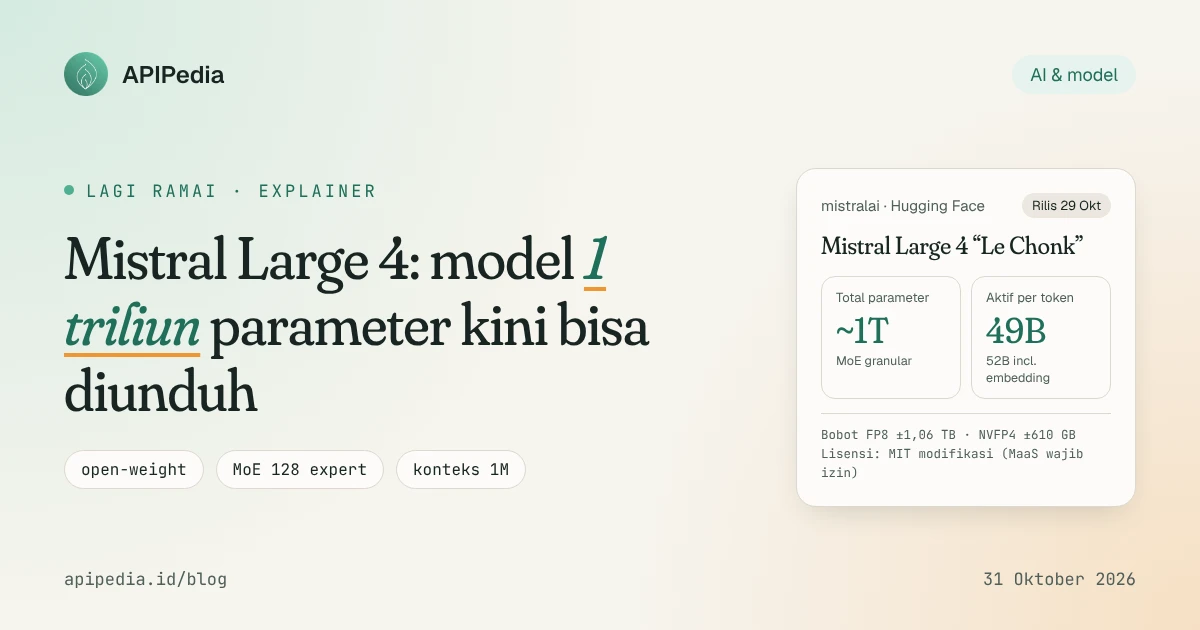
Mistral Large 4 is an open-weight AI model measuring around 1 trillion parameters whose weights were released by Mistral AI at Hugging Face on October 29, 2026. This model is popular because it can be downloaded and run independently, targets coding and cybersecurity, but still requires a multi-GPU server and has special licensing requirements for API businesses.
The last two days, the name “Le Chonk” (Mistral's internal nickname for the model) has appeared everywhere, from TechCrunch to daily AI news digests and local model user communities. This article summarizes what was actually released, how the architecture works, which ones are vendor claims and which ones have been verified, and what it means for developers in Indonesia.
What was actually released?
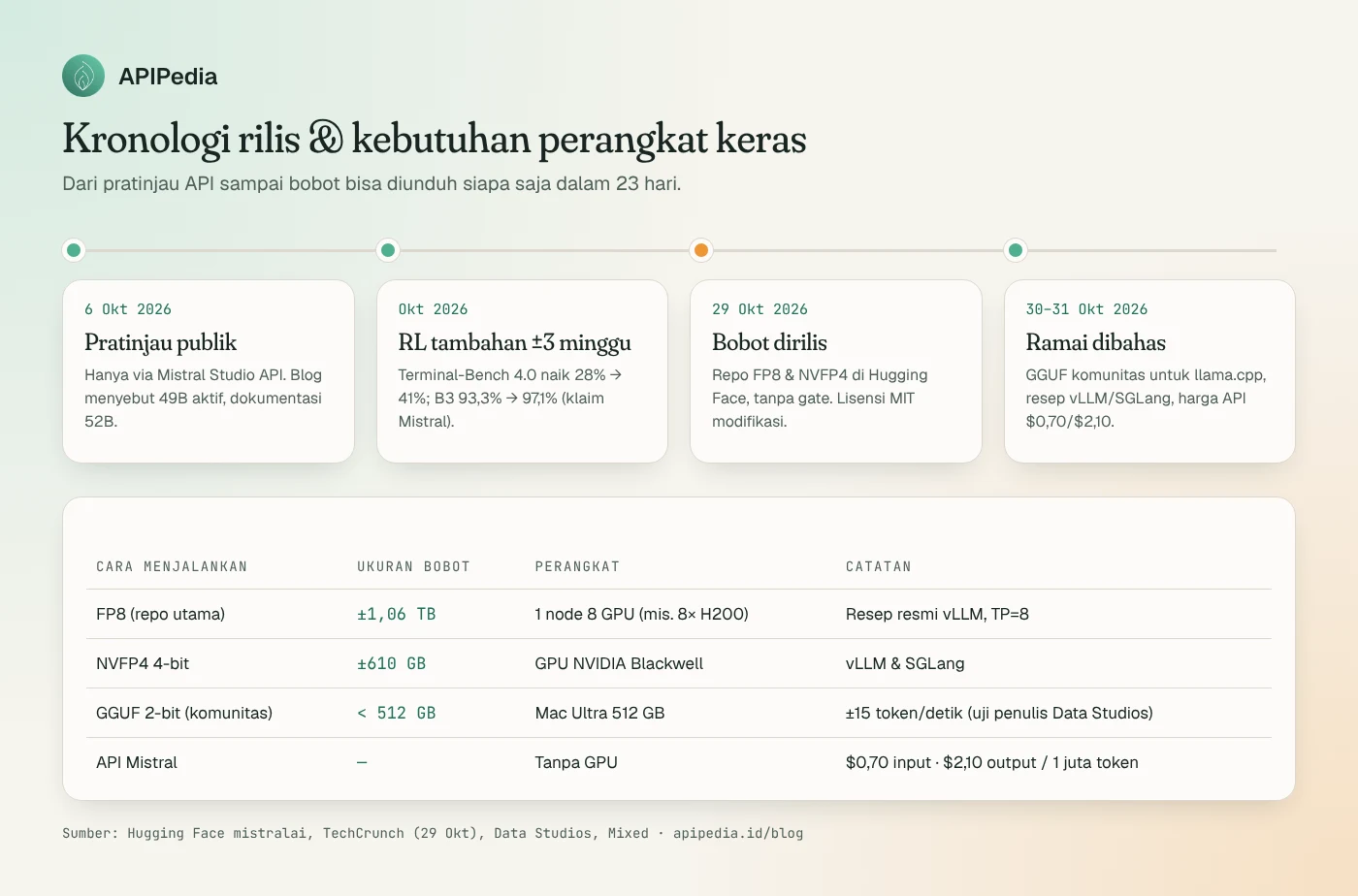
Mistral first opened a public preview of the Mistral Large 4 on October 6, 2026, only via API in Mistral Studio. At that time Mistral promised the weights would be by "the end of the month". The promise was kept: on October 29, two repositories appeared on account mistralai on Hugging Face.
- mistralai/Mistral-Large-4-1T-A52B: FP8 format main checkpoint, 68 files, total about 1.06 TB.
- mistralai/Mistral-Large-4-1T-A52B-NVFP4: 4-bit quantization version for NVIDIA Blackwell GPUs, approx. 610 GB.
Both are not gated: anyone can download without filling out a form. The model card also mentions that this checkpoint carries a draft head called DSpark for speculative decoding, and the llama.cpp community has provided a GGUF file.
To TechCrunch, Pierre Stock (Mistral's VP of Science) emphasized that access to the open-weight model is "unbreakable", so companies and governments can run it on their own servers to detect and respond to security incidents.
Why is it being talked about so much?
There are several mutually reinforcing reasons:
- The size. 1 trillion parameter open-weight models from Western labs are still rare. So far, the largest open models have come from Chinese labs such as GLM, Kimi, and DeepSeek.
- Cyber security focus. While other labs limit highly cyber-capable models to a select group, Mistral instead shares its weight with the public with a "sovereign cyber defense" argument.
- API prices fall. At preview, prices were recorded at $1.36 per million input tokens and $4.18 output. As of October 30, Data Studios recorded $0.70 input and $2.10 output after the launch discount period ended.
- A small controversy about numbers. The initial launch blog mentions 49 billion active parameters, while the documentation mentions 52 billion. The card model finally explains: 49B active, or 52B if embedding and output layers are taken into account.
How does Mixture-of-Experts work in this model?
Mistral Large 4 uses a granular Mixture-of-Experts (MoE) architecture. Imagine an office with 128 specialists. For each token (piece of words), a "router" only calls the 4 most suitable specialists, plus 1 common specialist ( shared expert) who always works.
As a result, the computation per token only involves about 49 billion parameters, not 1 trillion. That's why this model can be quite fast and cheap to operate for its size.
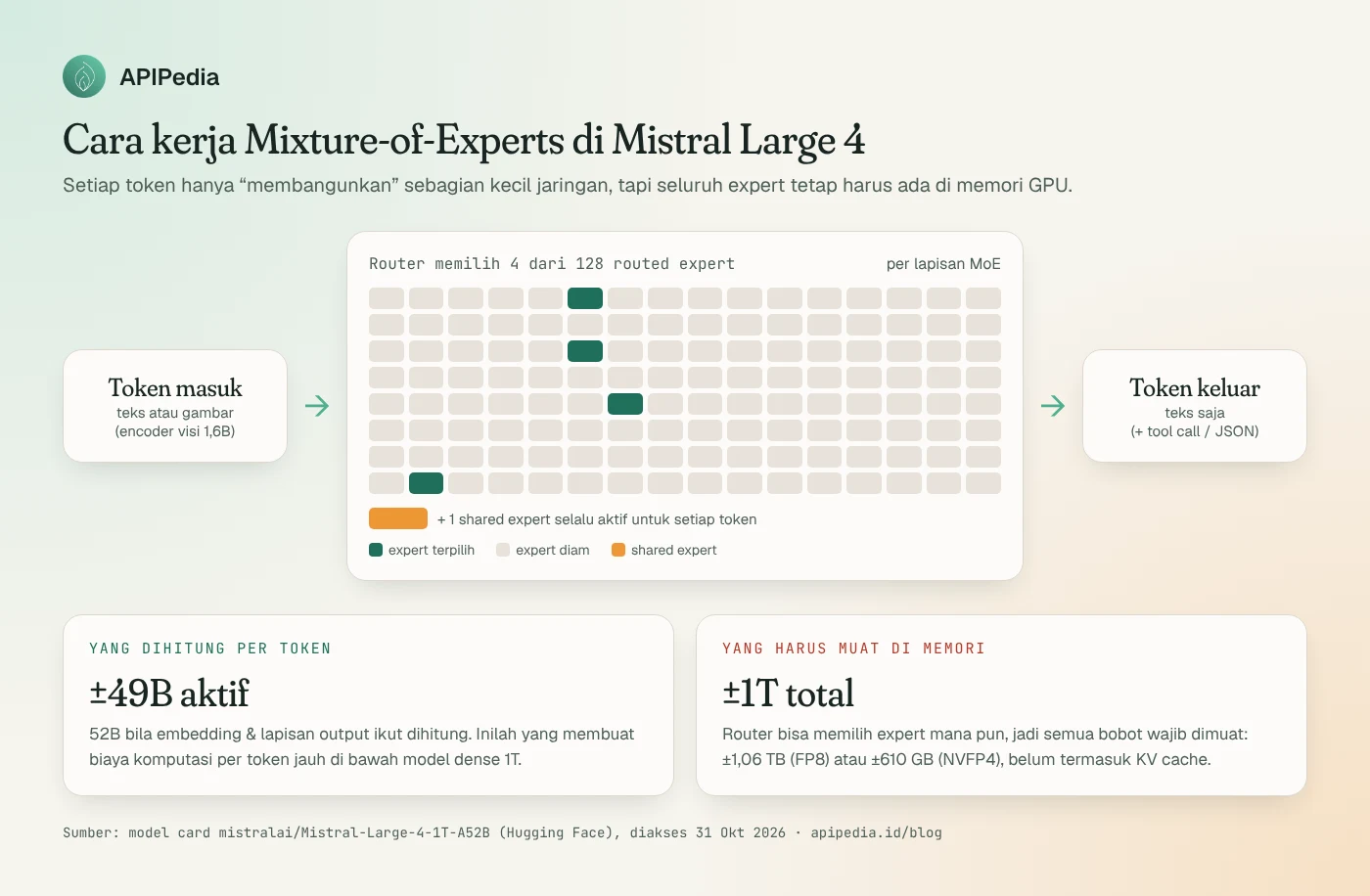
But there is a trap that is often missed: all experts must still be in memory. The router can choose any expert for the next token, so the entire weight of 1 trillion parameters must be loaded into the GPU. The active parameter determines the speed, while the total parameter determines how much memory you need.
Key specifications
| Aspect | Mistral Large 4 | Source |
|---|---|---|
| Total parameters | ~1T (documentation: 1.05T) | Model card, Mistral docs |
| Active parameters | 49B (52B including embedding & output) | Card models |
| Expert | 128 routed (4 active) + 1 shared | Card models |
| Context | 1 million tokens | Card models |
| Modality | Text & image input, text output | Card models |
| Reasoning mode | low / medium / high (default high) | Card models |
| Language | 160+ languages, including Indonesian | Card models |
| Training | 3,800 NVIDIA Grace Blackwell GPUs in Europe | Mistral, TechCrunch |
| API Pricing | $0.70 input · $0.07 cached · $2.10 output / 1 million tokens | Data Studios (Oct 30) |
How smart? Myth vs fact
On social media, claims vary: from "on par with the best closed model" to "far behind the Chinese model". Here's what to hold:
- Myth: "The open-weight model is the best in all areas." Fact: in the Artificial Analysis Intelligence Index v5, Mistral itself reported a score of 26, the highest among Western open-weight models. Mistral admitted China's best open model was still ahead in the composite index.
- Myth: "Coding is equivalent to a closed frontier model." Fact: on the Artificial Analysis Coding Agent Index, it scores 48%, roughly tied with GLM-5.3 but with 47% fewer tokens per task. It's about efficiency, not necessarily overtaking the top closed model.
- Myth: "Open cyber model = weapons for attackers." Fact: Mistral claims an average rejection rate of 96.6% for malicious cyber requests (JailbreakBench, StrongREJECT, AgentHarm). But these are internal numbers, and Mistral said its cyber guardrails are still being adjusted, so the behavior of self-hosted weights could differ from the API.
- Myth: "The numbers have been independently tested." Fact: most benchmarks (Terminal-Bench 4.0 41%, B3 97.1%, FrontierCode 2.0 19.7%) are reported by Mistral or its partners. Independent evaluations of downloadable checkpoints have not been widely published.
It should be noted that the index scores in circulation vary because the index versions are different. During the preview, several media quoted a score of 38 in the previous version of the Intelligence Index, while the card model used v5 with a score of 26. Don't compare the two numbers directly.
Can it be run alone?
Yes, but not on a laptop. The official vLLM recipe uses a single 8 GPU node with tensor parallelism 8, and Hugging Face Inference Endpoints uses 8× NVIDIA H200. The NVFP4 version requires a Blackwell generation GPU.
Before downloading, first check the repository size via Hugging Face's public API so you don't get surprised:
# Hitung total ukuran file di repo (butuh curl + jq)
curl -s "https://huggingface.co/api/models/mistralai/Mistral-Large-4-1T-A52B?blobs=true" \
  | jq '[.siblings[].size] | add / 1e9 | floor | "\(.) GB"'

# Unduh hanya config dan lisensi dulu untuk dibaca
hf download mistralai/Mistral-Large-4-1T-A52B config.json LICENSE --local-dir ./ml4
If you do have sufficient GPU nodes, the serve command from the card model looks like this:
docker run --runtime nvidia --gpus all \
  -v ~/.cache/huggingface:/root/.cache/huggingface \
  -p 8000:8000 --ipc=host \
  vllm/vllm-openai:mistral-large-4 \
  --model mistralai/Mistral-Large-4-1T-A52B \
  --tensor-parallel-size 8 \
  --tool-call-parser mistral \
  --reasoning-parser mistral \
  --enable-auto-tool-choice \
  --gpu-memory-utilization 0.85
For most teams, the most realistic path remains APIs. This model is available in the Mistral API with ID mistral-large-4, as well as in OpenRouter, NVIDIA NIM, and Microsoft Foundry. Simple call example:
curl https://api.mistral.ai/v1/chat/completions \
  -H "Authorization: Bearer $MISTRAL_API_KEY" \
  -H "Content-Type: application/json" \
  -d '{
    "model": "mistral-large-4",
    "reasoning_effort": "medium",
    "temperature": 1.0,
    "top_p": 0.95,
    "messages": [
      {"role": "user", "content": "Jelaskan risiko SQL injection dalam 3 poin, bahasa Indonesia."}
    ]
  }'
The model card recommends temperature=1.0 and top_p=0.95 for all levels of reasoning. Also note that on the vLLM server, max_completion_tokens computes reasoning tokens, not just visible answers.
Is the license really free?
Almost. Mistral uses the Mistral Ecosystem Open-Weight License, which is a modified MIT license. You may use, modify, fine-tune, and sell it commercially, with one big exception: Model-as-a-Service businesses must maintain a separate commercial license with Mistral.
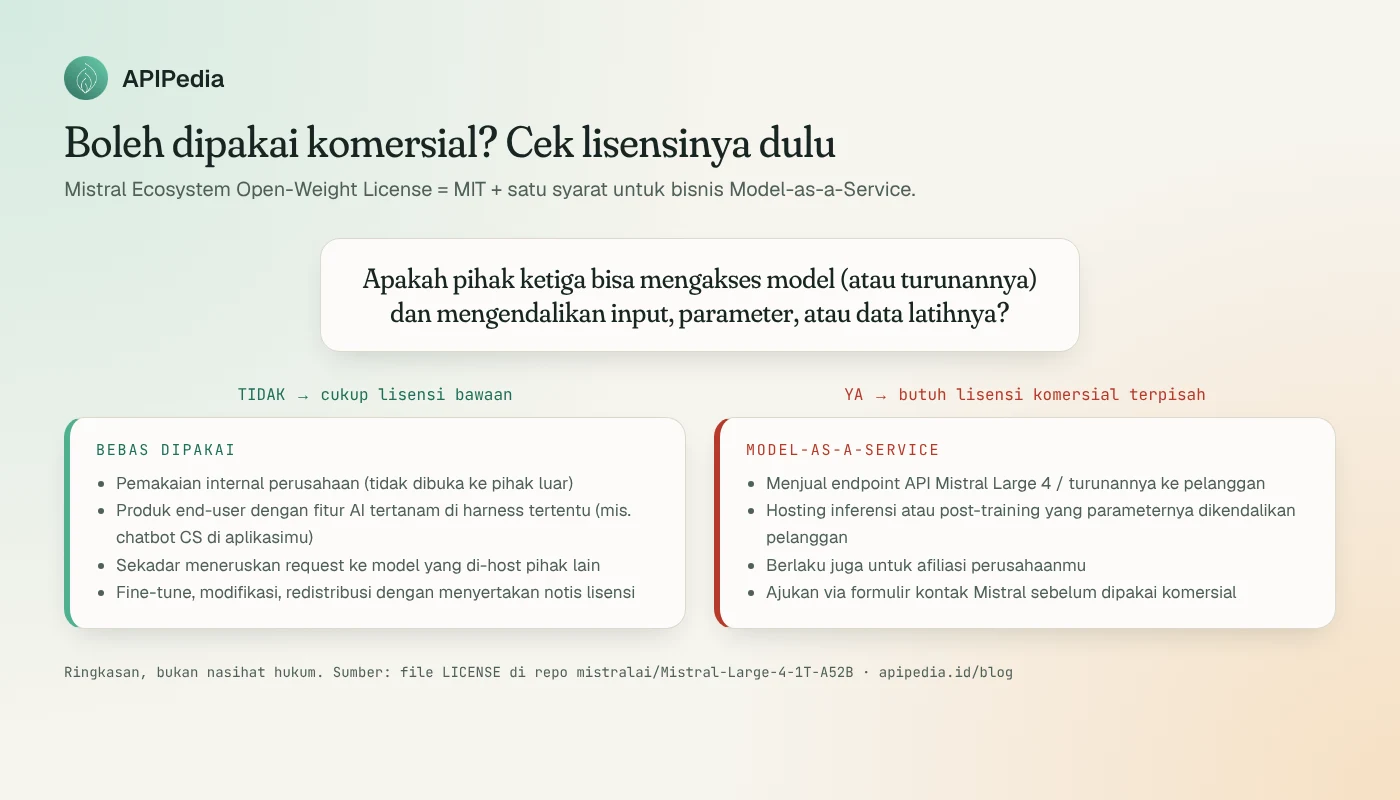
The definition of MaaS in the LICENSE file is quite specific: providing third parties with inference or post-training access with meaningful control over inputs, parameters, or training data. End-user products that only embed model capabilities in certain features, internal use, and simply forward requests to other parties' hosted models are not included. This is a summary, not legal advice; read the license text directly if you plan to sell API access.
What does this mean for Indonesian developers?
- Sensitive data can remain on-premises. Banks, hospitals, or agencies that are not allowed to send data abroad now have the option of high-end models that run in their own data centers, as long as they can provide the GPU.
- Indonesian is also supported. The card model lists
idandmsin its language list, although no Indonesian-specific benchmarks have been published yet. - Suitable for agents. Function calling support, strict JSON schema, and 1 million token contexts make it worth trying for agents that call a lot of APIs, for example agents that call region, exchange rate, or holiday data via MCP APIPedia.
- Compare total costs, not price per token. During preview, Artificial Analysis noted the model was very "chassy" (around 200 million output tokens at evaluation). Reasoning tokens are billed, so test with real workloads before migration.
If you're considering other models, also check out our reviews of the GPT-6 and Claude Haiku 5.5.
FAQs
Is Mistral Large 4 free?
The weights are free to download from Hugging Face. What it costs is the hardware to run it, or the Mistral API at $0.70 per million input tokens and $2.10 per million output tokens (as of October 30, 2026).
Can it run on a gaming PC or regular MacBook?
Not practically. The FP8 version requires around 1.06 TB of memory for weight alone. Community testing with 2-bit GGUF on an M3 Ultra chip Mac with 512 GB of memory yielded about 15 tokens per second, and that's already a high-end machine.
What is the difference between 49B and 52B active parameters?
Both are correct with different calculation methods. 49 billion are active parameters in the transformer block, while 52 billion includes the embedding and output layers. The repo name uses the numbers 52B ("A52B").
Can it be used in my SaaS product?
If the model is only a feature in your product (for example, a document summary in an application), it is generally included in the excluded category. If you sell API access to the model itself so that customers control the inputs and parameters, that's Model-as-a-Service and requires a commercial license from Mistral.
Are the benchmarks reliable?
Treat it as a vendor claim until there is an independent evaluation of the public checkpoint. Mistral itself admits that China's open model is still superior in the combined intelligence index.
Source
- Model card & LICENSE Mistral-Large-4-1T-A52B (Hugging Face)
- TechCrunch: Mistral releases weights for its trillion-parameter AI model, targeting cybersecurity (29 Oct 2026)
- Data Studios: Mistral Large 4 open weights, 1M context, licensing, benchmarks and API pricing
- Mixed: Mistral's blog says 49 billion active parameters, its docs say 52 billion
- Noze: Mistral Large 4 architecture, benchmarks and open weights
- DEV Community: AI Daily Digest October 30, 2026
Topics: #mistral #llm #open-weight #ai #hugging-face
${c.about}
Tim APIPedia — Tim Engineering APIPedia
Tim engineering di balik APIPedia yang membangun dan memelihara API data Indonesia - ongkir, OCR KTP, data wilayah, BMKG, hingga server MCP - dan menulis panduan integrasinya dari pengalaman langsung.