Digital Tax November 9: Transfers Are Not Automatically Subject to VAT, These Are the SPP-TDLN Facts
By Tim APIPedia, Tim Engineering APIPedia · Published · Updated · 10 min read
The November 9 digital tax is not a new tax: VAT on foreign digital services is now collected by banks via SPP-TDLN. These are the facts, impacts and practical steps.
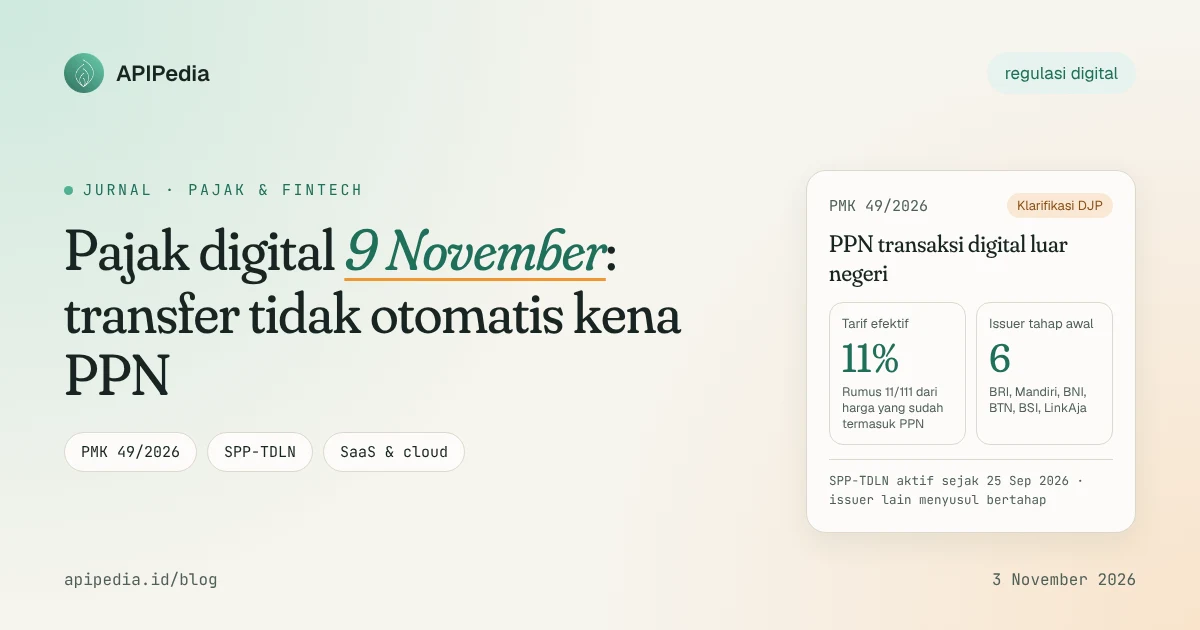
The November 9 digital tax is the expansion stage of SPP-TDLN, a system for collecting VAT on purchases of digital goods and services from abroad via banks and fintech when you pay. This is not a new tax, and transfers between accounts are not automatically subject to VAT. Those affected are subscriptions to software, cloud, streaming and foreign digital services.
This news has been busy since November 2 2026. The chain message said "all bank transfers are taxable starting November 9" and that marketplaces such as Shopee, Lazada and GoTo are obliged to collect it. The Directorate General of Taxes (DJP) has straightened it out. This article summarizes what's true, what's unclear, and what developers and business owners who regularly pay for offshore services need to prepare.
What exactly is SPP-TDLN?
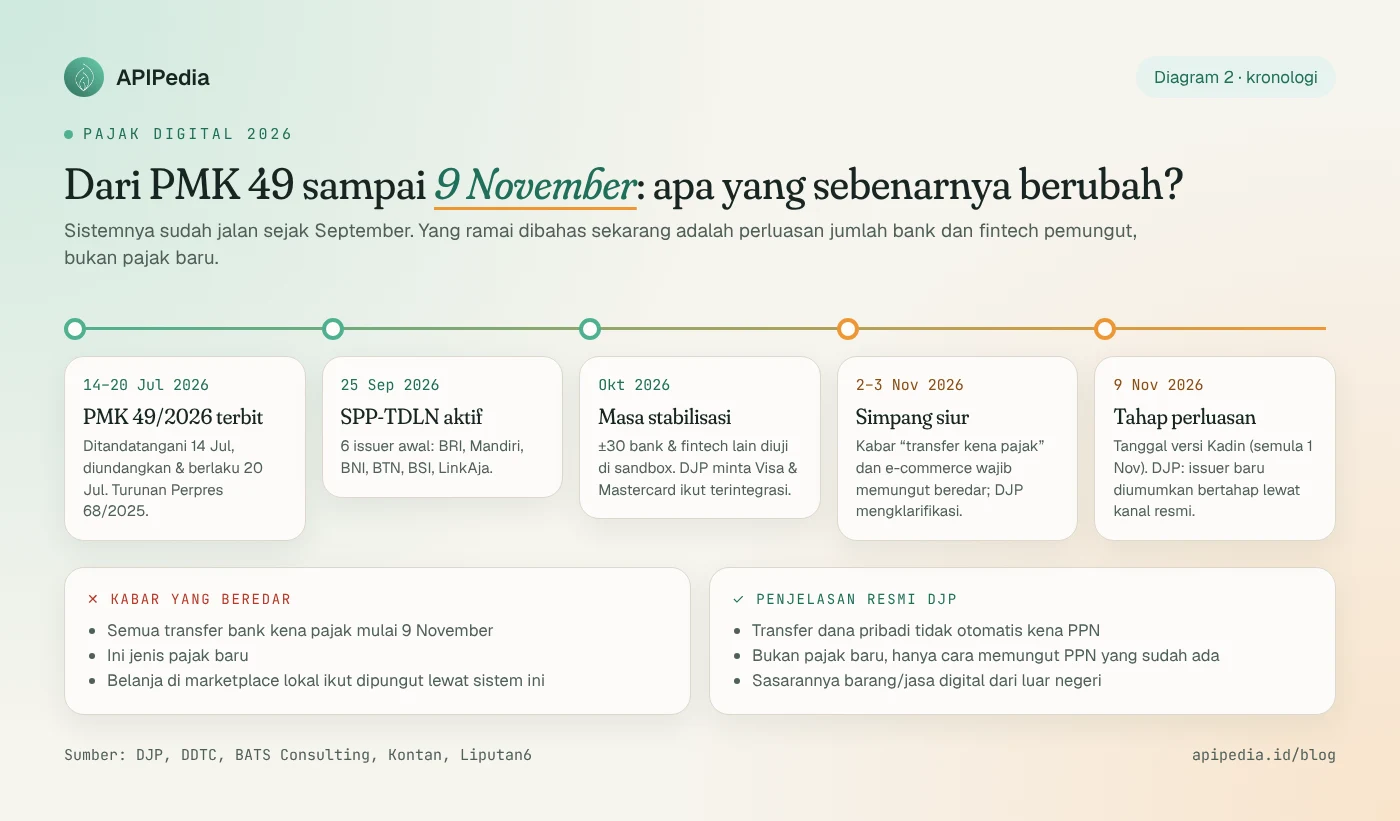
SPP-TDLN stands for Tax Collection System for Overseas Digital Transactions. The basis is Presidential Decree 68/2025, then detailed in PMK Number 49 of 2026. According to BATS Consulting, this PMK was signed by the Minister of Finance Purbaya Yudhi Sadewa on July 14 2026. DDTC noted that the PMK was promulgated and took effect on July 20 2026. The system itself began operating on September 25 2026, according to DJP's statement.
The object is the use of intangible goods and digital services from outside the customs area for use in Indonesia. Examples mentioned by DJP and the media include:
- software and applications, including SaaS subscriptions;
- cloud, web hosting, and video conferencing services;
- streaming movies and music, e-books;
- digital games, virtual goods and virtual coins;
- AI-based services and other software-based services.
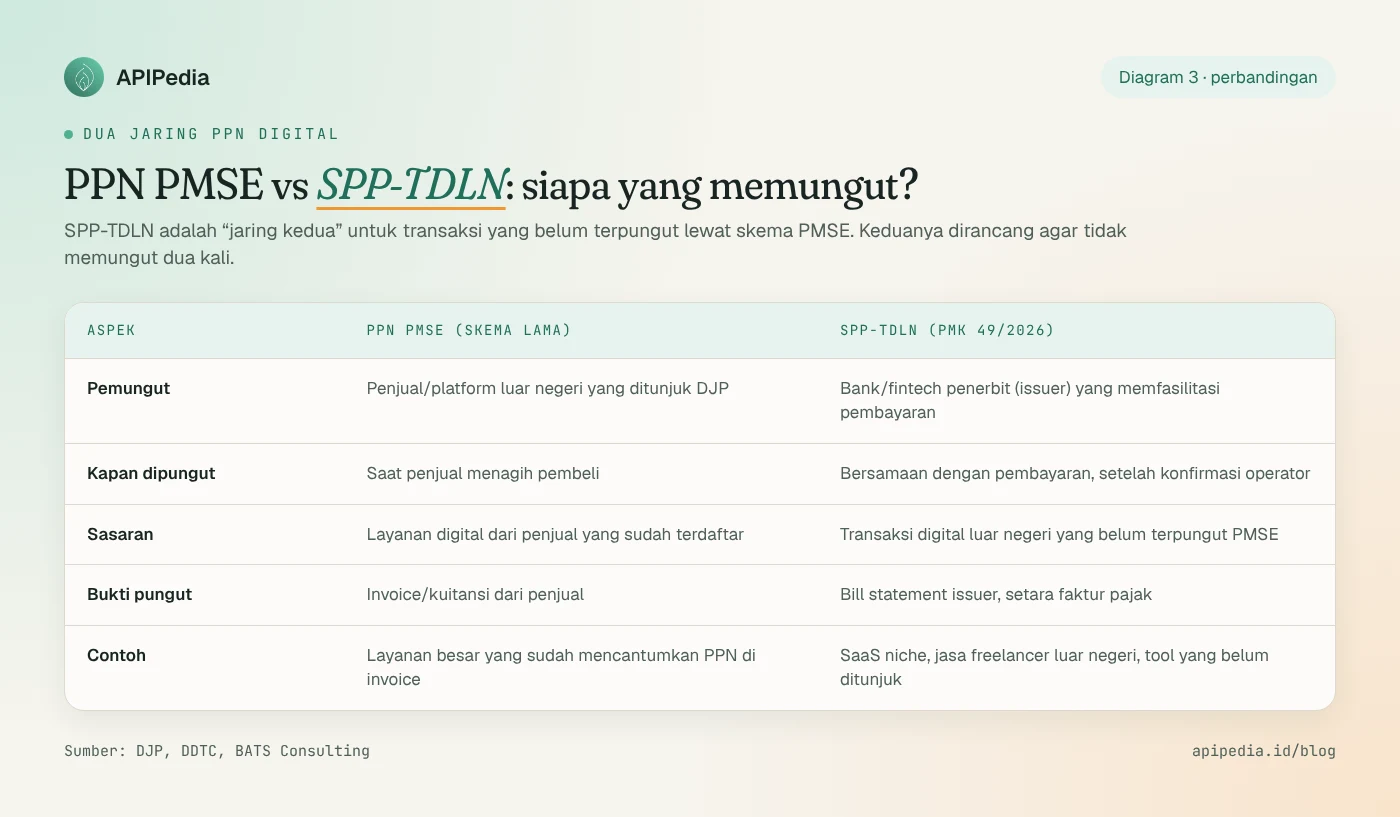
The difference with the old scheme is who collects it. So far, VAT on foreign digital services has been collected by foreign sellers appointed by the DJP as PMSE VAT collectors. SPP-TDLN adds a "second net": banks or fintechs that facilitate payments (called issuers) also collect, specifically for transactions that have not been collected via PMSE.
Why is November 9 so busy?
This date was called by Hashim Djojohadikusumo, Chairman of the Kadin Advisory Council, as the start of the policy's implementation. Liputan6 noted that the initial schedule was November 1 2026. On the other hand, DJP emphasized that SPP-TDLN has been running since September 25. The move in November only increased the number of collecting parties, not starting a new tax.
Director General of Taxes Bimo Wijayanto, as quoted by Kontan, said that the DJP had given potential issuers "until November". Around 30 other banks and fintechs are expected to follow the initial six issuers. DJP also wants Visa and Mastercard to be integrated with SPP-TDLN before November 2026.
Until this article was written, DJP had not announced a list of new issuers. Director of P2Humas DJP Inge Diana Rismawanti said that other potential issuers are still in the stabilization period, and their appointments will be announced via official channels in stages according to the readiness of their respective systems.
Is it true that bank transfers are taxable?
Not automatic. DJP emphasized three things:
- SPP-TDLN is not a new type of tax, but rather a new way of collecting existing VAT.
- Not all overseas transactions are subject to VAT, only those that meet the tax object criteria.
- Personal fund transfers are not automatically subject to VAT.
There is one technical detail that may trigger misunderstanding. According to DDTC's summary of PMK 49/2026, issuers send transaction data for confirmation, and the scope of the data includes foreign digital transactions as well as certain fund transfers and remittances. This means that certain transfer data can be checked. However, what determines whether or not VAT is subject to VAT is the operator's confirmation based on the object criteria, not just because there is a transfer.
Regarding local marketplaces: the claim that Shopee, Lazada, and GoTo are obliged to collect through this system comes from Hashim's statement, not from DJP. The DJP clarification quoted by Liputan6 only mentions bank issuers and institutions other than banks. There has been no official appointment for marketplaces in the SPP-TDLN scheme.
How does it work, step by step?
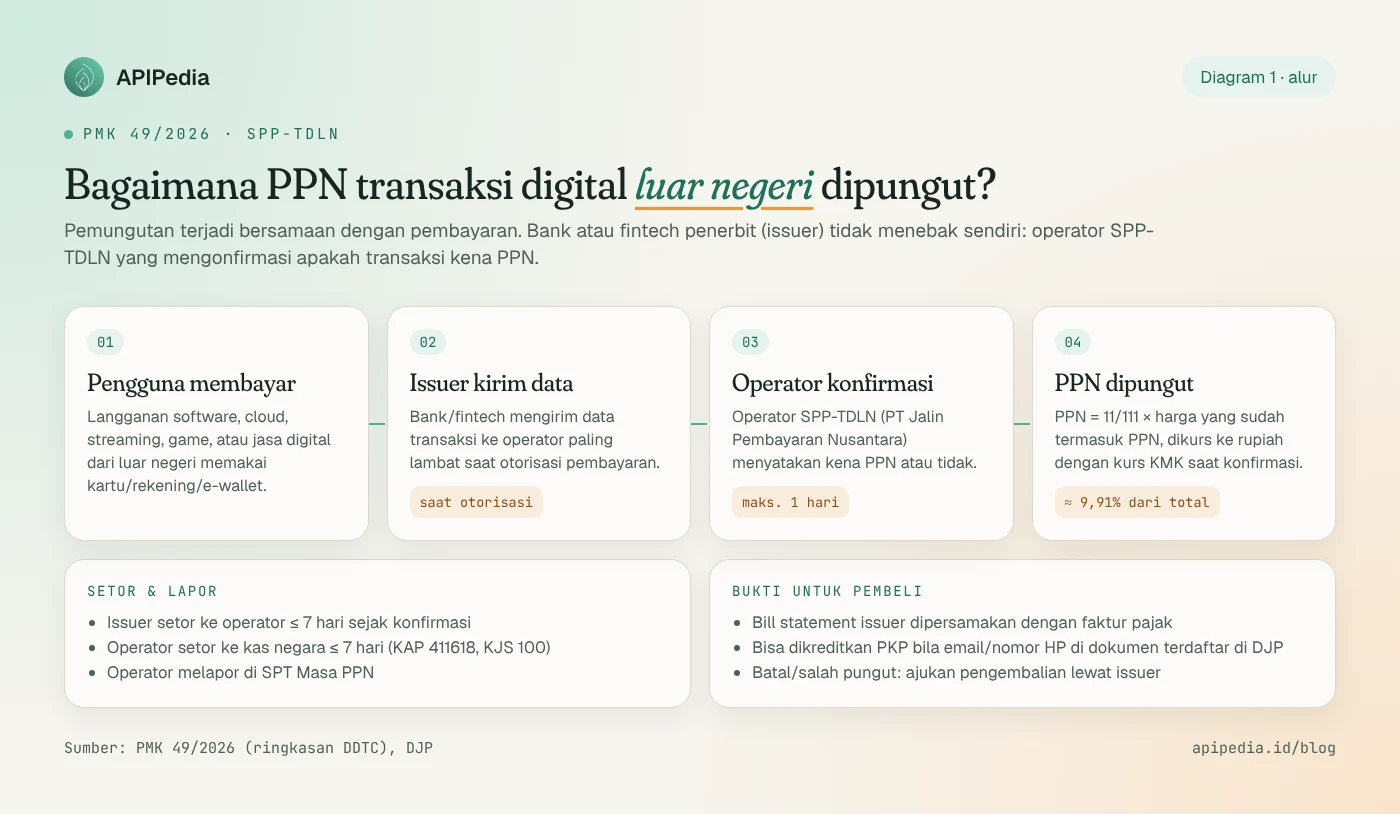
Based on the DDTC summary of PMK 49/2026, the flow is like this:
- Payment. You pay for overseas digital services with a card, account or e-wallet from the designated issuer.
- Data transmission. The issuer sends transaction data to the SPP-TDLN operator, PT Jalin Payment Nusantara (a subsidiary of BUMN), no later than the time of payment authorization.
- Confirmation. The operator confirms within a maximum of 1 day whether the transaction is subject to VAT. VAT is payable when confirmation is provided.
- Counting. VAT is calculated using the formula 11/111 from the price or payment which includes VAT. Foreign exchange transactions are converted at the Minister of Finance (KMK) rate in effect at the time of confirmation.
- Deposit. Issuer deposits with the operator no later than 7 days from confirmation. The operator deposits it into the state treasury no later than 7 days, then reports it in the Periodic VAT SPT.
The 11/111 formula means an effective rate of 11% of the tax base, or around 9.91% of the total paid. For example, from a payment of IDR 1,110,000, the VAT portion is IDR 110,000 and the DPP is IDR 1,000,000.
How is it different from the existing PMSE VAT?
| Aspect | PMSE VAT (old scheme) | SPP-TDLN (PMK 49/2026) |
|---|---|---|
| Collector | Seller/platform appointed by DJP | Bank or fintech issuer |
| Collection time | When the seller charges | Simultaneously with payment, after operator confirmation |
| Target | Services from appointed sellers | Overseas digital transactions that are not subject to PMSE |
| Proof of collection | Seller's invoice/receipt | The issuer's bill statement is equivalent to a tax invoice |
| Example transaction | A large service that includes VAT on the invoice | SaaS niche, overseas freelancer services, tools that have not been appointed |
| Be in effect | It's been a long time | System active September 25 2026, issuers increase gradually |
DJP said the SPP-TDLN was designed to prevent double collection. Transactions that have been collected by PMSE collectors will no longer be collected via SPP-TDLN.
What impact will this have on developers and businesses?
For tech teams paying for AWS, GCP, domains, AI APIs, or SaaS tools with enterprise cards, a few things have changed:
- The bill may contain VAT from the issuer. If the service does not yet collect PMSE VAT, the card or account bill statement can include the VAT collected by the bank.
- It could be input tax. For PKP, VAT in the bill statement can be credited as long as the email or cellphone number in the document is registered with the DJP and the general crediting conditions are met.
- Risk of double charges. BATS Consulting reminds companies that they still need to match vendor invoices with bill statements, so that the same VAT is not recorded twice.
- Exchange rate gap. Conversion uses the KMK rate upon confirmation, which may be different from the bank rate on the bill. Exchange rate reconciliations need to be noted.
- Mistakes can be returned. For canceled transactions or VAT that was incorrectly collected, refunds are submitted via the issuer.
For individual users, the effect is simple: subscriptions from overseas services that do not currently charge VAT can feel more expensive after your card or e-wallet issuer is appointed.
Practical steps you can take this week
- Overseas subscription inventory. Make a list of vendors, payment methods, and whether the invoice includes Indonesian VAT.
- Register your billing email and cellphone number with DJP. Make sure the data used on the card or company account is the same as that registered, so that the VAT on the bill statement can be credited.
- Save the bill statement. DGT recommends that consumers keep proof of transactions and information on taxes collected.
- Add a tax column in the expense recording. Separate DPP, VAT, exchange rate and reference numbers for easier monthly reconciliation.
- Monitor DJP's official announcements. The list of new issuers will be announced in stages. Don't rely on chain messages.
If your financial system pulls the exchange rate automatically, you can use the rupiah exchange rate API as a quick comparison. For tax reporting, continue to use the official KMK exchange rate.
Example of a simple reconciliation script
The following script separates DPP and VAT from total payment (11/111 formula), then marks transactions that have the potential to be collected twice, namely those that have VAT on the vendor invoice and on the bill statement at the same time.
// rekonsiliasi-ppn.js - jalankan: node rekonsiliasi-ppn.js
// Memisahkan DPP & PPN (11/111) dan menandai potensi pungutan ganda.

const transaksi = [
  { ref: "INV-001", vendor: "SaaS A", totalBayarIdr: 1110000, ppnDiInvoiceVendor: false, ppnDiBillStatement: true },
  { ref: "INV-002", vendor: "Cloud B", totalBayarIdr: 2220000, ppnDiInvoiceVendor: true,  ppnDiBillStatement: true },
  { ref: "INV-003", vendor: "Tool C",  totalBayarIdr: 555000,  ppnDiInvoiceVendor: true,  ppnDiBillStatement: false },
];

function pisahkanPpn(totalTermasukPpn) {
  const ppn = Math.round((totalTermasukPpn * 11) / 111);
  return { dpp: totalTermasukPpn - ppn, ppn };
}

for (const t of transaksi) {
  const { dpp, ppn } = pisahkanPpn(t.totalBayarIdr);
  const ganda = t.ppnDiInvoiceVendor && t.ppnDiBillStatement;
  console.log(
    `${t.ref} ${t.vendor}: DPP Rp${dpp.toLocaleString("id-ID")}, ` +
    `PPN Rp${ppn.toLocaleString("id-ID")}` +
    (ganda ? "  <-- CEK: PPN muncul di invoice dan bill statement" : "")
  );
}
// Output INV-001: DPP Rp1.000.000, PPN Rp110.000
A per-transaction data structure worth keeping for auditing would be something like this:
{
  "referensi_issuer": "BS-2026-11-000123",
  "tanggal_konfirmasi": "2026-11-10",
  "vendor": "SaaS A",
  "mata_uang_asal": "USD",
  "kurs_kmk": null,
  "dpp_idr": 1000000,
  "ppn_idr": 110000,
  "email_terdaftar_djp": "[email protected]",
  "sumber_ppn": "SPP-TDLN"
}
Fill in kurs_kmk with the KMK exchange rate in effect on the confirmation date.
What's not clear yet?
- List of new issuers. DJP has not yet released the names of the banks and fintechs that followed the initial six issuers.
- The exact date of the second phase. Kadin said November 9. DJP only said that the addition of issuers would be carried out in stages.
- How issuers recognize transactions. The media we read did not specify whether identification uses merchant category codes, merchant lists, or other methods.
- PMK date. BATS said it was signed on July 14 2026, DDTC said it was promulgated and took effect July 20 2026. The two do not contradict each other, but refer to the official text for certainty.
FAQs
Do I have to pay additional taxes when transferring to family abroad?
According to the DJP, personal fund transfers are not automatically subject to VAT. SPP-TDLN targets purchasing digital goods and services from abroad.
What is the VAT rate at SPP-TDLN?
PMK 49/2026 uses the 11/111 formula for prices including VAT. That is equivalent to an effective rate of 11% of the DPP, or around 9.91% of the total payment. DJP said this system does not change the applicable VAT rates.
If Netflix or Google already collect VAT, do banks collect it again?
It shouldn't be. Transactions that have been collected by PMSE VAT collectors are no longer collected via SPP-TDLN. If double charges occur, submit a refund via the issuer.
Which banks have collected it?
As of 25 September 2026: BRI, Mandiri, BNI, BTN, BSI, and LinkAja (PT Fintek Karya Nusantara). Other issuers will be announced by DJP in stages.
Can the company credit this VAT?
Yes, if the company has PKP status, the email or cellphone number on the bill statement is registered with the DJP, and the general conditions for input tax credit are met.
This article is general information, not tax advice. For specific cases, consult a tax consultant or the official DJP channel.
Source
- DJP: Overseas Digital Transactions and SPP-TDLN, What Do Taxpayers Need to Understand?
- DDTC News: PMK 49/2026, VAT on Overseas Digital Transactions Via SPP-TDLN
- BATS Consulting: PMK 49/2026, Banks Become Foreign Digital Transaction Tax Collectors
- Kontan: Digital Tax Comes into Effect on November 9, These are the Types of Tax That Will Be Collected
- Liputan6: Straightening out the confusing digital tax regulations November 9
Topics: #pajak digital #ppn #fintech #regulasi #saas
${c.about}
Tim APIPedia — Tim Engineering APIPedia
Tim engineering di balik APIPedia yang membangun dan memelihara API data Indonesia - ongkir, OCR KTP, data wilayah, BMKG, hingga server MCP - dan menulis panduan integrasinya dari pengalaman langsung.