AI Stock Falls, Nasdaq −5.5% a Day: Bubble Burst or Political Panic?
By Tim APIPedia, Tim Engineering APIPedia · Published · Updated · 10 min read
Nasdaq −5.5% and chip stocks fall after US midterm elections. What was the trigger, did the AI bubble really burst, and what does it mean for developers?
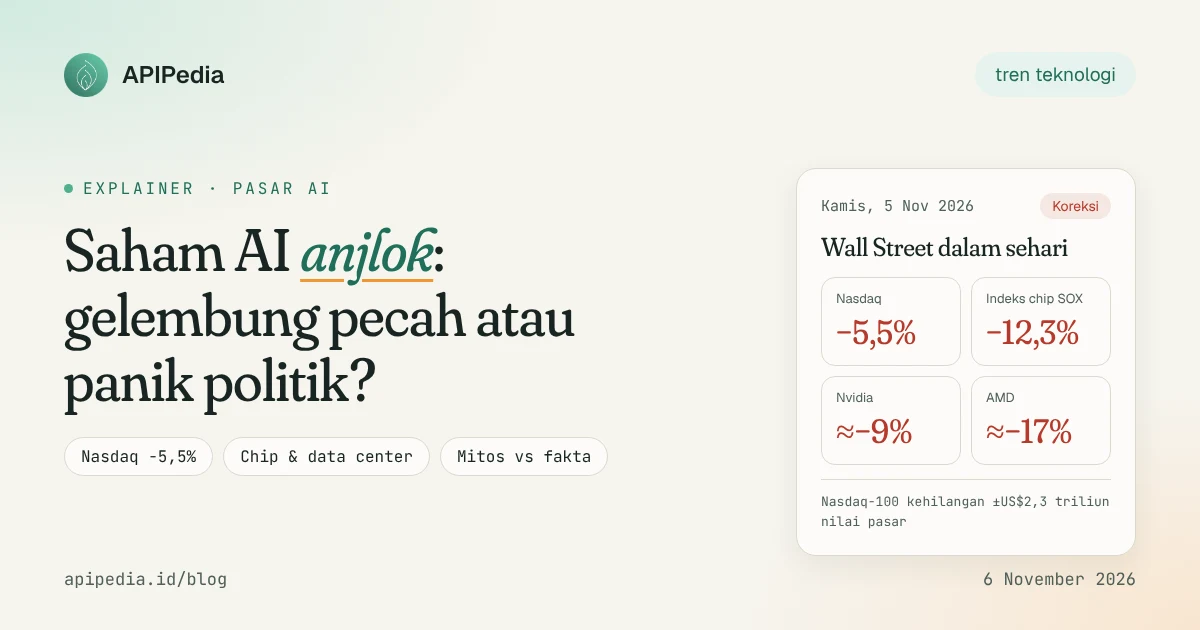
Thursday, November 5, 2026, US technology stocks had one of their worst days in years: the Nasdaq Composite fell 5.52% and the SOX semiconductor index plunged 12.25%. The trigger is a mixture of politics, fear about data center regulations, and profit-taking. For developers, the important question: is this a sign the AI bubble is bursting?
Timeline X, Reddit, and investor groups are abuzz with two opposing narratives. The first camp says "the AI bubble has finally burst". The second camp says this is just momentary political panic. This article dissects what's going on, why chips are hurting the most, and what the impact will be for those of us building products on top of AI APIs.
Note: this article is a news explanation, not investment advice.
What really happened on November 5?
Two days earlier, Tuesday 3 November, the US held by-elections for 435 DPR seats and 35 Senate seats. Wednesday the market briefly rallied: The Dow rose about 3% and the Nasdaq rose 1.44%. Then Thursday everything turned around.
According to Yahoo Finance's live records, the Democratic Party won both chambers of Congress. The market is then worried that the new Congress will tighten the rules for building AI data centers and chip exports. As soon as the opening bell rang, the post-election gains disappeared immediately.
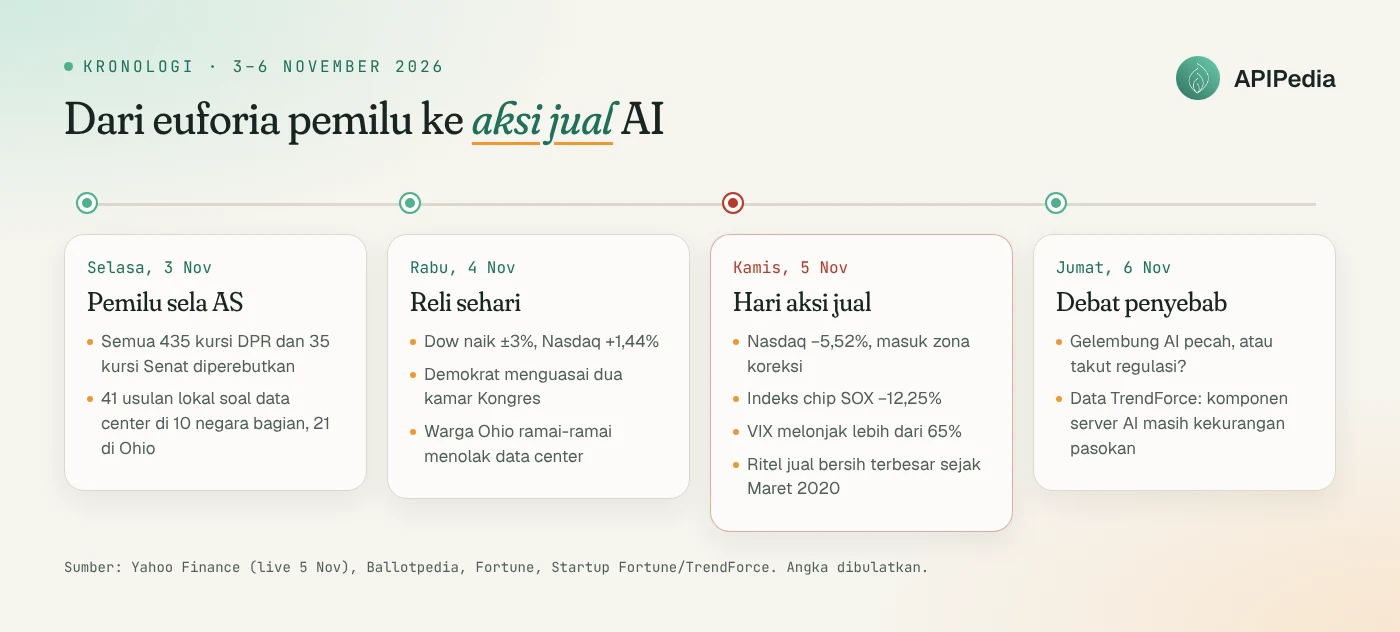
Summary of the day's numbers
| Indicator | Changes Nov 5, 2026 | Notes |
|---|---|---|
| Dow Jones | −3.44% (−1,833 points) | Closed 51,523.06; second day after the worst by-election since 1896 |
| S&P 500 | −4.36% | Some media wrote 4.3% or 4.4% |
| Nasdaq Composite | −5.52% | Enter the correction zone; worst since April 2025 |
| Nasdaq-100 | −6.36% | About US$2.3 trillion in market value was lost |
| Semiconductor (SOX) | −12.25% | Deepest daily decline since March 2020 |
| VIX (“fear” index) | up >65% | Had touched 27.45 |
| Bitcoins | down >5% | It was under US$76,000 |
Why is this incident so widely discussed?
There are three things that make it go viral, not just a "regular red market".
- The scale is historical. The Dow recorded its second worst post-midterm election day since the index was created in 1896.
- Retail panicked too. Retail investors sold a net of around US$358 million in US shares as of 14.58 New York time, the biggest selling day since March 2020. Viraj Patel of Vanda Research called it "total capitulation by retail investors". This figure was written differently (US$257 million and US$265 million) in another part of the same report because the data continues to be updated.
- AI's big names fell together. Nvidia is down about 9%, AMD and Micron about 17%, SanDisk almost 22%. Palantir and CrowdStrike fell more than 10%.
Charlie McElligott, Nomura's cross-asset strategist, described the scene with a sentence that immediately became a meme: "They're shooting the generals." This means that what is being sold is precisely the shares of the "general" leader of the 2026 AI rally.
What are the triggers?
1. Fear of data center regulations
The main concern: The Democrat-controlled Congress is thought to be stricter on the construction of AI data centers and chip exports. For the market, stricter rules could mean spending on AI infrastructure slows, and that puts immediate pressure on chipmakers.
2. Residents reject the data center in the voting booth
This is the part that is often missed. According to Ballotpedia, there were 41 local proposals for data centers in 10 states as of November 3, 21 of them in Ohio. A total of 28 proposals aim to limit data centers, for example a ban or moratorium.
Fortune reports all five communities in Central Ohio that had proposals voted against the data center. In Trenton the ban passed 80% to 20%. In Wilmington about 80% of voters rejected rezoning land for data centers. The ICAPP/SurveyUSA survey in October also noted that 55% of Ohioans opposed building a data center, while only 22% supported it.
3. Take profit from long rallies
AI stocks are the biggest winners of 2026. As sentiment changes, hedge funds rush to lock in profits. McElligott calls it a "frantic dash". Because many investors hold the same stock, simultaneous selling causes prices to fall more quickly.
4. Additional factors
The same report also cited oil uncertainty and the Iran conflict (Brent at around US$98 a barrel), the Bank of England's first interest rate hike since 2023, and Qualcomm's weak profit guidance. On the same day, Bloomberg (quoted by TechStartups) reported that Microsoft rejected the option to expand its Texas data center contract with Nscale. Shares of "neocloud" providers such as Nebius and IREN fell more than 13%.
Why are chip stocks falling the hardest?
The way it works is similar to a supply chain. AI money flows from applications to the cloud, from the cloud to data centers, and then from data centers to chip and memory makers. If the market is concerned that data centers will be restricted, the end of the chain that is most dependent on new spending will be hit hardest.
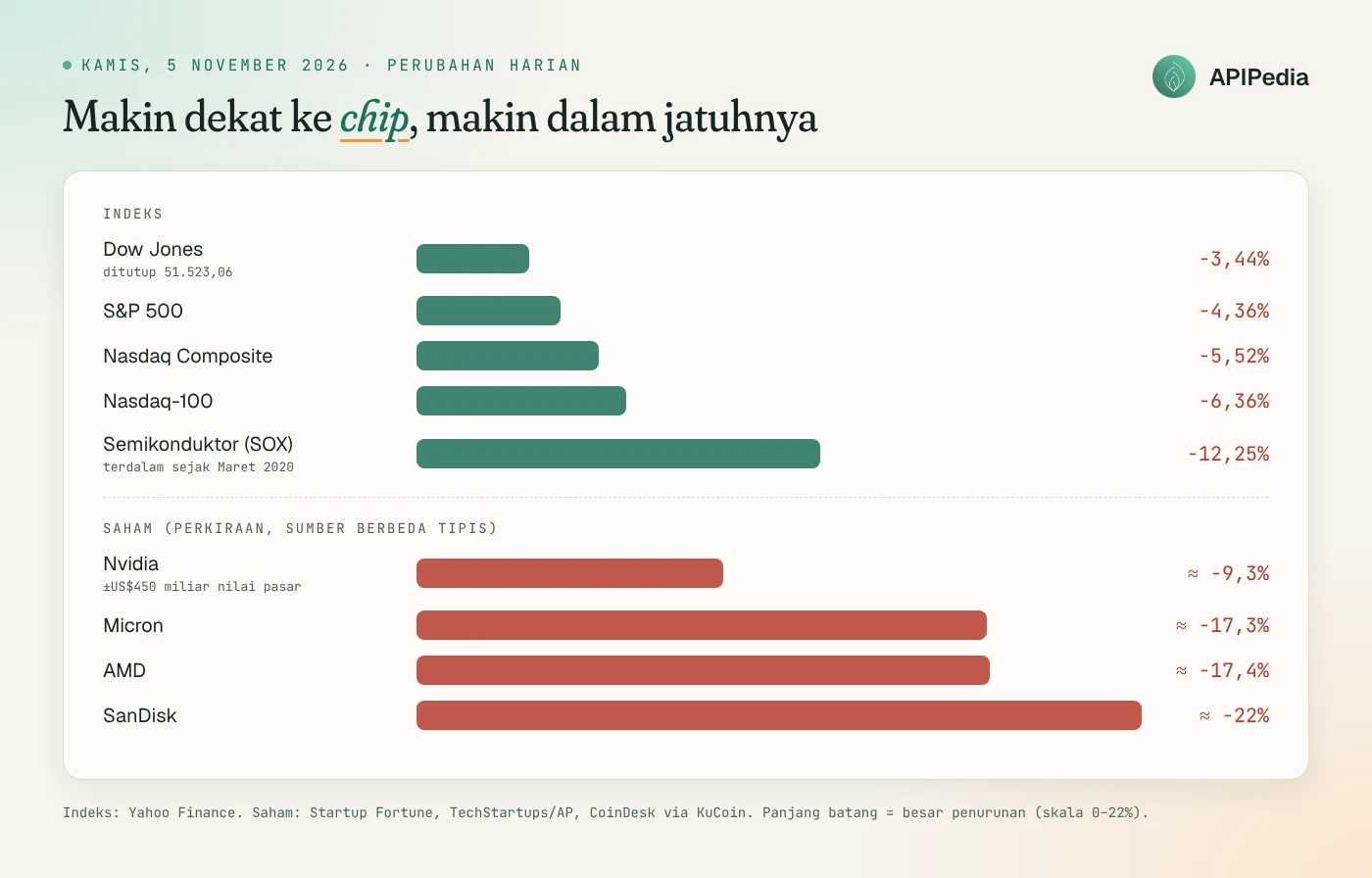
The pattern was clear: broad indexes like the Dow fell 3.44%, the tech-heavy Nasdaq fell 5.52%, and the chip index fell 12.25%. Memory stocks like Micron and SanDisk fell the most because their earnings depend heavily on new AI server orders.
One note about numbers. Sources differ slightly for individual stocks. Yahoo Finance wrote that AMD fell 15% in the middle of the session, while Startup Fortune recorded −17.4% and TechStartups/AP −17.3%. Differences like this are normal because some quote intraday prices and some quote closing prices.
Myths vs facts: has the AI bubble burst?
| Outstanding claims | In fact |
|---|---|
| "Demand for AI chips has collapsed." | There is no evidence yet. TrendForce Radar as of November 2 shows that 6 out of 7 AI server components are still in short supply. |
| "This is purely because AI doesn't make money." | Doubts about returns are certainly a factor, but the most frequently mentioned daily triggers are election results and regulatory risks. |
| "AI API prices will immediately fall/rise." | The share price does not automatically change the API price. Prices are determined by computing costs and provider competition, which do not change within a day. |
| "A correction means a market crash." | A correction is the technical term for a decline of 10% or more from a peak. The Nasdaq is now about 11.9% below its record. |
| "Data center regulations are definitely coming." | Not yet. There are only market expectations. The new federal law requires a long process in the Congress, which was only sworn in in January. |
The most interesting argument comes from Startup Fortune, which says the market is "trading the headline and not the hardware." If demand really collapses, we will see factories idle and component prices on the spot market fall. What happened was just the opposite.
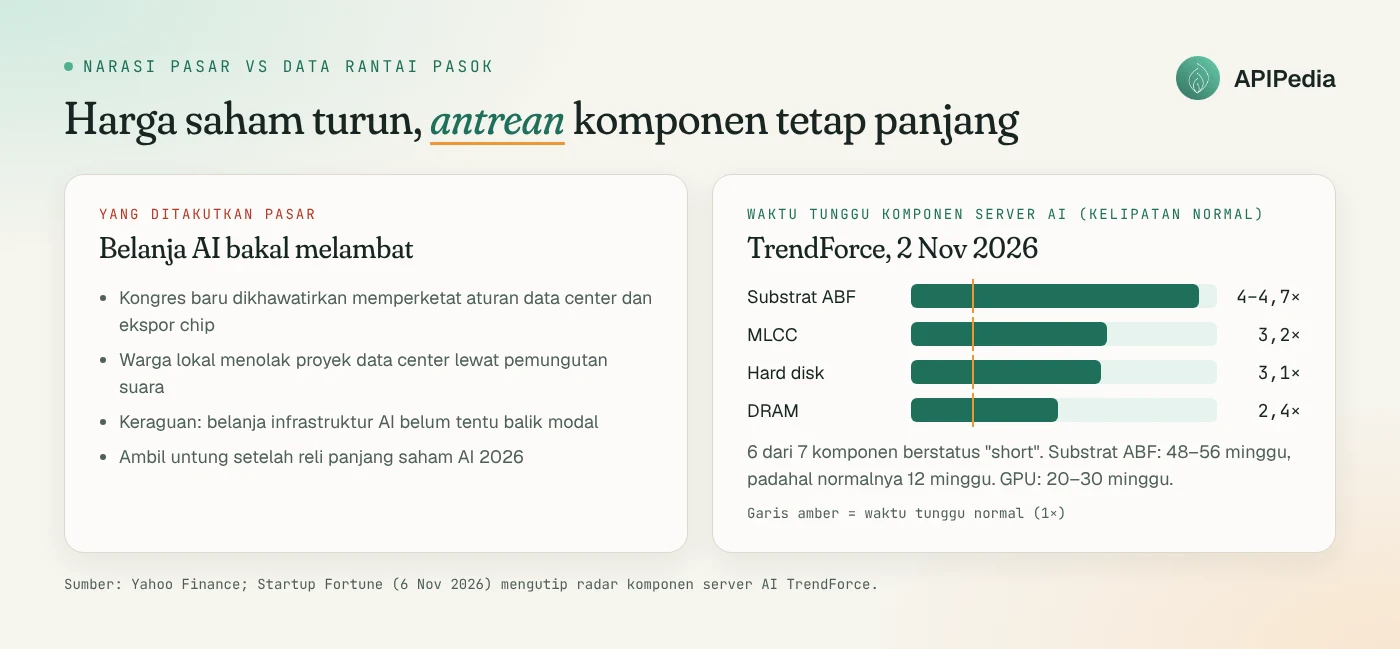
However, this argument also has its limits. Startup Fortune itself admits that regulation is a real risk that could reduce future orders. A lack of supply today does not guarantee that demand will remain high next year.
What does this mean for developers and businesses in Indonesia?
The good news is, your app won't stop just because Nvidia stock goes down. But there are some signals worth paying attention to.
Hardware prices may not necessarily go down
If you plan to buy a server, GPU, or RAM, don't expect prices to fall like stock prices. TrendForce data shows DRAM lead times are still 2.4 times normal and substrate ABF is 48–56 weeks. This shortage is expected to only subside when new substrate capacity arrives starting in 2027.
The computing provider risks are real
The news that Microsoft is holding back expansion with Nscale shows computing contracts can change quickly. Smaller cloud GPU providers could be affected first. For products that depend on a single model provider, this is a reminder to set up a backup.
Set up cross-provider fallback
A simple pattern to use: try the primary provider, and if it fails or takes too long, move to a backup provider. The following example uses an endpoint compatible with the OpenAI Chat Completions (Node.js 18+) format.
// fallback.js — jalankan: node fallback.js
const providers = [
  { name: "utama", url: process.env.LLM_URL_1, key: process.env.LLM_KEY_1, model: process.env.LLM_MODEL_1 },
  { name: "cadangan", url: process.env.LLM_URL_2, key: process.env.LLM_KEY_2, model: process.env.LLM_MODEL_2 },
];

async function chat(messages, timeoutMs = 15000) {
  const errors = [];
  for (const p of providers) {
    if (!p.url || !p.key) continue;
    try {
      const res = await fetch(`${p.url}/chat/completions`, {
        method: "POST",
        headers: { "Content-Type": "application/json", Authorization: `Bearer ${p.key}` },
        body: JSON.stringify({ model: p.model, messages }),
        signal: AbortSignal.timeout(timeoutMs),
      });
      if (res.status === 429 || res.status >= 500) throw new Error(`HTTP ${res.status}`);
      if (!res.ok) throw new Error(`HTTP ${res.status}: ${await res.text()}`);
      const data = await res.json();
      return { provider: p.name, text: data.choices[0].message.content };
    } catch (err) {
      errors.push(`${p.name}: ${err.message}`);
    }
  }
  throw new Error(`Semua penyedia gagal → ${errors.join(" | ")}`);
}

chat([{ role: "user", content: "Ringkas berita pasar hari ini dalam 2 kalimat." }])
  .then((r) => console.log(`[${r.provider}]`, r.text))
  .catch((e) => console.error(e.message));
Store API keys in environment variables, don't code them. AI key leaks can result in huge bills, as we discussed in the article LLMjacking: AI API Key Stolen. If you are also using OpenAI products that will be closing at the end of the month, check out the Agent Builder and Evals migration guides.
Monitor costs, not stock news
For businesses, the more relevant metrics are cost per request, quotas, and API error rates, not Nasdaq charts. If you use the API via APIPedia, usage and logs can be monitored from console.apipedia.id.
FAQs
Is this a sign the AI bubble is bursting?
It cannot be concluded from one trading day. The most commonly cited drivers are politics and regulatory fears, while supply chain data still shows demand for AI components is high.
What is the SOX index?
PHLX Semiconductor Index (SOX) is an index that contains shares of semiconductor companies, such as chip makers and chip equipment. The index fell 12.25% on November 5, the deepest since March 2020.
Will AI services like ChatGPT or Claude be disrupted?
There is no indication of service disruption due to this decline in shares. Stock prices and service operations are two different things.
Why does the election in the US affect data centers?
Data center construction requires land, electricity and water permits. Local and federal rules determine how quickly a project can be built. On November 3, 41 local proposals regarding data centers were voted on by residents.
What should developers do now?
No need to panic. Set up cross-provider fallbacks, monitor API costs, and suspend assumptions that hardware prices will drop soon.
Source
- Yahoo Finance: Stock market today, 5 November 2026 (live)
- Startup Fortune: Nvidia chip selloff hides a supply shortage, not a demand collapse
- Fortune: Ohioans overwhelmingly oppose data centers. 21 ballot measures just put their ire to the test
- Ballotpedia News: data center ballot measures 2026
- TechStartups: Top Tech News Roundup, November 5, 2026
- KuCoin News (quoting CoinDesk): Chip and AI stocks plunge as Nasdaq falls 5.5%
Topics: #ai #saham teknologi #data center #nvidia #explainer
${c.about}
Tim APIPedia — Tim Engineering APIPedia
Tim engineering di balik APIPedia yang membangun dan memelihara API data Indonesia - ongkir, OCR KTP, data wilayah, BMKG, hingga server MCP - dan menulis panduan integrasinya dari pengalaman langsung.