What is a Decision Model? AI Decides, Not Chats
By Tim APIPedia, Tim Engineering APIPedia · Published · 6 min read
Decision models are AI that choose answers from a fixed list plus probabilities. Understand how it works, calibration, and model options.
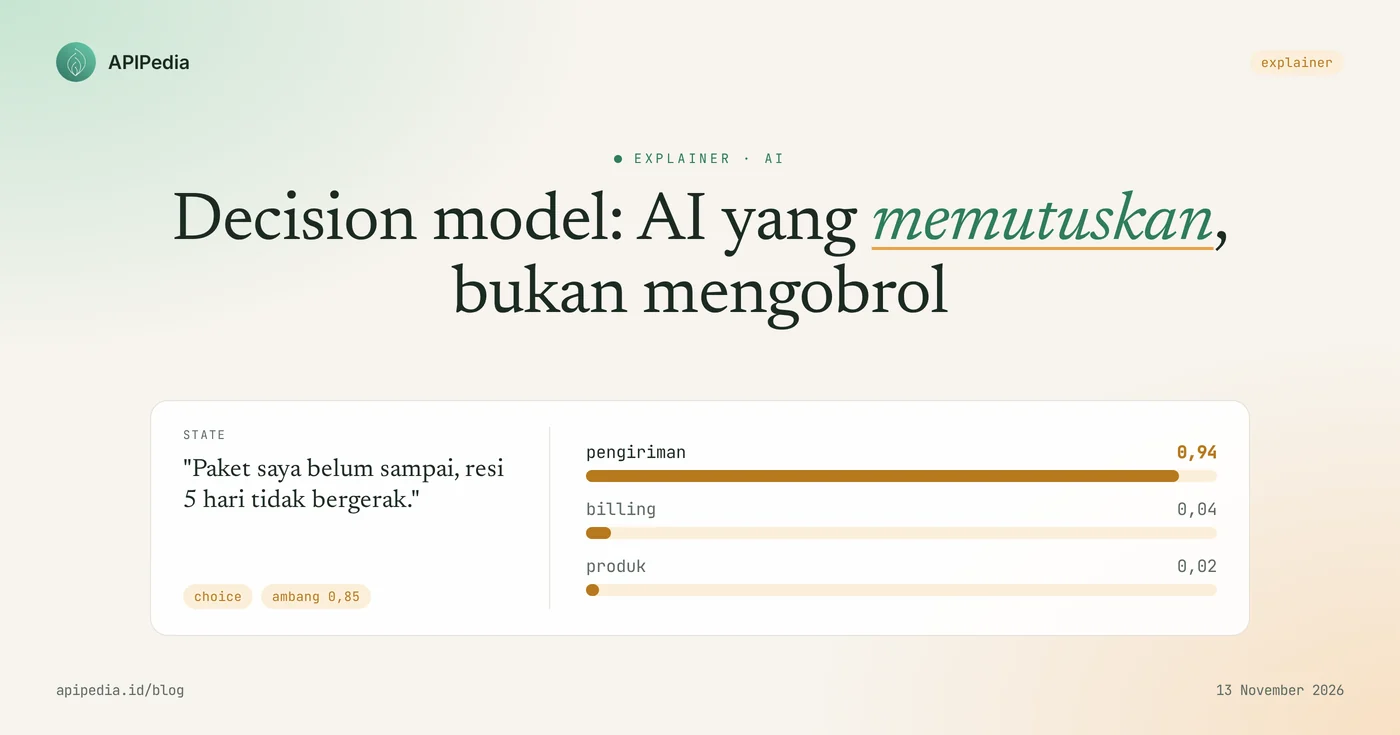
A decision model is an AI model that receives data and questions with predetermined answer choices, then returns a decision along with its probabilities, without writing text. This term has been widely used since TypeSafe AI released Jev in September 2026. Now there are several other decision models, both closed ones such as Liquid d1 and OpenAI Decisions, and open ones such as Clef 27B from Cloudflare and Kev 9B.
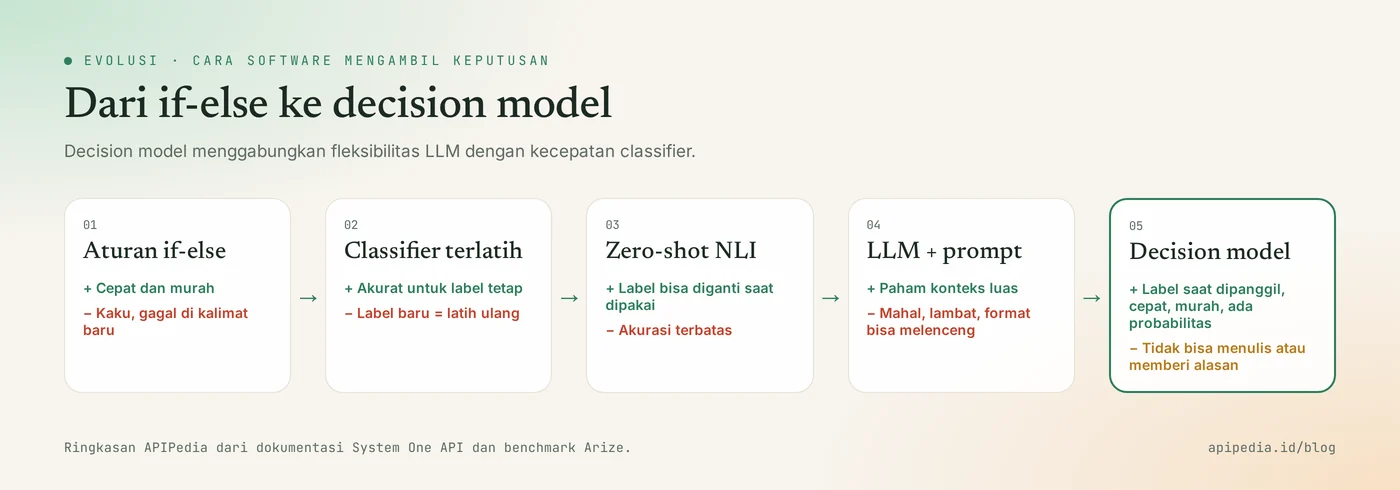
For developers, decision models fill the gap between the rigid rule of if-else and the expensive and slow LLM. This article explains how decision models work, what calibration is, how it differs from old classifiers, and how to choose a model.
Quick summary: what is a decision model?
Decision models are AI "functions": the input is states and questions, the output is answers of a type that can be directly used by code.
| Items | Explanation |
|---|---|
| Inputs | State (text, JSON, sometimes image) + question type |
| Answer type | Yes/no (probability), choose one from a list, or score on an ordered scale |
| Main characteristics | The answer space is fixed, the output is according to the scheme, there are probabilities, it is ideally calibrated |
| Example models | Jev (TypeSafe), Liquid d1 (Liquid AI), OpenAI Decisions, Clef 27B (Cloudflare), Kev 9B, Laya |
| General bill | Per input token; for Jev, output is free |
| Usage | Routing, classification, moderation, hallucination detection, LLM judge, agent tool selection |
How do decision models work?
This model works by assessing each answer option you give against the state, then assigning a probability to each option. Developers don't write free prompts, but instead structure questions like this:
{
  "state": "Pesanan saya belum sampai, padahal resi sudah 5 hari tidak bergerak.",
  "questions": {
    "tim": {
      "type": "choice",
      "instructions": "Tim mana yang harus menangani pesan ini?",
      "criteria": {
        "pengiriman": "Paket terlambat, hilang, atau resi tidak bergerak",
        "billing": "Tagihan, refund, atau potongan saldo",
        "produk": "Barang rusak atau tidak sesuai"
      }
    },
    "marah": { "type": "noul", "instructions": "Pelanggan terdengar kesal" }
  }
}
The results are numbers, for example tim: pengiriman (0,94) and marah: 0,72. Your code decides the next step: send directly to the delivery team, prioritize, or pass to a human when confidence is low. The request format above follows the System One API used by Jev and a number of other providers.
How is it different from the old classifier?
Older classifiers (e.g. self-trained sentiment or spam models) only recognize the labels used during training. If you want new labels, you have to collect data and retrain. The decision model receives its labels and definitions when called, so you simply substitute criteria for the new task. These capabilities are similar to NLI-based zero-shot classifiers, but modern decision models are trained more extensively and support multiple queries in a single call.
What is calibration, and why is it important?
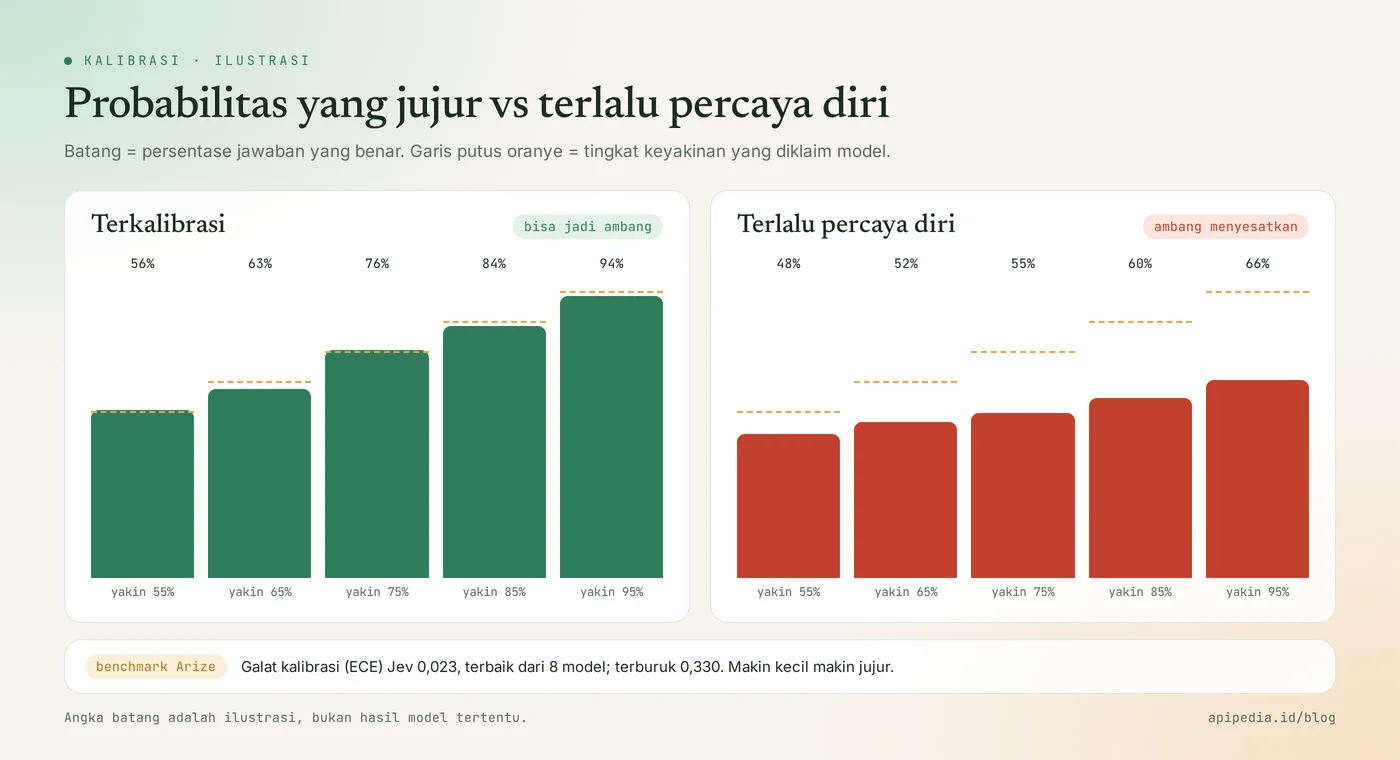
Calibration is important because it determines whether the model probabilities can be trusted as automatic thresholds. Calibration is the correspondence between the probabilities given by the model and the degree to which they are true in the real world. A well-calibrated model, if it assigns 80% confidence to a set of answers, will be correct about 80% of them. Without calibration, a figure of 0.9 may only be correct 60% of the time, making your automatic threshold misleading.
Calibration is usually measured by ECE (expected calibration error): the smaller it is, the more honest the probability. In the Arize benchmark of eight decision models, Jev recorded the smallest calibration error (0.023), while the worst model reached 0.330. TypeSafe trained Jev with a method they call RLCD (Reinforcement Learning for Calibrated Decisions) precisely to pursue this trait.
How to use probability correctly
- Collect 100–500 labeled examples of your original data, for example tickets that have been assigned the correct team.
- Run the decision model on that example and store the probabilities.
- Look for a threshold that provides high enough accuracy, for example 95% for answers with confidence ≥ 0.85.
- Automate only above threshold. The rest pass to humans or bigger LLMs.
- Retest every time you change the model version or change the wording of the question.
The fifth step is important. Arize found that some model results were reversed when the same question was worded differently, so tested several versions of the sentences before using them.
What decision models already exist?
As of November 2026, there will be closed (accessible via API) and open (can be run independently) decision models. The list below follows the Arize benchmark (October 7, 2026):
| Model | Maker | Access | Input price per 1 million tokens |
|---|---|---|---|
| Jev 1.13 | TypeSafe AI | Closed, API | $0.042 |
| Liquid d1 | LiquidAI | Closed, API | $0.04 |
| OpenAI Decisions | OpenAI | Closed, API | $0.10 |
| Clef 27B | Cloudflare | Open (Apache 2.0) | $0.24 via API, or self-hosted |
| Kev 9B | Jared Palmer | Open | Free self-hosted |
| Jeeves 9B | PostHog | Open | Free self-hosted |
| Strands Decider 2B | AWS | Open | Free self-hosted |
| Laya is multilingual | Convai Innovations | Open (Apache 2.0) | Free self-hosted |
In that benchmark, the top model is narrowly separated. On hallucination detection, Jev, Clef, and Liquid differ by about one percentage point, so Arize recommends choosing first based on deployment method (API or self-host), then comparing latency and cost.
When to use a decision model?
The decision model is most appropriate to use if the decisions are repeated, the answer choices can be written in advance, and you need fast and cheap results. Stick with generative LLM if you need long texts, explanations or reasoning. For applications in Indonesia, also test with Indonesian text mixed with regional languages or chat abbreviations, because most public benchmarks use English.
The decision model is a concrete manifestation of the System One model concept. The best known example is Jev from TypeSafe AI, and his comparison with a chatbot is in the article differences between Jev and a regular LLM.
Frequently asked questions
Is a decision model the same as a classifier?
Decision models are a more flexible form of classifier. Labels and definitions are given during the call, not during training, and one call can answer several questions at once.
Can decision models read images?
Some can. Some open models accept images, and Jev has image support which is still experimental. Check the documentation for each model before use.
How much does one decision cost?
Depends on input length. In the Arize benchmark, the cost per 1,000 hallucination detection decisions is approximately $0.034 for Liquid d1 and $0.045 for Jev. By comparison, the LLM judges they calculated cost $14.30 per 1,000 assessments.
Can the probability figures be immediately trusted?
Not necessarily. Calibration differs between models and between task types. Always measure against your own labeled data before determining an automatic threshold.
Source
Topics: #ai #decision model #model keputusan #kalibrasi #jev #explainer
About the author
Tim APIPedia — Tim Engineering APIPedia
Tim engineering di balik APIPedia yang membangun dan memelihara API data Indonesia - ongkir, OCR KTP, data wilayah, BMKG, hingga server MCP - dan menulis panduan integrasinya dari pengalaman langsung.