DeepSeek Super-Agent: An Open Source Coding Agent that Reads Team Chats
By Tim APIPedia, Tim Engineering APIPedia · Published · Updated · 8 min read
DeepSeek released an MIT-licensed Super-Agent prototype: a coding agent that monitors team chat and replies with pull requests. Here's how it works and how to try it.
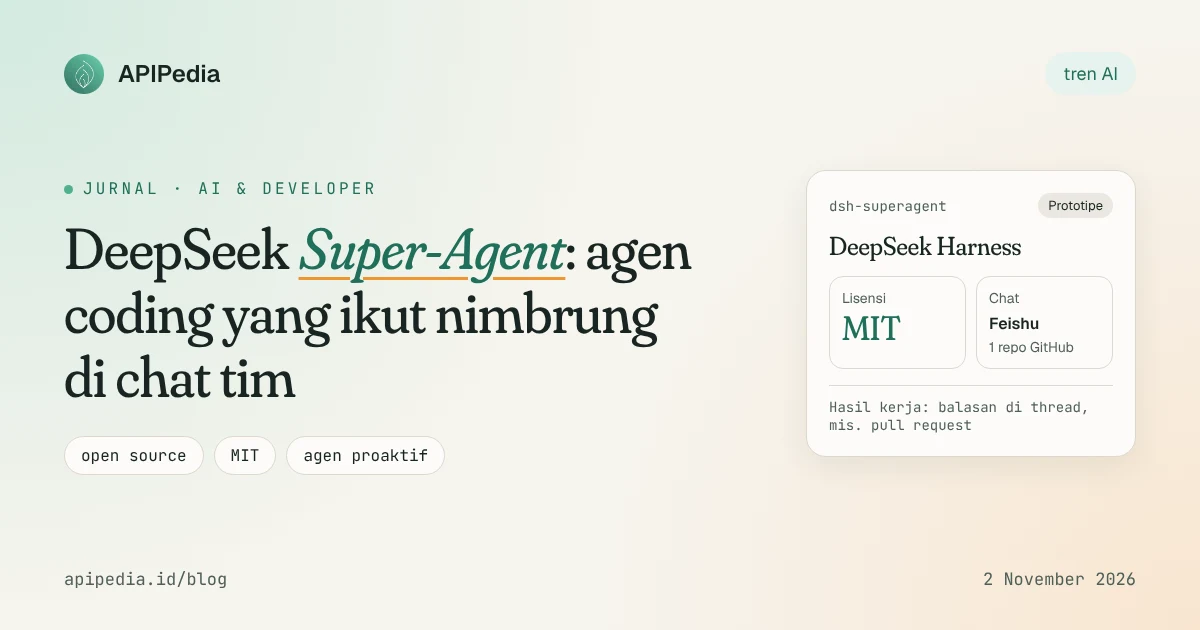
DeepSeek Super-Agent is an open source coding agent prototype (MIT license) that can monitor developer chat groups, recognize code problems, then offer solutions, for example via pull requests, without having to be called one by one. This November 1, 2026 release is important because it shifts the way AI agents work: from “assistants waiting for orders” to “teammates chiming in on conversations.”
The prototype code was published on GitHub under the name dsh-superagent-prototype, a day after the DeepSeek team explained the design via a WeChat post. Bloomberg and a number of media said this step was DeepSeek's attempt to challenge Claude Code from Anthropic. Let's dissect what's really new, what's not yet, and how to try it safely.
What exactly is DeepSeek Super-Agent?
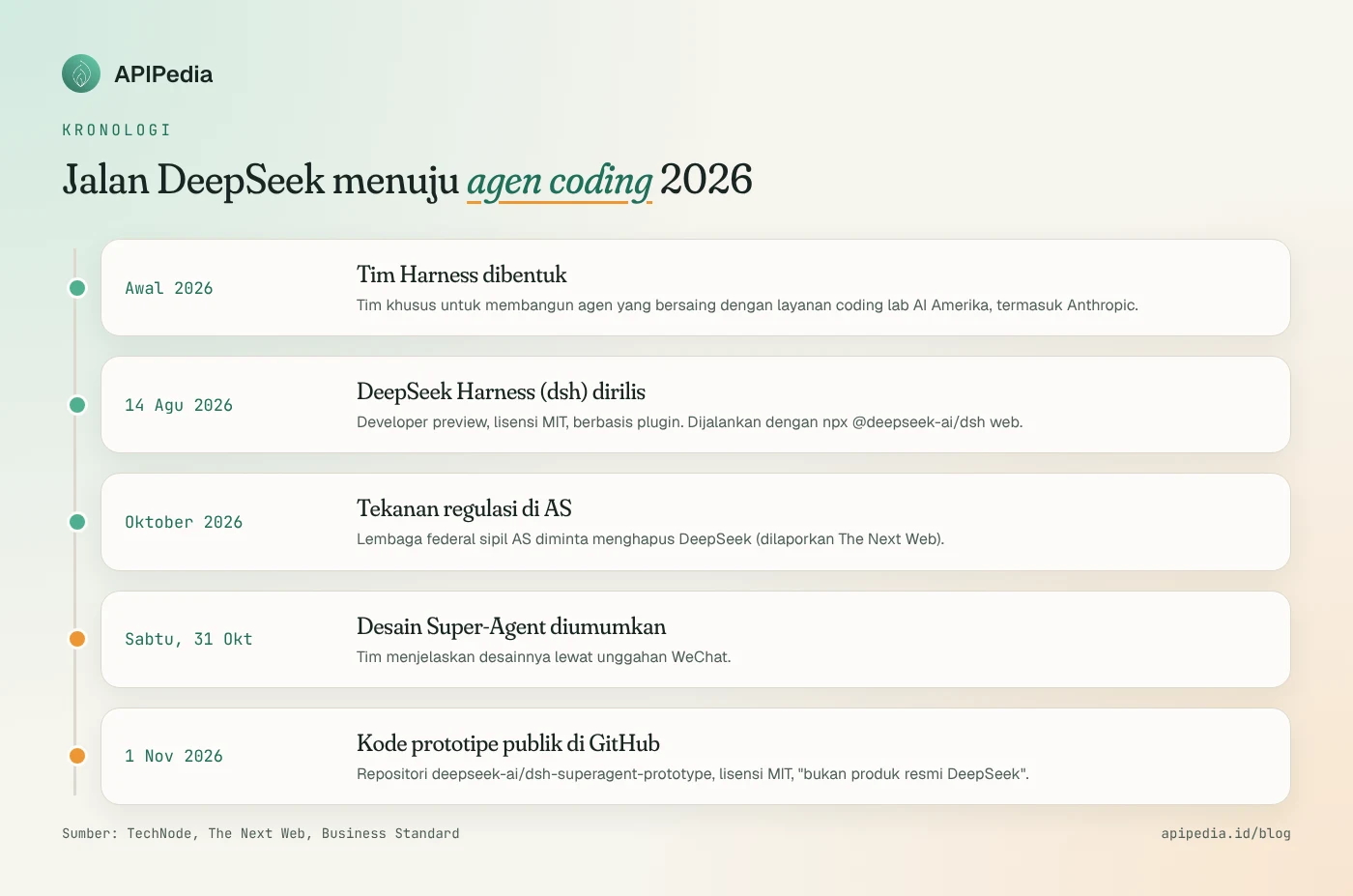
Super-Agent was built by the Harness team DeepSeek, a team formed in early 2026 to create an agent that could compete with coding services from American AI labs. The term "harness" here means a software framework around a large language model (LLM) that helps agents perform complex tasks: calling tools, reading files, executing commands, and managing sessions.
According to The Next Web's report, the key points are:
- Status of research prototypes. DeepSeek insists it is "not an official DeepSeek product" and asks users to review and adjust the code before running it.
- Connect to Feishu, ByteDance's work chat app (the international version is known as Lark).
- Focus one GitHub repository per deployment.
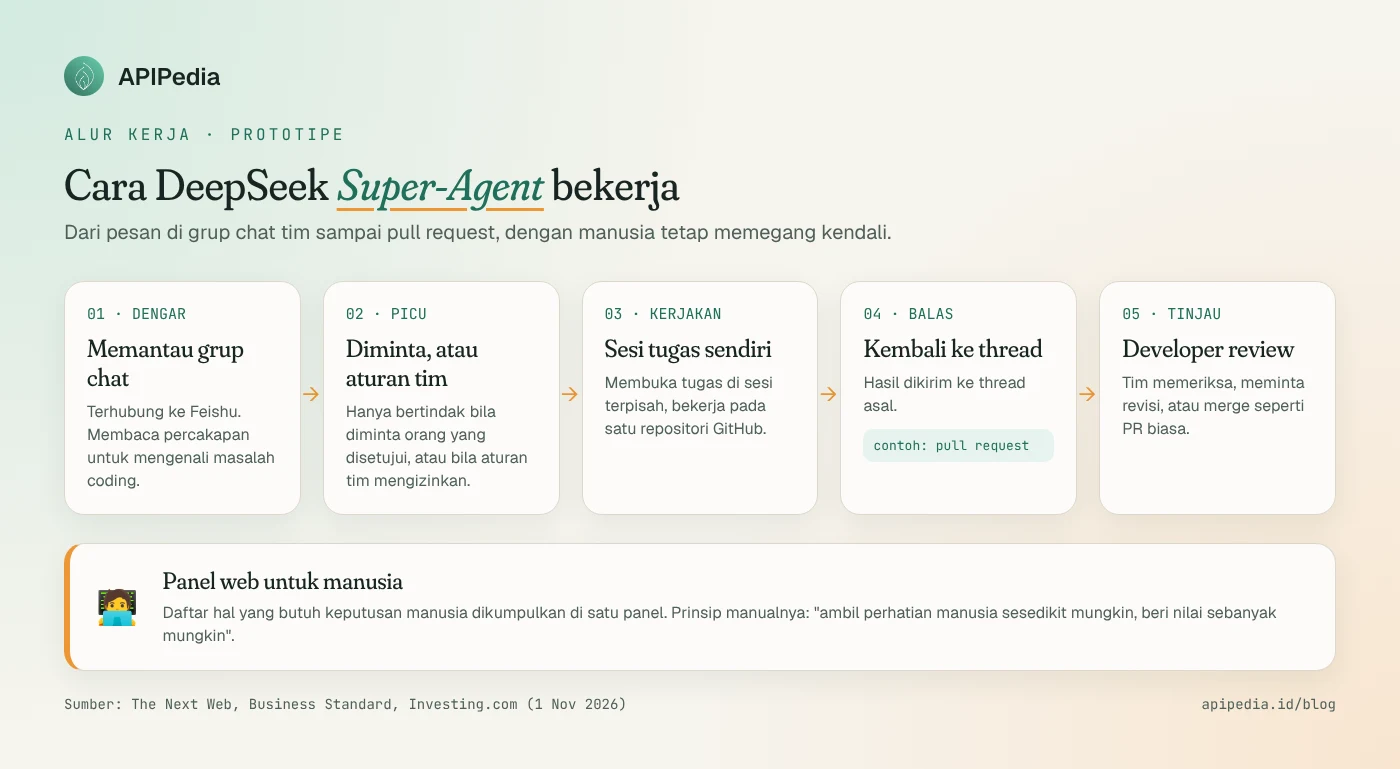
- Work in your own session. When an approved person requests work, the agent opens the task in a separate session and then replies in the original thread, for example with a pull request.
- A web panel that collects things that require human decisions.
- Activation rules: agents only act when requested, or when team rules allow it.
The principle written in the manual is quite clear: “take as little human attention as possible, and provide as much value as possible.”
Why is "proactive" the key word?
Nearly all of today's popular AI coding tools are on-demand: you open a terminal or IDE, type a command, and then the agent goes to work. Super-Agent tries to reverse that pattern. Business Standard and Investing.com report that these agents can monitor developer conversations, identify coding problems, and propose solutions without waiting for direct instructions.
There are nuanced differences between sources that are worth noting. Bloomberg (quoted by The Next Web) says agents can suggest solutions "without being called on", while the project's README, according to The Next Web, states agents only act when asked or when team rules allow. This means that proactive behavior is likely a team-configured option, not some wild default behavior. The Next Web also noted that the public code differs from DeepSeek's internal version, and some of the ideas in its design article have not yet been built.
The problem to be solved is quite real: coordination costs. When one team uses several AI agents at once, developers are busy being "operators" who provide context, copy logs, and monitor results. The Next Web cites a CooperBench study (January) that found the average success rate of coding agents was 30% lower when working as a team versus alone. The study did not test the DeepSeek agent, but showed that coordination between the agents was not yet complete.
What does this have to do with the DeepSeek Harness (dsh)?
Super-Agents don't appear from scratch. In August 2026, TechNode reported DeepSeek released DeepSeek Harness (dsh), an MIT-licensed open source agent harness in developer preview status, with a web interface and plugin-based structure. DeepSeek itself warns dsh is "still changing rapidly" and could bring changes that break compatibility.
The name of the Super-Agent repository starting with dsh- suggests that it is built on the same harness ecosystem. This ecosystem has also given rise to community plugins, for example dsh-feishu which makes Feishu a dsh interface (community plugin, not an official DeepSeek release).
How does it compare to other tools?
The following is a summary of Super-Agent's position compared to the tools it often mentions. The columns for other tools are intentionally kept general because the focus of this article is the DeepSeek release.
| Aspect | DeepSeek Super-Agent | DeepSeek Harness (dsh) | Claude Code (Anthropic) | Copilot App (GitHub Universe) |
|---|---|---|---|---|
| Status | Research prototype, "not an official product" | Developer preview | Commercial product | Introduced at GitHub Universe |
| License | M.I.T | M.I.T | Proprietary | Proprietary |
| How to trigger | Requested in chat, or team rules | Web UI or terminal (headless) | Developer orders | Developer orders |
| Main interface | Feishu chat group + web panel | Local web UI, CLI | Terminal, IDE | Copilot App |
| Repo coverage | One GitHub repository | Depends on configuration | Local repo | Multiple parallel repos |
| Official benchmark | Not yet published | Not yet published | There is | Sources are not discussed |
One thing that isn't in any source yet: benchmark numbers, the default model used by Super-Agent, and price. Some aggregator sites make performance claims, but without verifiable numbers, so they are best considered unproven.
How to try it?
Since Super-Agent is still a prototype and DeepSeek itself requires its code to be reviewed first, the safest path is to become familiar with its foundation, namely the DeepSeek Harness. The official order, as per the TechNode report and Opper integration documentation:
# Jalankan web UI DeepSeek Harness (tanpa instalasi terpisah)
npx @deepseek-ai/dsh web
# Web UI tersedia di http://127.0.0.1:3080

# Atau mode headless dari terminal
npx @deepseek-ai/dsh --profile headless "Ringkas repositori ini"
dsh accepts any OpenAI-compatible endpoint as a custom provider. The configuration is saved at $DSH_HOME/settings.yaml (default ~/.dsh). The following example is adapted from the Opper documentation; Change the provider name, base URL and model ID according to the service you use:
agent-default-model:
  provider: opper
  model: tensorx/deepseek/deepseek-v4-flash
llm-pi-ai:
  providers:
    opper:
      apiKeyEnv: OPPER_API_KEY      # kunci dibaca dari environment
      api: openai-completions
      baseURL: https://api.opper.ai/v3/compat   # tanpa /models, dsh menambahkannya sendiri
      models:
        - id: tensorx/deepseek/deepseek-v4-flash
For Super-Agent itself, the recommended steps:
- Read the README and manual in repository
deepseek-ai/dsh-superagent-prototype, including the sections that mention which features have not yet been built. - Test on a sandbox repository, not a production repo.
- Limit who can trigger agents (list of allowed users and chats).
- Use GitHub tokens with minimum permissions and require human review before merges.
- Make sure your company data policy allows team chat content to be read by agents and sent to model providers.
What does this mean for Indonesian developers?
Most teams in Indonesia use Slack, Discord, Telegram, or WhatsApp, not Feishu. So Super-Agent cannot be used directly without adaptation. However, because the code is MIT, the pattern offered, namely "chat as an agent interface", can be studied and applied to other platforms.
There is also an aspect of caution. An agent reading all team conversations means there is internal data flowing into the model. For companies subject to the Personal Data Protection Act, the question of “what data goes where” needs to be answered before the trial, not after.
If you are building your own agency, you can also give the agent access to local Indonesian data via MCP. The guide is in the article Claude MCP API: Connect APIPedia to Claude and AI Agents. For context on other agents' competition, see also GA's official Gemini Computer Use and Mistral Large 4 open-weight.
FAQs
Is DeepSeek Super-Agent free?
The code is open source with an MIT license, so it is free to use and modify. Fixed costs arise from the AI models you connect and the infrastructure that runs them.
Can Super-Agent be used on Slack or Telegram?
The published version links to Feishu. Support for other platforms has not been announced, but because it is open source, integrations can be built independently or by the community.
Does this agent read all messages and then immediately change the code?
According to the README quoted by The Next Web, agents only act when asked by an approved person or when team rules allow, and the results are in the form of replies in threads such as pull requests that still need to be reviewed.
How is it different from the DeepSeek Harness?
DeepSeek Harness (dsh) is a plugin-based general agent framework with web UI and terminal mode. Super-Agent is a prototype on top of that ecosystem that focuses on team workflows via chat.
What model does Super-Agent use?
There are no sources that mention the default model. dsh itself can use any endpoint that is compatible with OpenAI.
Source
- The Next Web: DeepSeek open-sources Super-Agent, a coding agent that reads team chats
- Business Standard: DeepSeek drops enhanced coding agent with aim at rival Anthropic
- Investing.com: DeepSeek launches autonomous coding agent to challenge Anthropic's Claude Code
- TechNode: DeepSeek Harness release report (August 2026)
- Opper documentation: DeepSeek Harness integration
- README dsh-feishu (community plugin)
Topics: #deepseek #agen ai #ai coding #open source #developer tools
${c.about}
Tim APIPedia — Tim Engineering APIPedia
Tim engineering di balik APIPedia yang membangun dan memelihara API data Indonesia - ongkir, OCR KTP, data wilayah, BMKG, hingga server MCP - dan menulis panduan integrasinya dari pengalaman langsung.