Gemini 4 Hydrogen Release: $1.50/$7.50 Price and Four Migration Pitfalls from 3.8 Flash
By Tim APIPedia, Tim Engineering APIPedia · Published · Updated · 9 min read
Google is releasing Gemini 4 Hydrogen on November 12, 2026. Here are the API prices in dollars, benchmark claims, and four subtle changes during the migration.
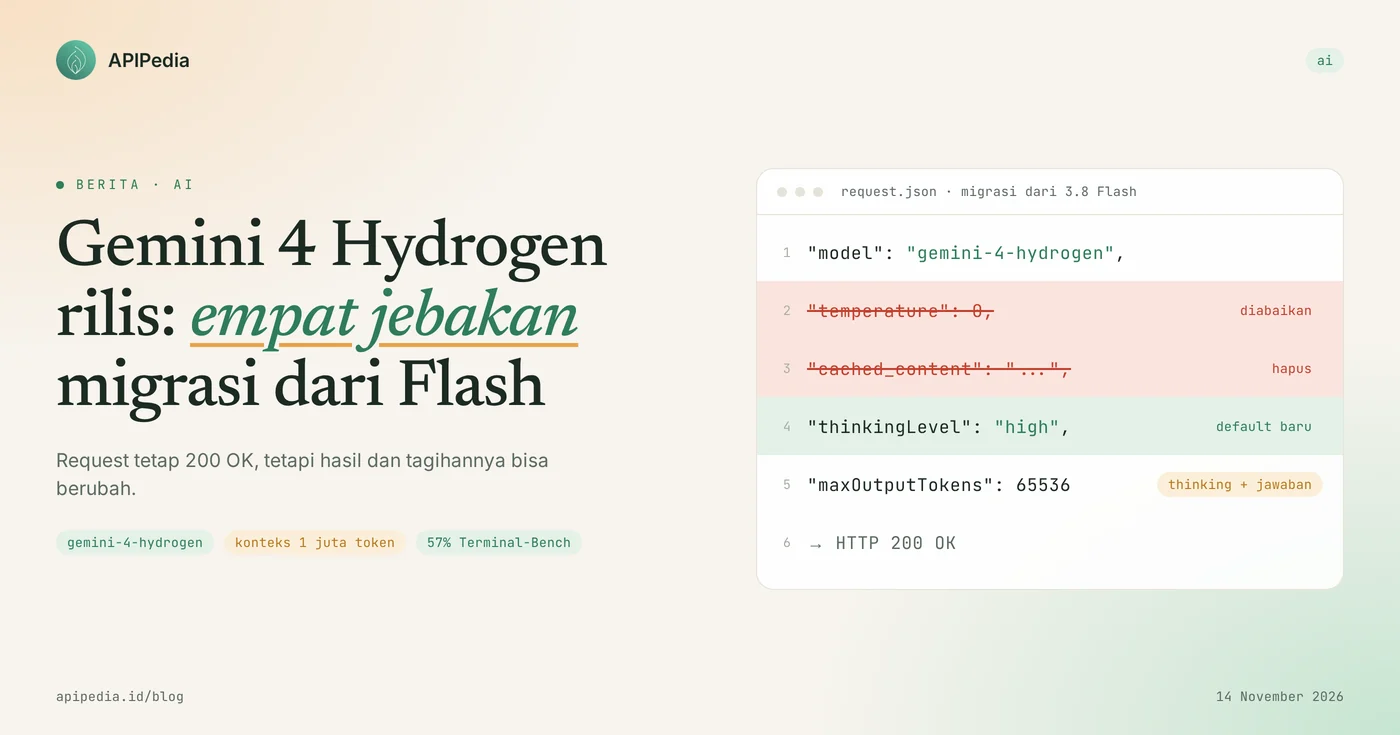
Gemini 4 Hydrogen is Google's new AI model for everyday coding and agents, released November 12, 2026 with an API price of $1.50 per 1 million input tokens and $7.50 per 1 million output tokens. This model replaces the role of the Flash line. Google claims Hydrogen completed tasks 2.5 times faster than Gemini 3.8 Flash and scored 57% in Terminal-Bench 4.1, up from 18.2%.
For developers in Indonesia, this news means two things. First, there is a new mid-range model with a context of 1 million tokens. Second, there are four API behavior changes that don't throw errors, but can change your results and billing. This article summarizes the release facts, price in rupiah, and safe migration steps.
Quick summary
| Items | Details |
|---|---|
| Release date | November 12, 2026 at 18.00 UTC (November 13 01.00 WIB) |
| model ID | gemini-4-hydrogen |
| Standard price | $1.50 input and $7.50 output per 1 million tokens, the same across a range of contexts |
| Context | 1 million tokens, shared by input, thinking, and output |
| Levels of thinking | low, medium, high (default), xhigh |
| Inputs | Text, PDF, spreadsheet, graphics, audio, video recording |
| Available at | Gemini API, Google AI Studio, Gemini app, Google Search, Antigravity (AI Pro and Ultra) |
| Gemini Fate 3.8 Flash | Still available, no closing date yet, price increases 2x starting January 1, 2027 |
What did Google release?
Google released the Gemini 4 Hydrogen as a fast and economical model for everyday coding and agency work. In the Gemini 4 family, Carbon and Argon are positioned for long reasoning, while Hydrogen is for fast execution. Hydrogen can be used alone or as a “worker” directed by Carbon in a multi-model flow.
The numbers below are from Google's own announcements, unless otherwise noted:
| Size | Gemini 4 Hydrogen | Comparator |
|---|---|---|
| Terminal-Bench 4.1 | 57% | Gemini 3.8 Flash: 18.2% |
| Artificial Analysis Intelligence Index | 51 (high), 54 (xhigh) | Gemini 4 Argon: 50 |
| Speed of completing tasks | 2.5x faster | Gemini 3.8 Flash, high level |
| Model-fabricated claims | Down more than 5x | Gemini 3.8 Flash |
| Test partners (SQL, graph, company data) | 2x to 2.8x faster, 12% to 23% fewer tokens | Gemini 3.8 Flash |
| Indirect injection prompt resistance | More than 2.3x more resistant | IPI Gray Swan Benchmarks |
On the product side, Hydrogen is the default AI Mode model in Google Search for all users. Free users of the Gemini app get it via automatic model selection. In Antigravity, the Orchestrator feature can switch between Carbon and Hydrogen in one session. Google reports this combination is close to Carbon's success rate with around 24% less quota and 19% faster time.
Note to read the benchmark numbers
- All scores above are vendor reported. Third-party measurements cited by the media recorded a time difference per task of around 1.8x, not 2.5x, because the test set was different.
- Google's announcement calls Terminal-Bench version 4.0 in one section and 4.1 in another.
- The same third-party measurement recorded the time to Hydrogen's first token as longer than 3.8 Flash at high thinking levels. This is important for latency-sensitive chat applications.
How much does the Gemini 4 Hydrogen cost in rupiah?
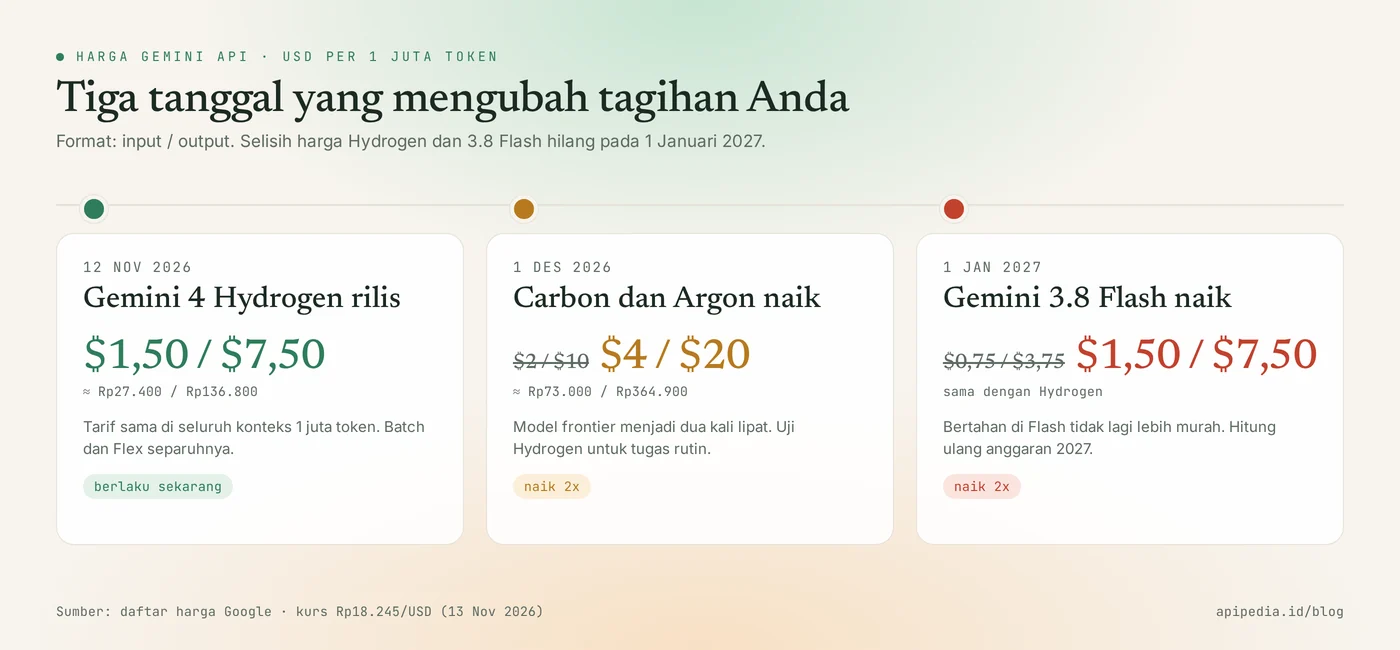
The standard price for Gemini 4 Hydrogen is equivalent to around IDR 27,400 per 1 million input tokens and IDR 136,800 per 1 million output tokens, at an exchange rate of IDR 18,245 per US dollar (reference rate 13 November 2026). Thinking tokens are billed as output.
| Track | Input / 1 million tokens | Output / 1 million tokens | Estimated Rupiah |
|---|---|---|---|
| Standard | $1.50 | $7.50 | Rp. 27,400 / Rp. 136,800 |
| Batch and Flex | $0.75 | $3.75 | Rp. 13,700 / Rp. 68,400 |
| Priorities | $2.70 | $13.50 | Rp. 49,300 / Rp. 246,300 |
| Input from cache | $0.075 | not applicable | Rp. 1,400 |
The Hydrogen is twice as expensive as the Gemini 3.8 Flash today ($0.75 and $3.75). However, the difference disappears on January 1, 2027, when the price of 3.8 Flash rises to the same figure. Carbon and Argon also rose from $2 and $10 to $4 and $20 starting December 1, 2026.
Example of cost calculation
Let's say your customer service chatbot receives 1,000 requests per day, each with 3,000 input tokens and 800 output tokens including thinking. Per day that's 3 million input tokens ($4.50) and 0.8 million output tokens ($6.00). The total is $10.50 per day, or around IDR 5.7 million per 30 days. This is an illustration, not an official number. Measure your real token usage before creating a budget.
What changes during migration from Gemini 3.8 Flash?
There are four changes that do not throw an error when you change the model ID from gemini-3.8-flash to gemini-4-hydrogen. Requests are still answered with a status of 200, but the results and costs can be different.
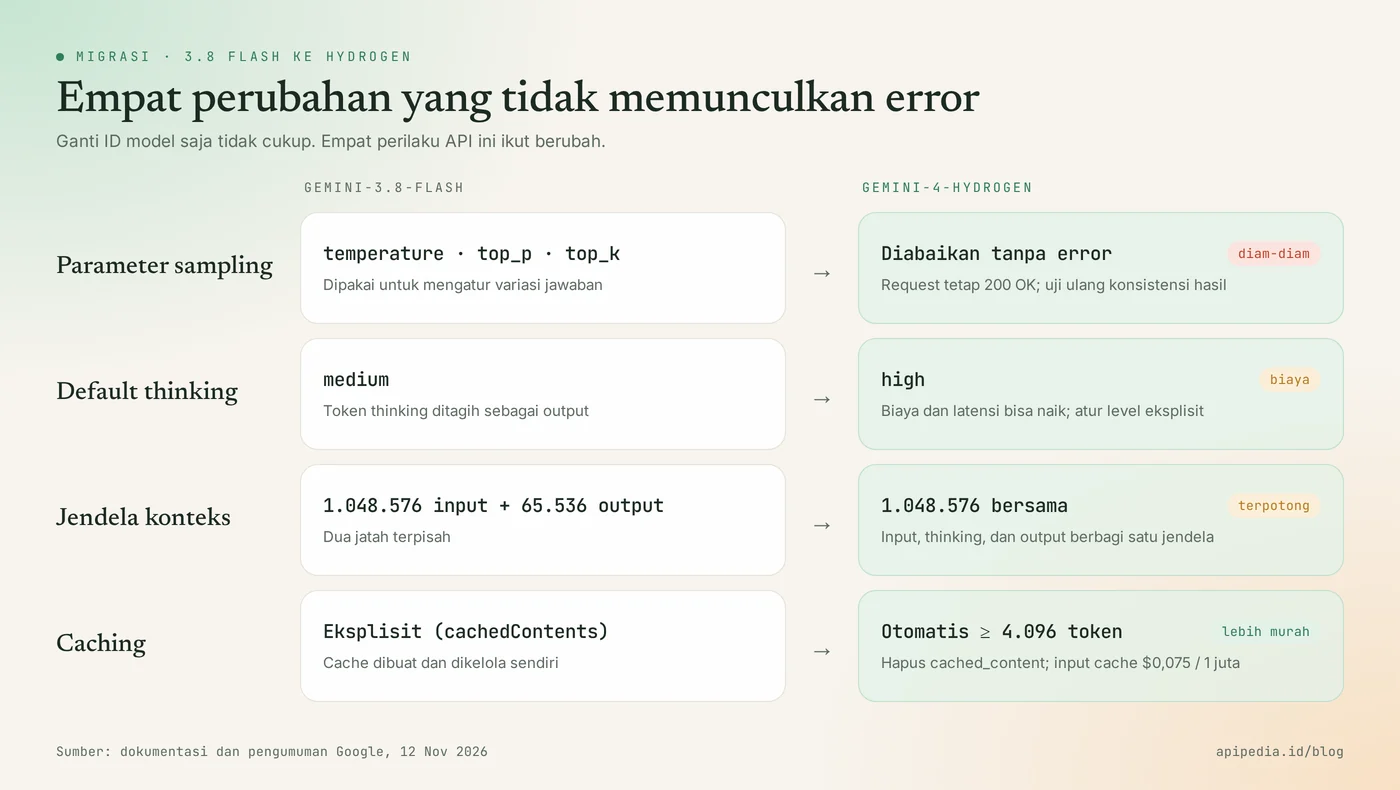
- Sampling parameters are ignored.
temperature,top_p, andtop_kare not rejected, but have no effect. If your application relies ontemperature: 0for consistent answers, retest the results. - Default thinking increases from medium to high. Thinking tokens are billed as output, so costs and latency can go up without you changing anything. Level
minimalis not supported. - One shared context window. In 3.8 Flash, the 1,048,576 input tokens are separate from the allotted 65,536 output tokens. In Hydrogen, input, thinking, and output share a single window of 1,048,576 tokens. The 900K token prompt only leaves around 148K tokens for thinking and answering. Long answers will be truncated, not an error.
- Explicit caching is not available. Field
cached_contentmust be deleted. Hydrogen uses automatic caching for requests starting at 4,096 tokens, with a cache input price of $0.075 per 1 million tokens.
One more thing about output limits. max_output_tokens in Hydrogen limits the combination of thinking and answers. Old limits like 8,192 can be used up to think about before the answer is written. Google's guidelines suggest the limit be removed or raised to 65,536.
Example of a minimum request
The following example calls Hydrogen with the thinking level set explicitly, without sampling parameters. Check the official documentation for the latest field names before using them in production.
curl -s -X POST \
  "https://generativelanguage.googleapis.com/v1beta/models/gemini-4-hydrogen:generateContent" \
  -H "x-goog-api-key: $GEMINI_API_KEY" \
  -H "Content-Type: application/json" \
  -d '{
    "contents": [{"parts": [{"text": "Ringkas log error ini dalam 3 poin."}]}],
    "generationConfig": {
      "thinkingConfig": {"thinkingLevel": "medium"},
      "maxOutputTokens": 65536
    }
  }'
Why is this release important?
This release is important because Hydrogen shifts the bar for “cheap and fast” models to a class previously filled with large models. In fact, at the default level of thinking, Hydrogen's intelligence index score (51) is slightly above Argon's (50), even though Argon was priced at $2 and $10 and would be $4 and $20.
Here's our analysis, not Google's statement:
- The price per token increases, the cost per task does not necessarily. Hydrogen uses fewer tokens and succeeds more often, so the cost per task completed can decrease even if the rate per token doubles. The results depend on your workload.
- Google's price direction is upward. Three price changes in seven weeks (Hydrogen, Carbon and Argon, 3.8 Flash) show the era of promotional rates for midrange models is starting to end.
- There is less and less control in the hands of developers. Omitted sampling parameters and fully automatic caching mean model behavior is more provider-defined. Regression testing becomes more important.
What is the impact for developers and businesses in Indonesia?
The main impact is on budget and application stability, as API bills are paid in dollars while your revenue is in dollars.
- Teams using 3.8 Flash: You don't have to move now. But from January 1, 2027 3.8 Flash rates are the same as Hydrogen, so the 2027 budget needs to be recalculated assuming double the token cost.
- Teams using Argon for routine tasks: Hydrogen is worth testing as a replacement before Argon prices increase on December 1, 2026.
- Digital business owners: AI Mode in Google Search now uses Hydrogen globally. Monitor your organic traffic, especially for informational queries.
- IT Admin: in the free tier, input and output can be used to improve Google products. For customer data or internal data, use the paid tier and check its compliance with your organization's personal data protection obligations.
What do you need to do now?
Test Hydrogen in a staging environment first, then decide based on cost per task, not price per token.
- Look for all uses of
temperature,top_p,top_k,cached_content, andmax_output_tokensin your code. - Set the level of thinking explicitly. Start at
mediumto match the old behavior, then increase if the quality is lacking. - Run 50 to 100 real examples on both models. Record success rate, total tokens, latency, and time to first token.
- Calculate the cost per task completed in rupiah, including thinking tokens.
- Set budget limits and alerts in the billing console before redirecting production traffic.
- Move non-urgent jobs to Batch or Flex lanes to cut rates in half.
Frequently asked questions
Is Gemini 4 Hydrogen free?
Part. Free users of the Gemini app get Hydrogen via automatic model selection, and Google AI Studio makes it available for all tiers. Production-scale API usage is still billed at $1.50 and $7.50 per 1 million tokens.
Will Gemini 3.8 Flash be turned off?
There is no closing date yet. Google says 3.8 Flash is still available, but prices are increasing to $1.50 and $7.50 per 1 million tokens starting January 1, 2027.
What is the difference between Hydrogen, Argon and Carbon?
Hydrogen is a fast model for daily work. Argon and Carbon are frontier models for long reasoning and the most complex tasks, priced at $2 and $10 per 1 million tokens until November 30, 2026.
Why do my results change even though the temperature is already 0?
Because Hydrogen ignores temperature, top_p, and top_k. For more consistent results, tighten up instructions, use structured output, and add automated tests.
What is the Gemini 4 Hydrogen model ID in the API?
The model ID gemini-4-hydrogen. Replace the old ID in your configuration only after the staging test is complete.
Related reading on APIPedia: GA's official Gemini Computer Use, how AI tokens and tokenizers work, the meaning of rate limits and error 429, and migrating from OpenAI Agent Builder by November 30.
Source
Topics: #berita #ai #gemini #google #llm #harga api
About the author
Tim APIPedia — Tim Engineering APIPedia
Tim engineering di balik APIPedia yang membangun dan memelihara API data Indonesia - ongkir, OCR KTP, data wilayah, BMKG, hingga server MCP - dan menulis panduan integrasinya dari pengalaman langsung.