Google Core Update November 2026 Starts Rolling Out: What's the Impact for Your Site?
By Tim APIPedia, Tim Engineering APIPedia · Published · 6 min read
Google releases core update November 2026 globally, rollout up to 2 weeks. Here's what needs to be monitored and when to act.
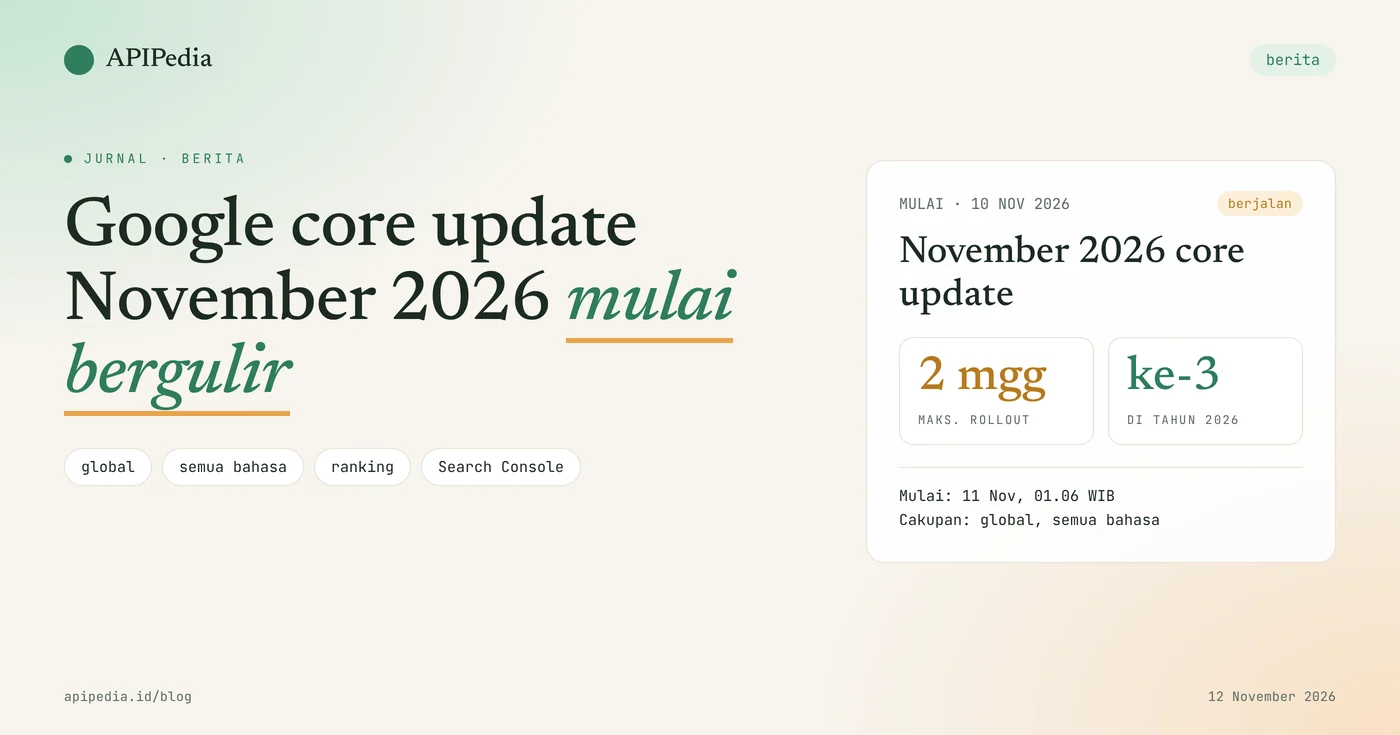
Google released the November 2026 core update on November 10, 2026 at 10.06 Pacific time (November 11, 01.06 WIB), valid globally for all languages, with a rollout that could take up to two weeks. This is the third core update this year after March and May, and for Indonesian language sites this means positions in search results may fluctuate until around November 24.
This article summarizes what Google has confirmed, what it doesn't know, and a reasonable sequence of steps for site owners, content teams, and developers managing a business website.
Quick summary
| Items | Details |
|---|---|
| Official name | November 2026 core update |
| Start | November 10, 2026, 10.06 Pacific time (November 11, 01.06 WIB) |
| Long rollout | Up to 2 weeks according to Google |
| Coverage | Global, all languages, including Indonesian |
| Who is affected | Google Search ranking system |
| Order in 2026 | Third core update (after March and May) |
| Status as of November 12 | Still running, no further updates on the status dashboard yet |
What happened?
Google noted an incident titled "November 2026 core update" in the Search Status Dashboard on November 10, 2026, with the affected service "Ranking". The note states that this update applies globally and for all languages, and rollout could take up to two weeks.
Google describes it as regular updates designed to display content that is relevant and satisfying to searchers on all types of sites. Google doesn't mention the specific types of sites, topics or techniques it targets.
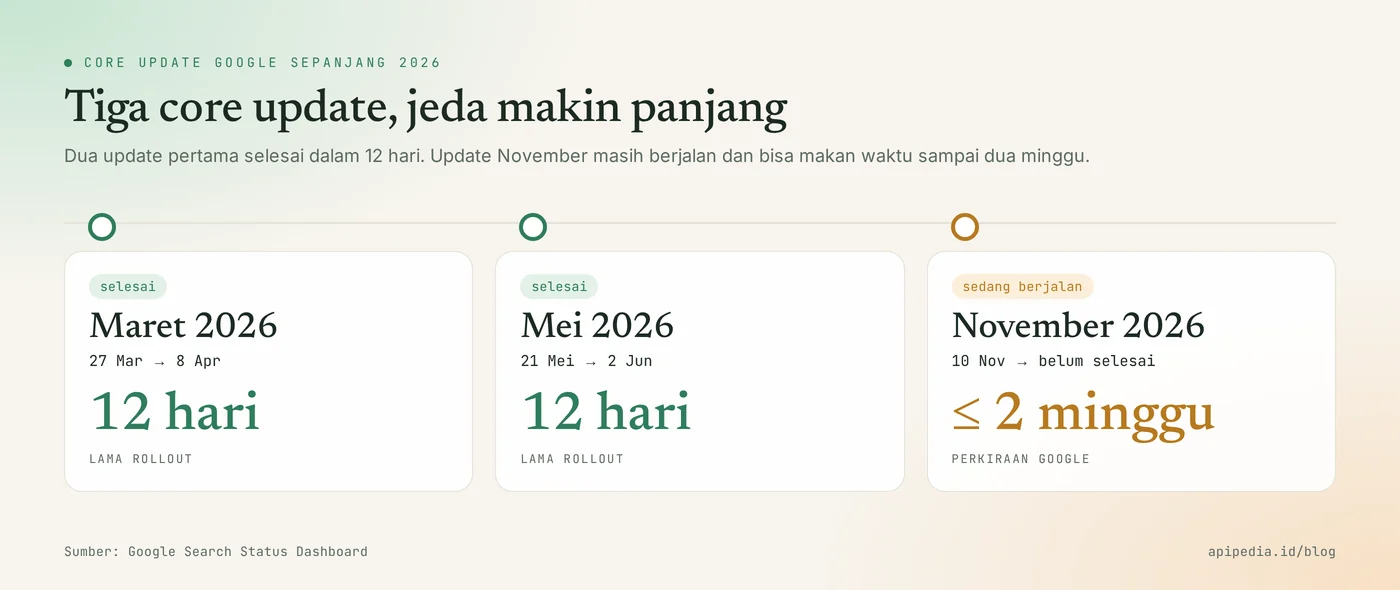
- March 2026: March 27 to April 8.
- May 2026: May 21 to June 2.
- November 2026: starting November 10, not yet finished.
The gap from the May to November update was more than five months, much longer than the gap from March to May.
What is a core update?
Core updates are broad changes to Google's ranking system that are released several times a year, not penalties for specific sites. Google documentation confirms the core update does not target individual sites or pages.
- The system reassesses content across the web, so the order of search results can shift.
- A page going down isn't necessarily doing anything wrong; it could be that other pages are now considered more relevant.
- Google likens it to an updated list of favorite restaurants: a drop in rankings doesn't mean the restaurant is bad.
- Apart from the big updates that were announced, Google also carried out small core updates without announcements.
Why is this update important?
This update is important because it coincides with the year-end shopping season, when search traffic is most valuable for online businesses. If the rollout runs for the full two weeks, the ranking shift will last until around November 24.
- Fact: rollout starts November 10 and according to Google could take up to two weeks.
- Fact: Google has not announced a completion date or details of the changes.
- Analysis: for Indonesian e-commerce players, this period falls between 11.11 and 12.12, so changes in organic traffic can be felt directly in sales.
- Analysis: data from the early days of the rollout cannot yet be used as a basis for decisions, because positions can still reverse before the update is complete.
What impact will this have on sites in Indonesia?
All Indonesian language sites are included because the update applies to all languages at once, without stages per country. The magnitude of the impact is different for each site and can only be assessed after the rollout is complete.
- Digital business owners and online stores: search traffic can go up or down; prepare other channels (ads, email, social media) for year-end campaigns.
- Publishers and bloggers: information pages are usually the most visible; monitor per page, not just site totals.
- Developers and IT admins: make sure the downgrade is not due to a technical problem such as a server error, slow page, or
robots.txterror, before concluding that the cause is a core update. - Content team: hold off on major overhaul; Note the pages that change position as evaluation material.
What do you need to do now?
While the rollout is running, what needs to be done is to record and monitor, not overhaul. Google recommends waiting at least a full week after the core update is complete before analyzing data in Search Console.
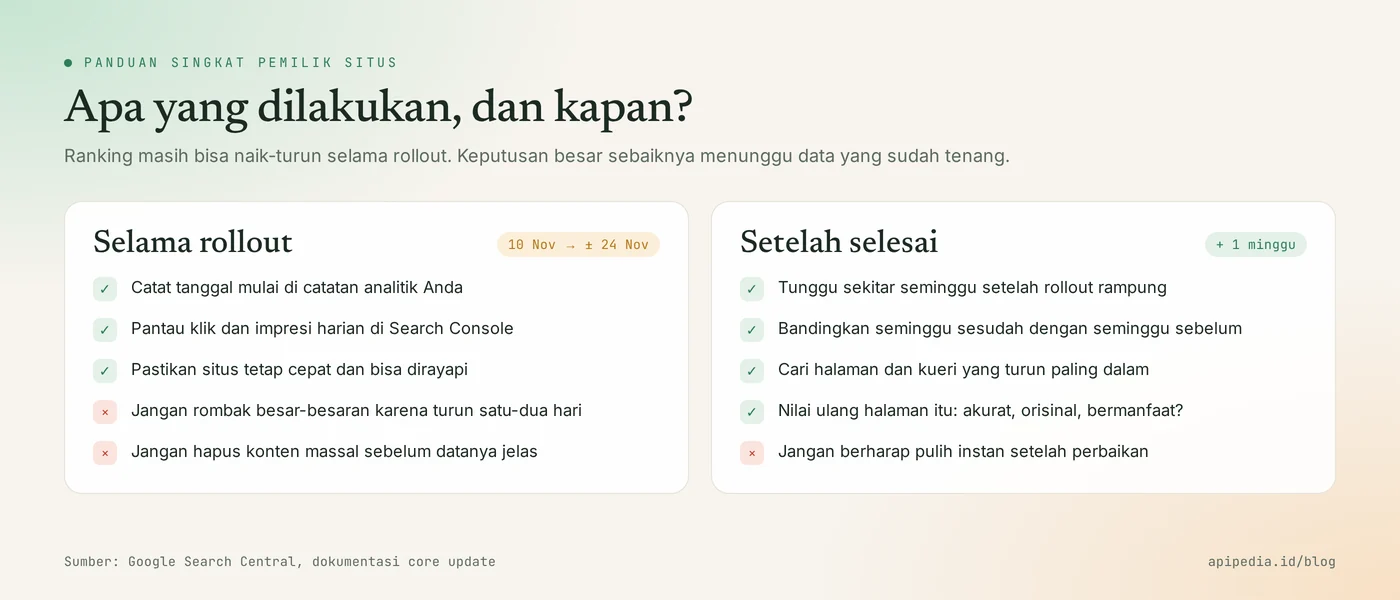
- Note the start date. Mark November 10, 2026 in the analytics log so that chart changes are easy to track.
- Check technical health. Make sure important pages reply to status 200 and are not blocked by crawling.
- Keep track of completion dates. View the Search Status Dashboard until Google marks the rollout as complete.
- Wait a week, then compare. In Search Console, compare one week after the update finished to one week before the update started.
- The value of the decrease is large. A small drop, for example from 2nd to 4th position, does not require drastic action. Big drops and holds require thorough evaluation.
- Improve it from the reader's side. Review the most impacted pages: are they accurate, original and genuinely helpful? Deleting content is a last resort.
Quickly check the status of important pages from the terminal:
for u in https://contoh.co.id/ https://contoh.co.id/produk https://contoh.co.id/blog; do
  curl -s -o /dev/null -w "%{http_code}  %{time_total}s  $u\n" "$u"
done
curl -s https://contoh.co.id/robots.txt | head -20
Regarding recovery, Google stated that some improvements can be seen within a few days, but the system can take several months to confirm that a site is indeed improving. There is no guarantee that the position will return to its original position.
Frequently asked questions
When will the November 2026 core update be finished?
Google has not announced a completion date. The official estimate is up to two weeks from November 10, 2026, so around November 24; The previous two core updates in 2026 were each completed in 12 days.
Are Indonesian language sites affected?
Yes. Google stated that this update applies globally and to all languages, so Indonesian language search results are included.
My traffic is down since November 11, is my site penalized?
Not necessarily. The core update is not a penalty and does not target specific sites. Check for possible technical issues first, then wait for the rollout to complete before drawing conclusions.
Do you need to delete or rewrite content now?
No need to rush. Google advises against changing content that is performing well just because of a minor decline, and calls removing content a last resort.
How long does it take for the ranking to recover after the repair?
There are no exact numbers. According to Google, results can appear in a few days or take several months, and sometimes they are only visible in the next core update.
Also read: Google's EEAT: meaning, how it works, and a practical checklist and how to opt-out of AI training via robots.txt.
Source
Topics: #berita #seo #google #core update #search console #bisnis digital
${c.about}
Tim APIPedia — Tim Engineering APIPedia
Tim engineering di balik APIPedia yang membangun dan memelihara API data Indonesia - ongkir, OCR KTP, data wilayah, BMKG, hingga server MCP - dan menulis panduan integrasinya dari pengalaman langsung.