Kimi K3.1 Pro: Open-Weights Promised Today, Here's How to Try It
By Tim APIPedia, Tim Engineering APIPedia · Published · Updated · 8 min read
The MoE 2.8T Moonshot model sticks to the Claude Opus 5.5 on Terminal-Bench at $2/$10. Here are the specifications, pricing, self-host requirements, and sample API code.
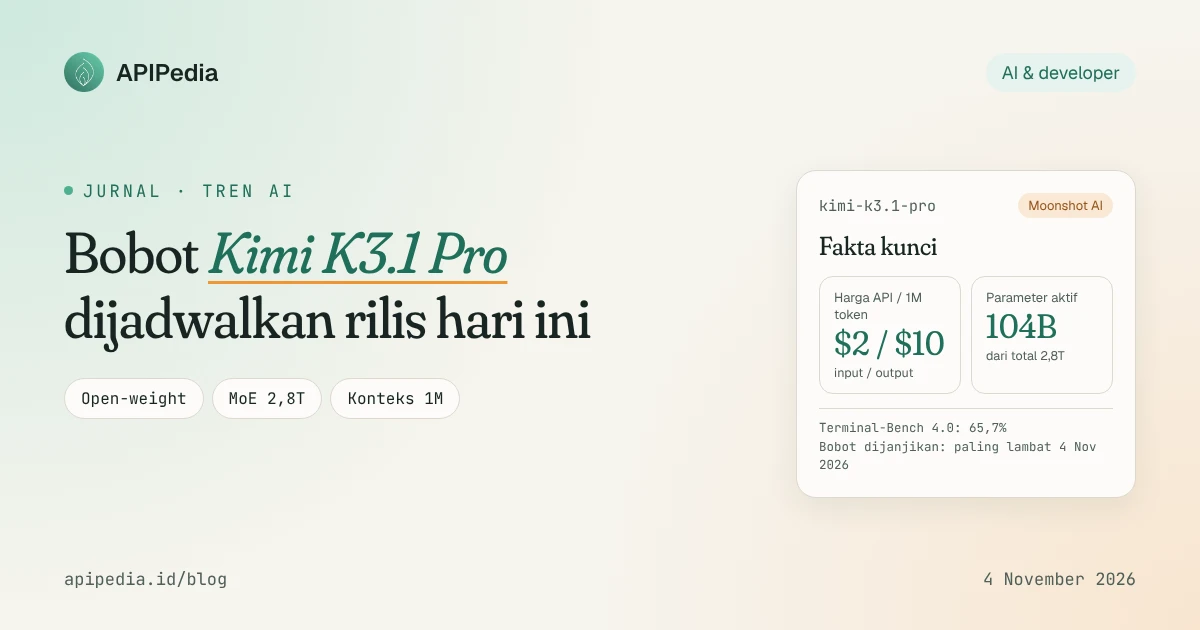
Kimi K3.1 Pro is the latest open-weight AI model from Moonshot AI, an advanced post-training result of Kimi K3 (Mixture-of-Experts 2.8 trillion parameters, context 1 million tokens). The model has been usable via API since the end of October, and Moonshot promises to release the full weight by today, November 4, 2026.
Why so many? Because in several agent and coding benchmarks, the scores reported by Moonshot adhere to a high-end closed model, even though the API price is only $2 per million input tokens. Once the weight is open, anyone with enough infrastructure can run it themselves.
This article summarizes what's new, the key numbers, comparisons to alternatives, and how to try it today.
What exactly is new in Kimi K3.1 Pro?
K3.1 Pro does not change the K3 architecture. According to Moonshot, the change is in training: post-training compute is much larger, with shared reinforcement learning across “hundreds of downstream domains.” The results are claimed to be felt in long-term coding, agent tasks, 3D workflows, and financial research.
- Model base: Kimi K3, MoE 2.8T total parameters with 104B active parameters per token.
- Context: 1,048,576 tokens (1M), shared for input and output.
- Multimodal input: images and videos can be input; the model does not produce video.
- Always "thinking": reasoning mode cannot be turned off. The effort level is
low,high, ormax(defaultmax). - Two variants:
kimi-k3.1-proandkimi-k3.1-pro-highspeedwhich are claimed to be 2–3 times faster. - Hallucinations down: in the Kimi Hallu Bench Hard internal test, the claim-level hallucination rate fell from 23.4% (Q3) to 8.3%.
Regarding the release date, sources differ slightly: some say October 23, 2026 (the day the API and application go live), while the Moonshot research index notes the announcement on October 24. This discrepancy is likely due to time zones and differences between the router listing and the official announcement.
How much stronger is it compared to the closed model?
Moonshot published a benchmark table comparing the K3.1 Pro with Claude Opus 5.5 and GPT-6 Astra. The results were mixed: excelling at some agent tasks, lagging far behind at others.
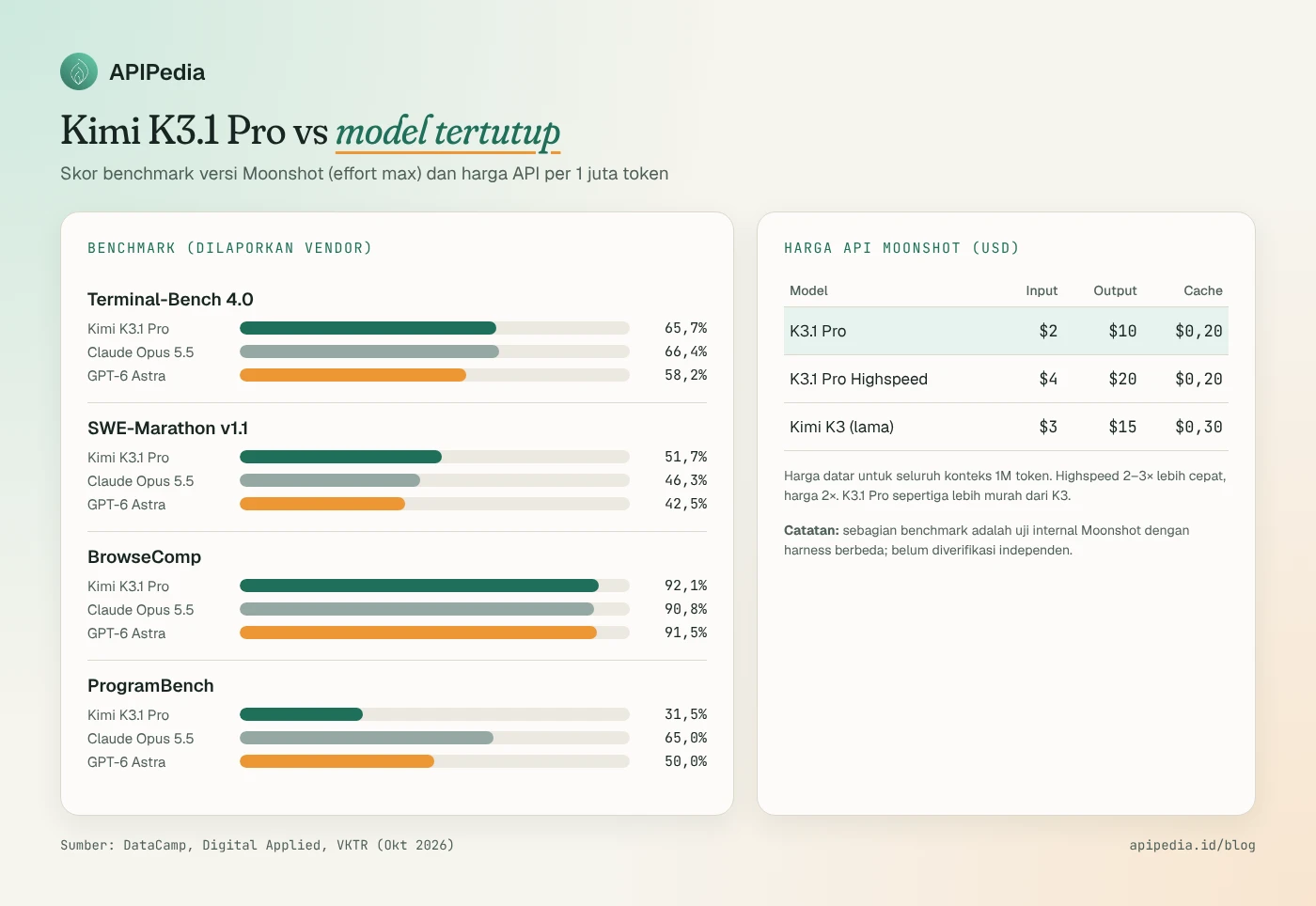
| Benchmark (effort max) | Kimi K3.1 Pro | Claude Opus 5.5 | GPT-6 Astra |
|---|---|---|---|
| Terminal-Bench 4.0 | 65.7% | 66.4% | 58.2% |
| SWE-Marathon v1.1 | 51.7% | 46.3% | 42.5% |
| DeepSWE v1.1 | 75.5% | 74.2% | 74.1% |
| BrowseComp | 92.1% | 90.8% | 91.5% |
| OSWorld V2.1 | 79.6% | 81.8% | 75.8% |
| ProgramBench | 31.5% | 65.0% | 50.0% |
| HLE-Diamond | 39.4% | 60.9% | 65.8% |
| GPQA-Diamond | 94.2% | 93.9% | 96.1% |
Two important notes before getting too excited:
- Here are the vendor numbers. Some are internal tests of Moonshot with different harnesses (e.g. Terminal-Bench 4.0 run with a Claude Code harness), and have not been independently verified. Simon Willison notes that K3.1 Pro is in the top ranks of the Artificial Analysis index, but it is also not a Moonshot table verification.
- Hallucination rates were inconsistent between documents. The launch post says 23.4% → 8.3%, while the API quickstart says 23.35% → 6.85%. Moonshot itself calls this test a stress test, not an everyday error rate.
How much does it cost and why is it interesting?
The K3.1 Pro is a third cheaper than the K3 on all tariffs. The price is flat for the entire 1M token context window, with no long context surcharges.
| Model | Inputs / 1M | Output / 1M | Cache input | Write cache (5 min / 1 hour) |
|---|---|---|---|---|
| kimi-k3.1-pro | $2.00 | $10.00 | $0.20 | $2 / $4 |
| kimi-k3.1-pro-highspeed | $4.00 | $20.00 | $0.20 | $4 / $8 |
| kimi-k3 (old) | $3.00 | $15.00 | $0.30 | $3 / $6 |
API access requires a minimum top-up of $1, and the total top-up determines the tier rate limit. Zero Data Retention is available for API customers, a relevant point if you process customer data.
What about “reduced cyber capabilities”?
This is the most interesting part policy-wise. For the open-weight release, Moonshot removed cybersecurity-related data from the mid-training corpus and cyber assignments from the RL environment. General coding is maintained.
The impact was measurable in the xdev-bench-hard (pass@3) internal exploit benchmark: the unfiltered checkpoint completed 90.5%, the released version 81.0%, and Q3 only 33.3%. This means the K3.1 Pro remains much stronger than its predecessor on this front, just "braked" a bit. Moonshot said it does not want to release weights that push the absolute limits of offensive cyber capabilities, and plans to increase them gradually.
When can the weights actually be downloaded?
Moonshot promise: "no later than November 4, 2026". Per the last check of the sources we read (October 27 to November 1), the K3.1 Pro repository has not appeared in the moonshotai organization on Hugging Face, and the license has not been announced. K3 previously used a special license (Kimi K3 License) with commercial terms, so don't assume K3.1 Pro is automatically Apache or MIT licensed.
The signals from the ecosystem are quite strong: a number of infrastructure providers such as Capital have already announced "Day 0" support for this week. You can monitor it yourself via the Hugging Face public API:
# Daftar model terbaru dari organisasi moonshotai di Hugging Face
curl -s "https://huggingface.co/api/models?author=moonshotai&sort=lastModified&direction=-1&limit=5" \
  | python3 -c "import sys,json; [print(m['id'], m.get('lastModified','')) for m in json.load(sys.stdin)]"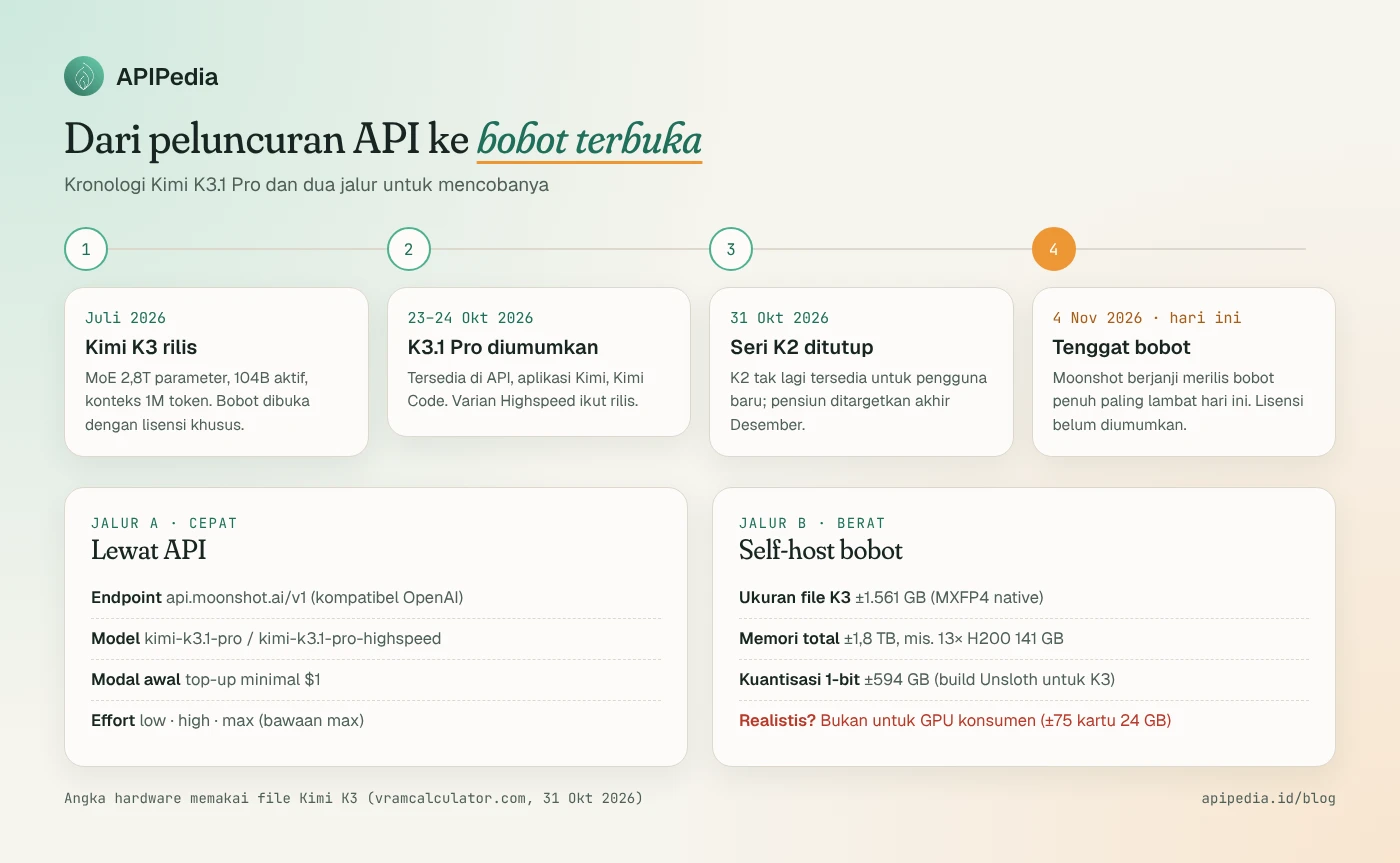
Can it be run alone (self-hosted)?
Yes, but realistically only for teams with large GPU clusters. The hardware specifications of the K3.1 Pro are not yet official, so the numbers below use the measured Kimi K3 files (same base):
- MXFP4 native format: approximately 1,561 GB, or ±4.46 bits per parameter.
- Total resident memory: about 1.8 TB including KV cache and overhead, for example 13× H200 (141 GB).
- Moonshot recommendation for K3: supernode configuration with 64 or more accelerators due to communication bandwidth requirements.
- Aggressive quantization: Unsloth's 1-bit build for K3 (UD-IQ1_S) is about 594 GB, still needs ±683 GB of memory.
- Consumer GPU: need about 75 24 GB cards for full residency. Offload to system RAM is estimated at only ±0.86 tokens/second.
For most Indonesian developers, the practical value of open weights is not running them on laptops, but rather: a greater choice of inference providers (competitively priced), on-premise options for sensitive data in large enterprises, and fine-tuning freedom for research labs.
How do I try it now via API?
Moonshot endpoints are compatible with OpenAI formats, so any SDK you already use can be directed to them directly. Store the key in environment variable MOONSHOT_API_KEY.
Quick test with curl
curl -s https://api.moonshot.ai/v1/chat/completions \
  -H "Authorization: Bearer $MOONSHOT_API_KEY" \
  -H "Content-Type: application/json" \
  -d '{"model":"kimi-k3.1-pro","reasoning_effort":"low","messages":[{"role":"user","content":"Jelaskan MoE dalam 2 kalimat."}]}'
Python with OpenAI SDK
import os
from openai import OpenAI

client = OpenAI(
    api_key=os.environ["MOONSHOT_API_KEY"],
    base_url="https://api.moonshot.ai/v1",
)

resp = client.chat.completions.create(
    model="kimi-k3.1-pro",
    reasoning_effort="high",  # low | high | max (bawaan: max)
    messages=[
        {"role": "system", "content": "Kamu reviewer kode yang teliti."},
        {"role": "user", "content": "Review fungsi ini dan cari bug-nya: ..."},
    ],
)
print(resp.choices[0].message.content)
Some pitfalls from the Moonshot documentation to be aware of:
- Don't send
temperature,top_p, or penalty. The values are locked (temperature 1.0, top-p 0.95); remove from request. max_completion_tokensdefault 131,072, upper limit 1,048,576. Because the model is always thinking, token reasoning is also calculated.- Tool calling: when the tool loops, returns the complete assistant message, including the reasoning content.
- Images: Public image URLs are not accepted; use base64 or uploaded file reference.
- The built-in web search (Formula tool) is currently being updated and is not yet recommended for production.
Moonshot also provides an Anthropic compatible endpoint ( https://api.moonshot.ai/anthropic), so that tools such as Claude Code can be directed to Kimi via variable ANTHROPIC_BASE_URL. Via OpenRouter, the model ID moonshotai/kimi-k3.1-pro.
How does it stack up compared to other open-weight models?
The giant open-weight wave is rushing. Last week we covered the open-weight Mistral Large 4, and on the coding agent side there was the DeepSeek Super-Agent. Compared to DeepSeek-V4.1-Flash-1017, the Moonshot table shows the K3.1 Pro far ahead on Terminal-Bench 4.0 (65.7% vs 42.3%) and Kimi Hallu Bench (5.4% vs 13.1%, the lower the better), but narrowly losing on DeepSWE v1.1 (75.5% vs 77.0%).
If you are building a product on several models at once, a router pattern like in the chat router article with the OpenAI Decisions API can be used to send cheap tasks to K3.1 Pro and hard tasks (e.g. ProgramBench-style) to other models.
FAQs
Is Kimi K3.1 Pro free?
In the Kimi app it is available to users, but API access is paid ($2/$10 per million tokens, minimum top-up $1). The weight will be free to download, with licensing terms yet to be announced.
Is the weight on Hugging Face yet?
Per the sources we read (as of November 1), not yet. The deadline is today, November 4 2026. Use the curl command above to check immediately.
What is the difference between K3.1 Pro and K3.1 Pro Highspeed?
The same model with 2–3 times higher speed, twice the price per token. Highspeed does not have separate benchmark results.
Can it run on one GPU?
Not realistic. Even the K3's 1-bit quantization requires about 683 GB of memory. For experiments, use APIs or third-party inference providers.
Is it safe to use customer data?
Moonshot offers Zero Data Retention for API customers. Please always check the privacy policy, data processing location and PDP Act obligations before sending personal data.
Source
- DataCamp: Kimi K3.1 Pro, Benchmarks, Pricing, and How to Access It
- Digital Applied: Kimi K3.1 Pro Prices, Capabilities and Weight Release
- VKTR: Kimi K3.1 Pro Nears Top Proprietary Models as Moonshot Limits Its Cyber Skills
- Let's Data Science: Moonshot Releases Kimi K3.1 Pro API, Open Weights Due Nov 4
- AI Wiki: Kimi K3.1 Pro
- VRAM Calculator: Kimi K3.1 Pro VRAM Requirements
- ComputingForGeeks: Kimi K3.1 Pro API Setup
Topics: #ai #kimi #open-weight #llm #moonshot-ai
${c.about}
Tim APIPedia — Tim Engineering APIPedia
Tim engineering di balik APIPedia yang membangun dan memelihara API data Indonesia - ongkir, OCR KTP, data wilayah, BMKG, hingga server MCP - dan menulis panduan integrasinya dari pengalaman langsung.