LangChain Raises $300 Million at $3 Billion Valuation: What This Means for AI Agent Developers in Indonesia
By Tim APIPedia, Tim Engineering APIPedia · Published · Updated · 8 min read
LangChain announces $300M Series C led by CapitalG, $3B valuation. Here are the facts, LangSmith's direction, and what it means for Indonesian developers.
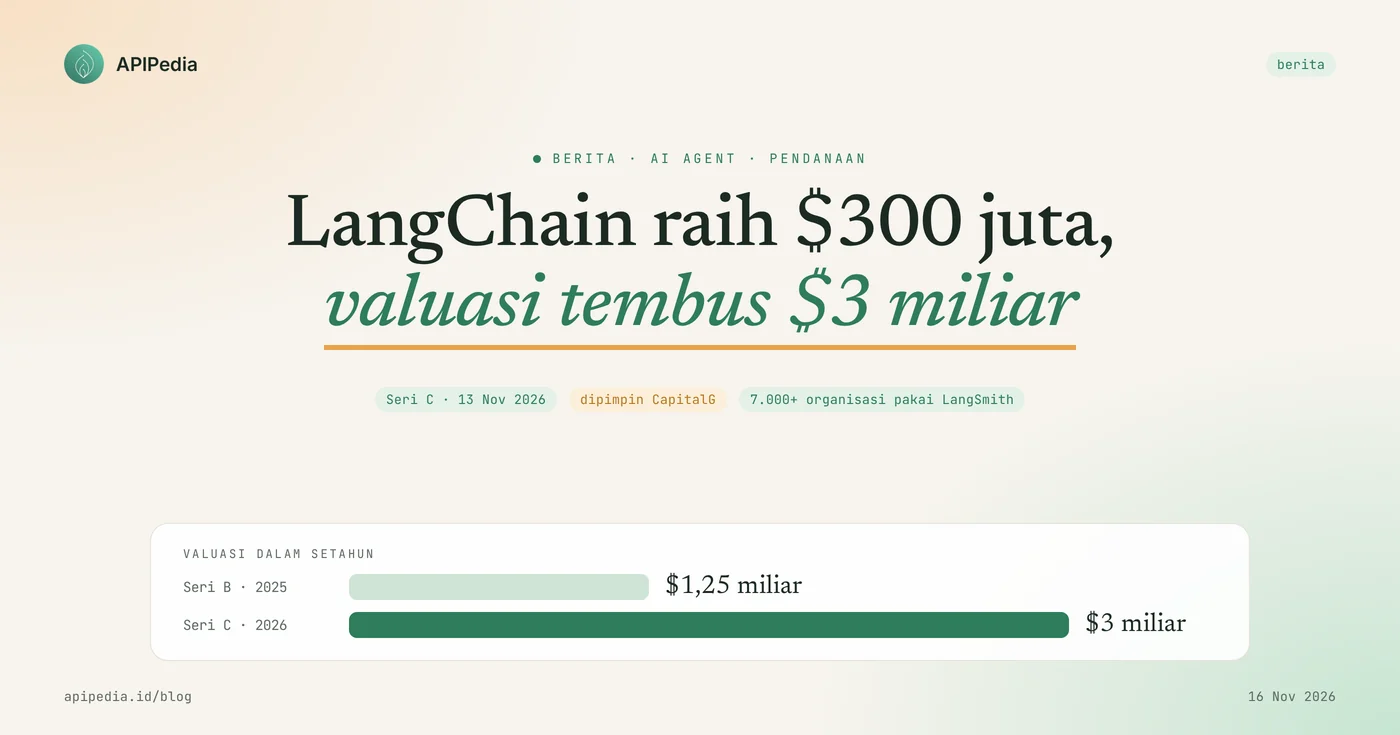
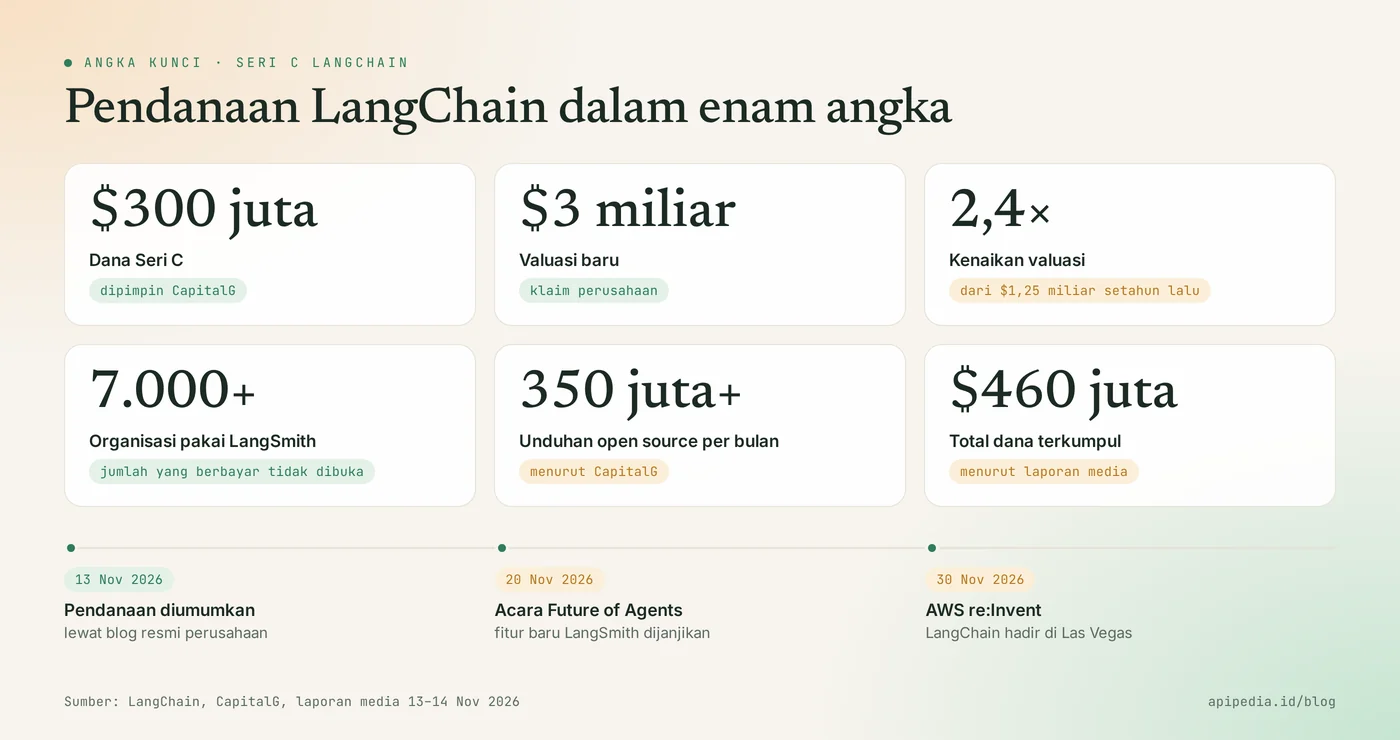
LangChain, the company behind the open source AI agent frameworks LangChain and LangGraph, announced a $300 million Series C funding round at a $3 billion valuation on November 13, 2026. The round was led by CapitalG, Alphabet's growth fund, and joined by new investors such as GIC and DFJ Growth. The valuation is up about 2.4 times from $1.25 billion in the previous round, about a year ago.
This news is important for those of you building chatbots, customer service agents, or internal automation on top of LangChain or LangGraph. That amount of funding shows where the product is headed: from just a framework to a paid platform for running, improving, and managing agents. This article summarizes the facts, separates what is certain from what is still being analyzed, and then explains what you should do.
Quick summary
| Items | Details |
|---|---|
| Incident | LangChain Series C funding, announced November 13, 2026 |
| Mark | $300 million, $3 billion valuation |
| Round leader | CapitalG (old investor) |
| Other investors | GIC, DFJ Growth, IVP, Sapphire Ventures, Salesforce Ventures, Insight Venture Partners, QuantumLight, MongoDB Ventures, Sequoia, Amplify, Benchmark |
| Previous round | $125 million Series B, $1.25 billion valuation, about a year ago (according to media reports) |
| Main product | LangSmith, a platform for running, improving, and managing AI agents |
| User | More than 7,000 organizations use LangSmith (company claims) |
| Next on the agenda | "Future of Agents" release event on November 20, 2026 |
What did LangChain announce?
LangChain announced three things: $300 million in new funding, a $3 billion valuation, and confirmation that LangSmith is its core product. The announcement was made by the CEO and one of the founders, Harrison Chase, via the company's official blog.
The list of investors is long. CapitalG took the lead, GIC and DFJ Growth entered as new investors, while IVP and Sapphire Ventures joined again. The company also named Salesforce Ventures, Insight Venture Partners, QuantumLight, and MongoDB Ventures, as well as Sequoia, Amplify, and Benchmark adding to their share.
There are some things that are not opened. The company did not break down its use of funds, did not mention revenue, and did not say how many of its more than 7,000 organizations were paying customers. The announcement also did not contain any new promises regarding open source licensing or price changes.
Supporting figures from other parties
The following two figures come from outside the official announcement, so please treat them as related party claims. CapitalG said the LangChain open source project had exceeded 350 million downloads per month. Media reports calculate the total funds raised since the company was founded in 2022 at around $460 million.
What is LangSmith and why is it at the center of the story?
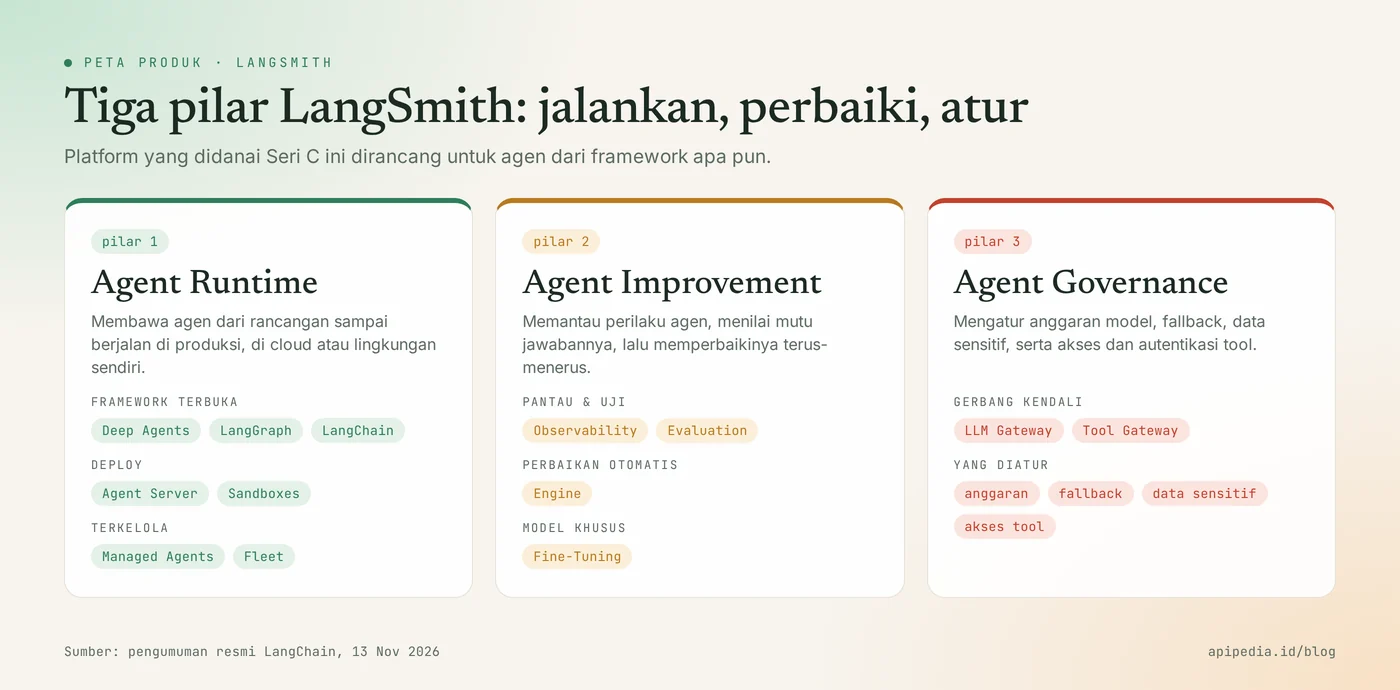
LangSmith is LangChain's commercial platform for running, improving, and managing AI agents, and it is this platform that is the main reason investors come in. LangChain calls it "framework-agnostic", meaning it can be used for agents built with any framework, not just LangChain.
The company divides LangSmith into three pillars:
- Agent Runtime: the path from agent design to production. It contains open frameworks (Deep Agents, LangGraph, LangChain), Agent Servers and Sandboxes for deploying in the cloud or your own environment, as well as Managed Agents and Fleet for fully managed pathways.
- Agent Improvement: Observability and Evaluation to monitor behavior and assess quality, Engine which looks for errors and then writes code improvements and prompts, and Fine-Tuning which converts agent work traces into special model training data.
- Agent Governance: LLM Gateway and Tool Gateway to manage model budgets, fallback behavior, sensitive data protection, and tool access and authentication.
As proof of use, LangChain mentions the names Harvey, Rippling, Listen Labs, NVIDIA, Toyota, and Salesforce. Clay is said to monitor hundreds of millions of agent executions per month via LangSmith. Workday is said to have cut the deployment time for a new agent from five months to less than a day. All these figures are company claims and have not been audited by an independent party.
Why is this funding important?
This funding is important because it marks a shift in value in the AI agent industry: from creating agents to operating them. The following section is an analysis, not an official company statement.
- Investors are betting on operations. Creating an agent demo is now easy. What's difficult is ensuring agents remain correct, economical, and secure while serving thousands of users. LangSmith's three pillars target exactly that problem.
- The competition is stiff. Agent monitoring is also carried out by Langfuse, Arize, and Braintrust. On the framework side there are LlamaIndex and CrewAI. Large model providers such as OpenAI, Anthropic, and Google also have their own agent tools.
- The "neutral" position is a selling point. LangChain offers freedom of choice of model and infrastructure. For companies that don't want to be locked into a single vendor model, this is a strong argument.
- The risk remains. High valuations demand high earnings. The pressure is usually felt around the limits of the free plan, price, or features that are only available in the paid version. As of now no such changes have been announced.
What is the impact on developers and businesses in Indonesia?
For developers and businesses in Indonesia, the immediate impact is small today, but the direction of the product influences your architecture decisions six to twelve months into the future.
- The framework you use has a long history. The new funding reduces the risk of this open source project being abandoned. This is good news for teams that have already invested in LangGraph.
- Costs in dollars need to be calculated. LangSmith is billed in US dollars. For startups and digital MSMEs, observability costs can increase with the number of agent executions, especially when exchange rates weaken.
- Agent traces often contain personal data. Trace contains the contents of user conversations, telephone numbers, addresses, even NIK. When sent to services overseas, you need to weigh this against your PDP Act obligations. The deploy in own environment option is relevant here.
- New features are coming fast. The November 20 release event could bring API or feature changes. Teams that lock down dependency versions will have more peace of mind.
What do you need to do now?
You don't need to change anything today, just take these five small steps to be ready for change.
- Dependency version lock. Make sure
langchain,langgraph, and related packages use fixed versions atrequirements.txtorpackage.json, not the "latest" versions. - Separate the business logic from the framework. Wrap model and tool calls in your own functions. If one day the framework is moved, only the thin layer will be replaced.
- Check the contents of the trace. See what data is sent to the monitoring service. Disguise personal data before sending, and note where it is stored.
- Set a model budget limit. Agents that spin endlessly can use up tokens in a matter of hours. Set daily limits and alarms, no matter what platform you use.
- Look for a November 20 release. Read the release notes before upgrading, and test in a staging environment first.
Frequently asked questions
Will LangChain and LangGraph remain free?
Yes, until now both of them remain open source projects that are free to use. The funding announcement made no mention of licensing changes. What is paid is LangSmith as a platform, especially for team and enterprise scale use.
Do I have to use LangSmith if I use LangChain?
No. LangChain and LangGraph can run without LangSmith. On the other hand, LangSmith can also be used for agents built with other frameworks.
What will the $300 million be used for?
The company didn't elaborate. What was conveyed was only the big direction: strengthening LangSmith, with a mission so that every company can "own its own intelligence." Details of the new features are promised at the November 20, 2026 event.
Will LangSmith prices increase?
There has been no announcement about that yet. Concerns about rising prices are a reasonable analysis of highly valued companies, not fact. The safest way is to design the system so that it is not completely dependent on a single service.
What's the difference between LangChain, LangGraph, and LangSmith?
LangChain is a library for connecting models, prompts, and tools. LangGraph is a framework for branching, stateful agent flows. LangSmith is a platform for running, monitoring, testing, and managing such agents in production.
Also read on APIPedia: what is MCP and how it differs from API, how RAG and embedding work, the closure of OpenAI's Agent Builder and Evals on November 30, as well as LLMjacking and how to guard your AI API key.
Source
Topics: #berita #langchain #langsmith #agen ai #pendanaan #developer
About the author
Tim APIPedia — Tim Engineering APIPedia
Tim engineering di balik APIPedia yang membangun dan memelihara API data Indonesia - ongkir, OCR KTP, data wilayah, BMKG, hingga server MCP - dan menulis panduan integrasinya dari pengalaman langsung.