What is the System One Model? AI that Thinks Fast, Not Long Writing
By Tim APIPedia, Tim Engineering APIPedia · Published · 6 min read
The System One model is an AI that answers type decisions with probabilities, not text. Here's the origin of the term, its characteristics, and when it is used.
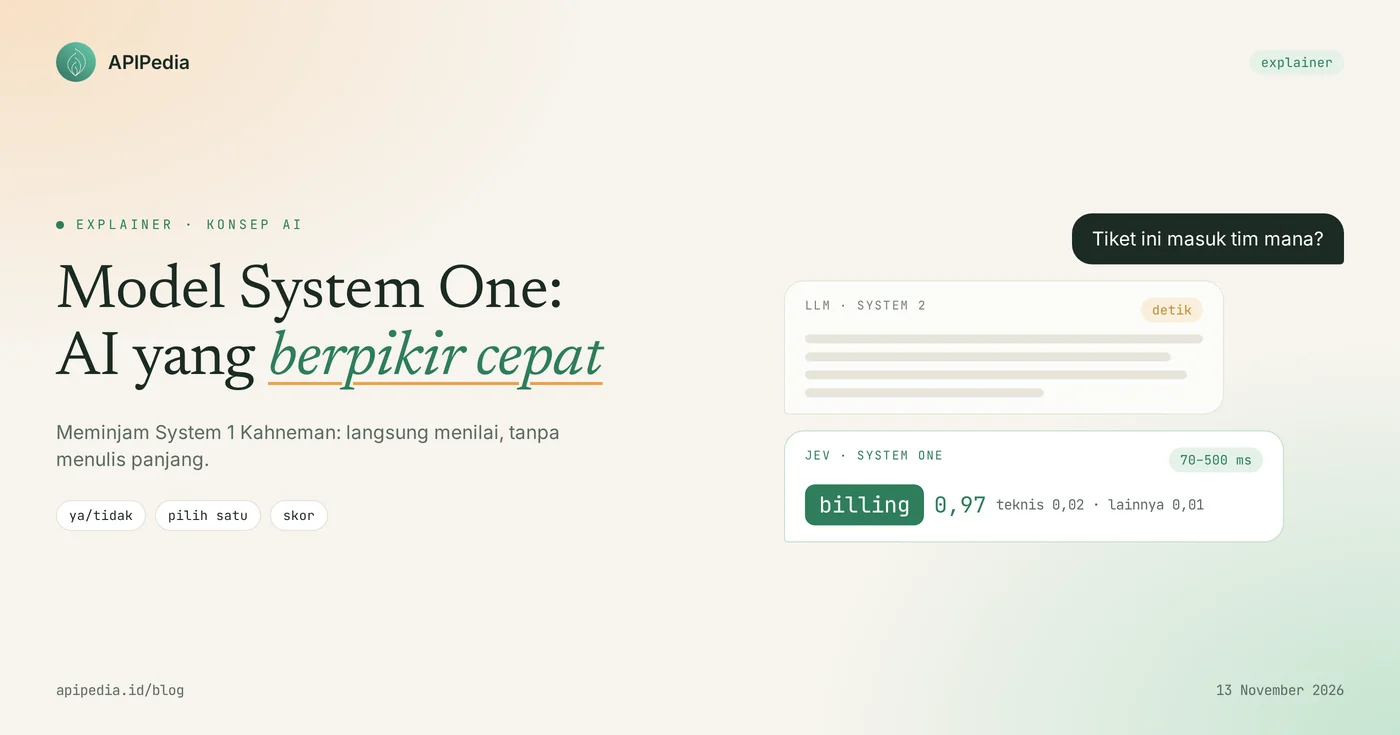
System One models are a class of AI models created specifically to make quick decisions (yes/no, pick one, or give a score) and then return the answers as data of type with probabilities, rather than as sentences. This term was introduced by TypeSafe AI when it released Jev on September 15, 2026, and the name borrows the concept of "System 1" from psychologist Daniel Kahneman.
This concept emerged because many applications use LLM for tasks that are actually simple: sorting tickets, filtering comments, or determining which model should answer a prompt. This article explains the origin of the term, the characteristics of the System One model, when it is suitable to use, and when it is not.
Quick summary: what is the System One model?
In short, the System One model is a fast decision-making AI whose answers are limited from the start.
| Items | Explanation |
|---|---|
| Origin of the term | Book Thinking, Fast and Slow (Daniel Kahneman): System 1 is fast and intuitive, System 2 is slow and thoughtful |
| Which is popularizing in AI | TypeSafe AI, via Jev model (release September 15, 2026) |
| Inputs | State (text, JSON, or array) + one or more question types |
| Outputs | Structured answers: yes/no, choice from a list, or score, each with probability |
| Can't | Write free text, explain reasoning, or create code |
| Suitable for | Classification, routing, moderation, scoring, and fast checking in the software |
Where does the term System One come from?
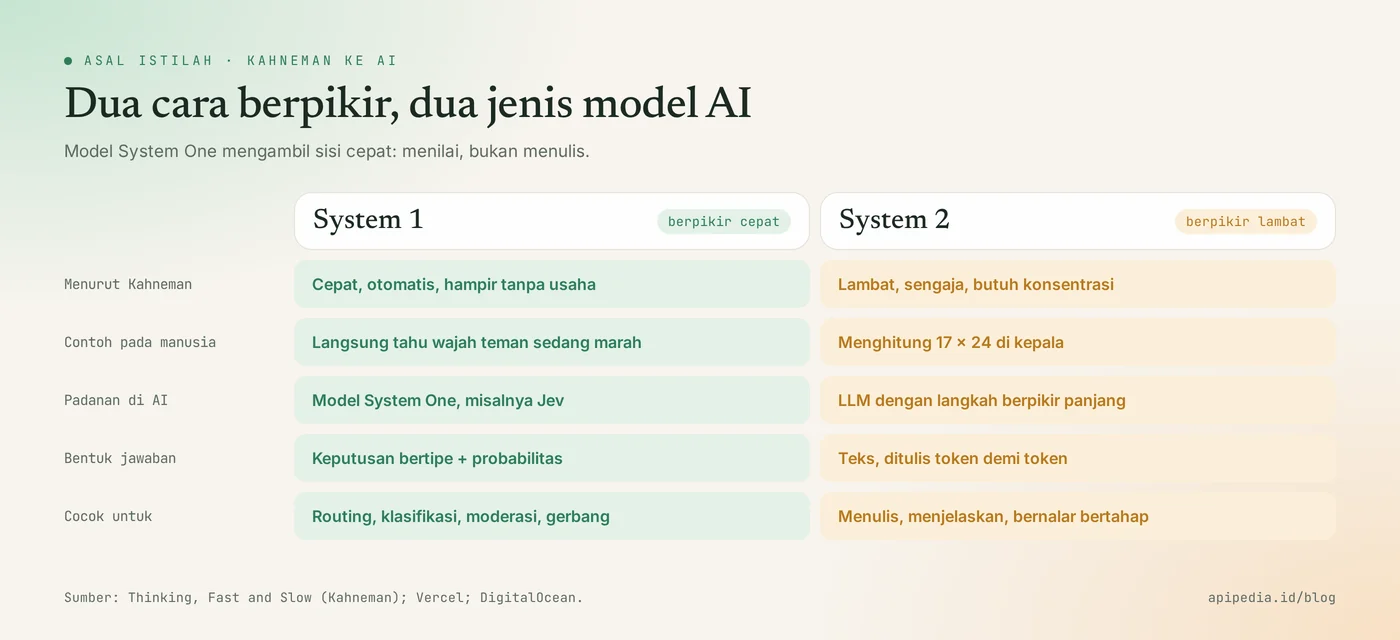
The term System One comes from the book Thinking, Fast and Slow (2011) by Daniel Kahneman, which divides human thinking into two. System 1 works quickly, automatically and almost effortlessly, for example when you immediately know that your friend's face is angry. System 2 works slowly and deliberately, for example when you calculate 17 × 24 in your head.
In the world of AI, modern LLMs that write chains-of-thought work in the style of System 2. TypeSafe uses the term System One for the opposite side: models that provide immediate, quick judgment. Vercel, one of the partners providing Jev, emphasized that for developers what is important is not the psychological analogy, but the form of the interface: questions with limited answer options.
What are the characteristics of the System One model?
The characteristics of the System One model are five, and they all differentiate it from a regular chatbot or LLM:
- Answer space is limited. The developer first determines the answer that can come out, for example
billing,teknis, orlainnya. Models cannot create new categories. - Output is of type, not text. The answer is a value that can be directly coded: a yes/no probability, a choice, or a score on a scale.
- There is a probability in each answer. Your code can set a threshold, for example only acting automatically if confidence is above 0.85.
- Several questions are answered at once. One state can be asked several things in one call, and according to the Vercel documentation each question is scored separately against the same state.
- The final decision remains in the hands of the application. Model only suggest. Thresholds, approvals, and actions are still set by your code.
Why is limited answer space important?
The limited answer space means that the output always matches the scheme, so there are no more cases of LLM answering "The category is probably billing, right, Sis!" which must be reparsed. But this only guarantees the form of the answer, not its correctness. Answers that are formatally valid can still misread the context, so they still need to be tested with labeled data before being used automatically.
How are System One models trained?
The System One model is trained so that the probabilities are honest, not so that the answers sound convincing. For Jev, TypeSafe mentioned three new things: a new model architecture, a parallel sampler instead of generating tokens one by one, and a training method called RLCD (Reinforcement Learning for Calibrated Decisions). RLCD is different from RLHF in that it trains a model so that the answer is liked by humans. The target: if the model says it is 80% sure, the answer should be correct about 80% of the time. This property is called calibration, and we discuss it in more depth in the article what is a decision model.
When is the System One model suitable for use?
This type of model is suitable for repeated decisions where the answer can be determined in advance, especially when the volume is large or a fast response is required. Example in the Indonesian application:
- Customer service: sort WhatsApp tickets or emails to billing, technical or shipping teams.
- Moderation: flag store comments or reviews that need human review.
- AI model router: determines whether a prompt can be answered by a small, cheap model or should be forwarded to a large LLM.
- AI agent checking: checks whether the agent's work results comply with the rules before being sent to the user.
- Mass scoring: prioritize thousands of leads or applications.
When is it best to stick with a regular LLM?
Stick with generative LLM when you need text: replying to a customer, summarizing a document, explaining why, or writing code. The System One model is also less suitable if the answer choices cannot be determined in advance, or if the decision requires long, gradual reasoning. A frequently used pattern is to combine the two: the System One model filters and sorts, the LLM writes the answers. A complete comparison is in the article differences between Jev and regular LLM.
Frequently asked questions
Is System One a product name?
No. System One is the name of the model category used by TypeSafe AI. The first product is Jev. The API endpoint also uses this name, namely /v1/systemone, and the same format is now used by several other providers.
Can the System One model hallucinate?
This model cannot create answers outside of the choices you specify. But he can still choose the wrong answer with confidence. Therefore the probability needs to be used as a threshold, and the results need to be tested with your own data.
Does the System One model replace the LLM?
No. This model takes over the decision work that LLM has been doing wastefully, while LLM is still used for writing, explaining and reasoning at length.
What does System One have to do with Jev?
The Jev is the first System One model to be released by TypeSafe AI. A complete explanation of Jev is in the article what is Jev.
Source
Topics: #ai #system one #model keputusan #jev #explainer #llm
About the author
Tim APIPedia — Tim Engineering APIPedia
Tim engineering di balik APIPedia yang membangun dan memelihara API data Indonesia - ongkir, OCR KTP, data wilayah, BMKG, hingga server MCP - dan menulis panduan integrasinya dari pengalaman langsung.