Apache Axis Vulnerability CVE-2026-90436: RCE Without Login in Confluence Data Center, Already Exploited
By Tim APIPedia, Tim Engineering APIPedia · Published · 10 min read
The Apache Axis 1.x vulnerability CVE-2026-90436 (CVSS 9.8) is exploited via Confluence Data Center and N-central. This is how to check, mitigate, and the safe version.
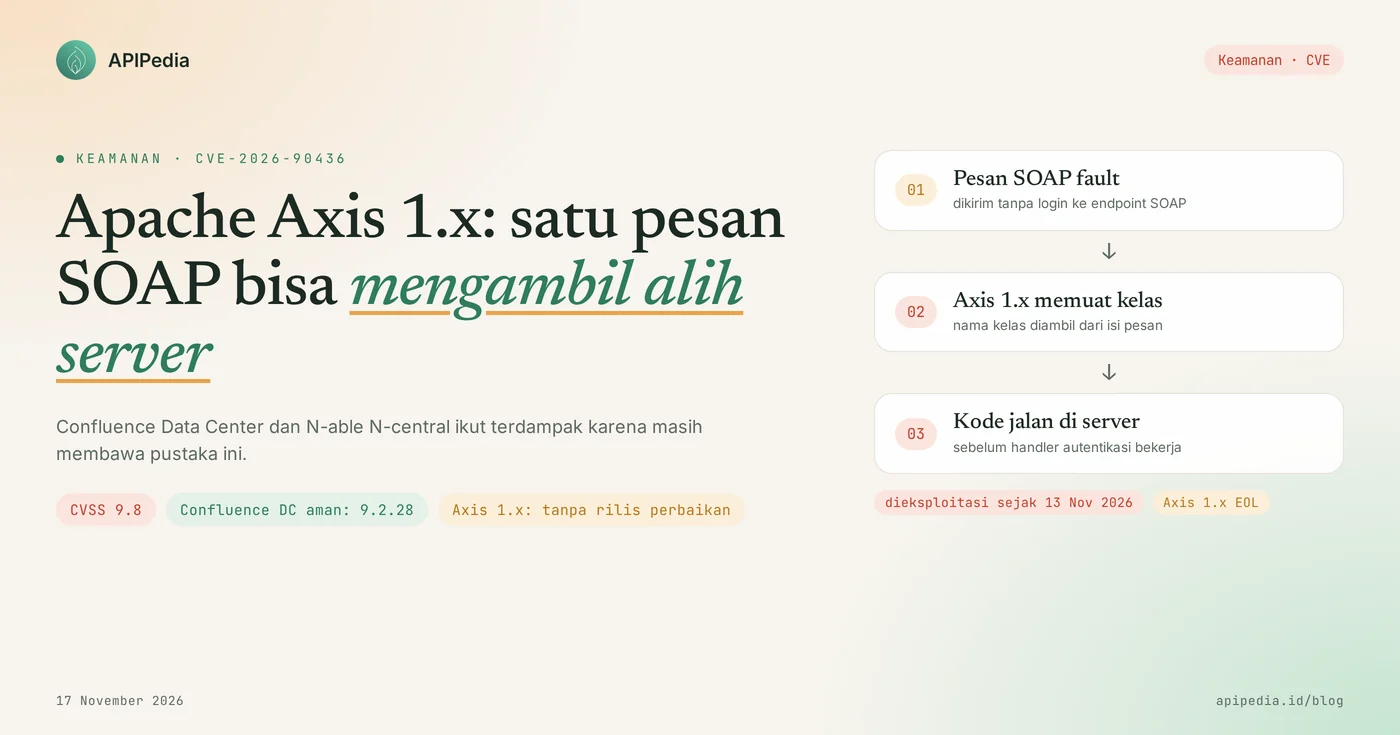
CVE-2026-90436 is a remote code execution vulnerability without login in Apache Axis 1.x, an end-of-life Java SOAP library, with a CVSS 3.1 score of 9.8. All versions of Axis 1.x through 1.4 are affected and there will be no fix release. Products that still carry this library are also exposed: Atlassian Confluence Data Center 1.x to 9.x (safe on 9.2.28) and N-able N-central. Exploits against both were detected on November 13, 2026.
This gap is important because Axis 1.x is rarely installed knowingly. These libraries are usually carried over into legacy Java applications, internal SOAP services, or vendor products. This article explains how it works, who is affected, safe versions, scripts to search for Axis 1.x on servers, mitigation steps in Confluence, and how to look for signs of a breach.
Quick summary
| Items | Details |
|---|---|
| CVE | CVE-2026-90436 |
| Product | Apache Axis 1.x (Java SOAP library, end of life) |
| Gap type | Unsafe class loading while processing SOAP fault message (CWE-470), resulting in code execution |
| Score | CVSS 3.1: 9.8 (critical), over network, no login, no user interaction. Atlassian rated 9.3 (CVSS 4.0) for Confluence |
| Impacted version | Axis 1.x to 1.4; Confluence Data Center 1.x to 9.x when Remote API is active; N-central on-premises when Legacy API is active |
| Safe version | Confluence Data Center 9.2.28 or 10.x. Axis 1.x did not have a fix release |
| Announced | November 6, 2026 by Apache Software Foundation |
| Status | Exploited since 13 November 2026. Not yet listed in the CISA KEV catalog version 13 November 2026 |
How does this Apache Axis loophole work?
This flaw works because Axis 1. If there is a matching class in the application's classpath, that load can result in the code running on the server.
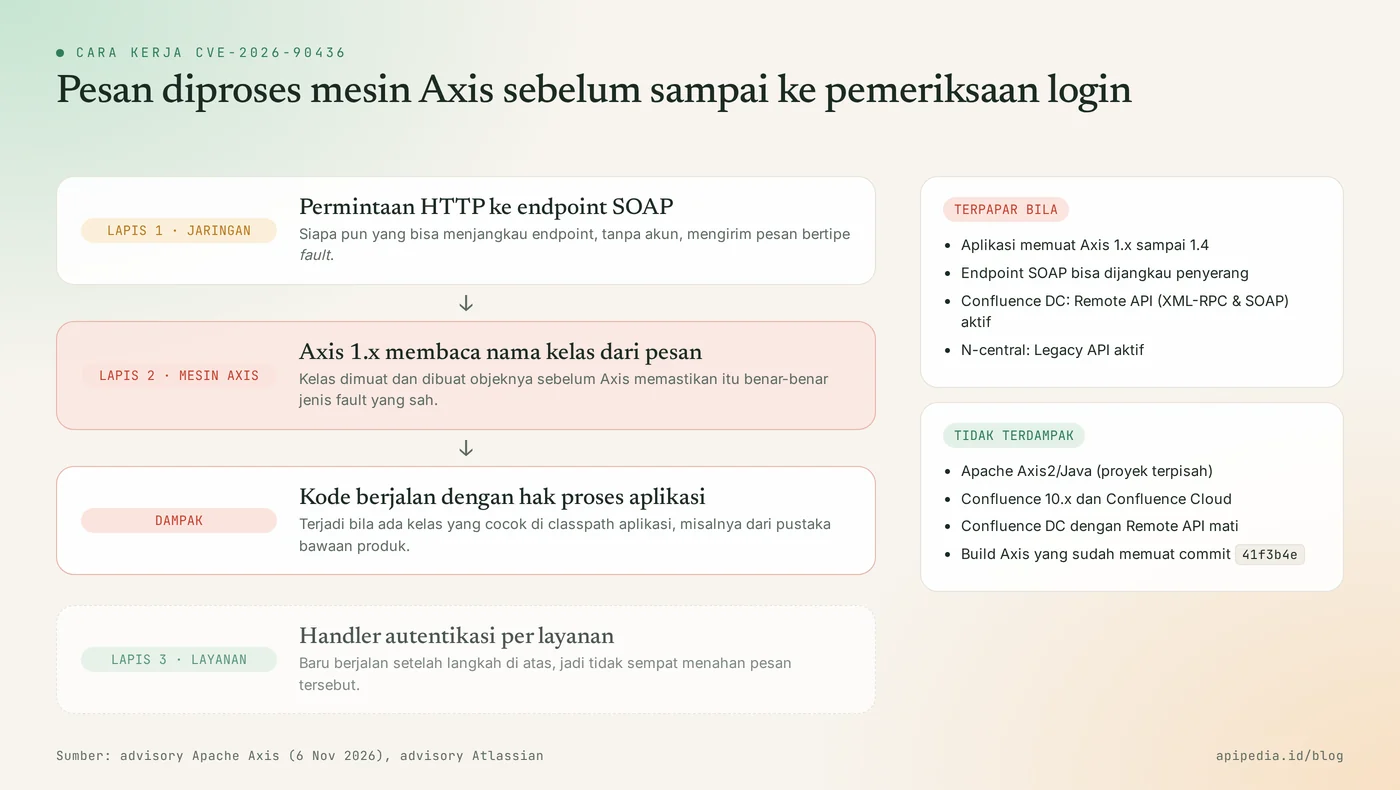
The order is like this:
- The attacker sends an HTTP request to the application's SOAP endpoint. No account required.
- The message is of type fault and mentions the name of a Java class.
- Axis 1.x loads the class and creates its objects. Checking that the class is truly a fault instance is only carried out afterwards.
- The loaded class also executes its initialization code with application process privileges.
Why doesn't service authentication withstand these attacks?
Because the fault message is processed while the Axis machine is still looking for the destination service, that is, before the per-service handler chain is executed. According to the Apache advisory, the authentication handler installed at the service level did not have time to check the request. This article intentionally does not contain examples of messages or class names used in attacks.
Who is affected?
Affected are any applications that load Axis 1.x and expose their SOAP endpoints to networks that attackers can reach. Groups that need to check immediately:
- Confluence Data Center 1.x to 9.x with Remote API settings (XML-RPC & SOAP) enabled. This setting is turned off by default for new installations since Confluence 3.0, but is often turned on for legacy scripts and integrations.
- N-able N-central on-premises with Legacy API active, including those already in 2026.4 HF2.
- Internal Java applications that still include
axis.jaroraxis-1.4.jar, for example legacy SOAP services, ERP connectors, or banking and government integration. - Distro packages: Debian notes package
axis(libaxis-java 1.4) in bookworm and trixie is still vulnerable.
Not affected: Apache Axis2/Java (separate project), Confluence 10.x and above (Remote API feature has been removed), and Confluence Cloud.
How serious is this loophole?
Very serious: the score is 9.8, it can be triggered without logging in, the library will not be patched, and real attacks have been detected in two different products.
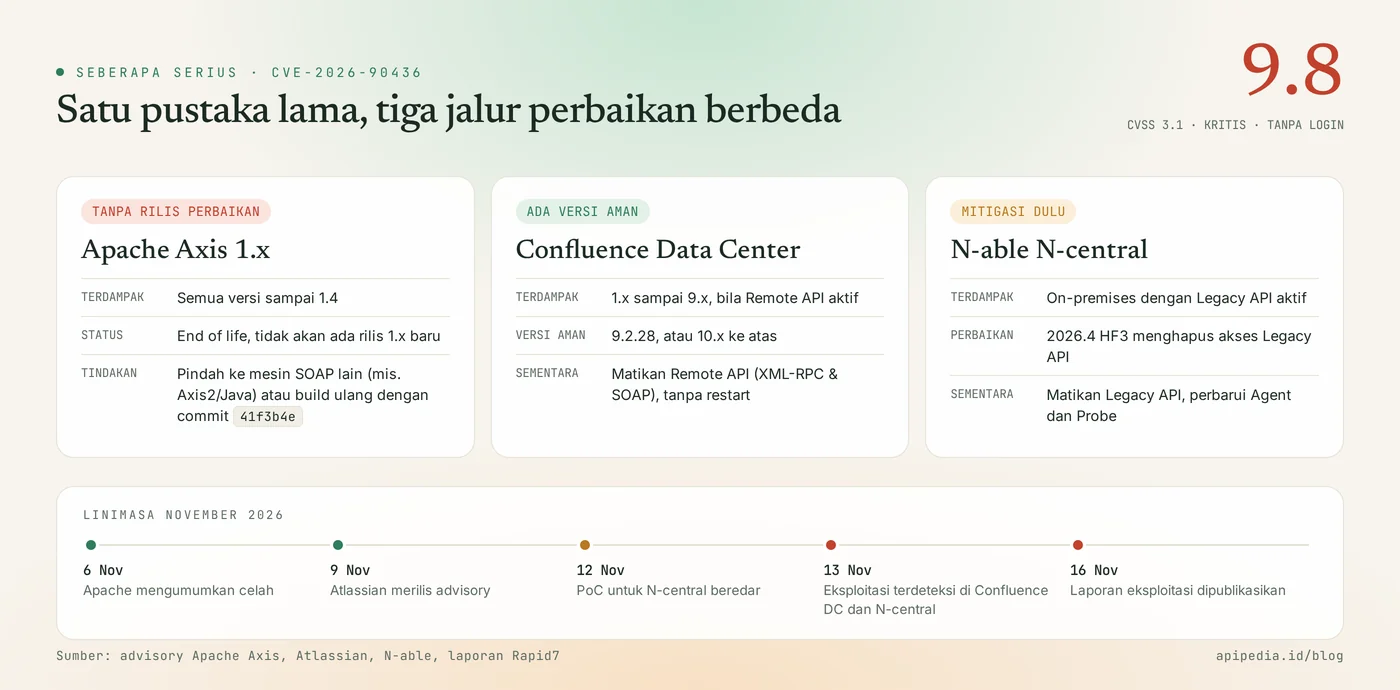
- November 6, 2026: Apache announces a loophole and says it will not release a new Axis 1.x.
- November 9, 2026: Atlassian issues an advisory for Confluence Data Center.
- November 12, 2026: proof of code (PoC) targeting N-central goes public.
- November 13, 2026: Rapid7's incident response team detected an exploit in a Confluence Data Center customer environment. On the same day, N-able reported an N-central exploit via a vulnerability that strongly correlated with this CVE.
- Impact on N-central: researchers reported 21 servers compromised, 19 of which had Hotfix 2 installed. The payload observed so far was an XMRig crypto miner, but the access gained was equivalent to root on a server managing multiple endpoints.
- KEV Status: This CVE is not yet listed in the CISA KEV catalog version 13 November 2026. Don't wait for KEV to act, because the exploit has been confirmed by vendors and researchers.
Which version is safe?
The secure version depends on the product: Confluence Data Center is secure on 9.2.28 or 10.x, while Axis 1.x itself does not have a secure version.
| Product | Affected | Safe | Action |
|---|---|---|---|
| Apache Axis 1.x | All versions up to 1.4 | No fix release | Move to another SOAP engine like Axis2/Java, or rebuild with commit 41f3b4e |
| Confluence Data Center | 1.x to 9.x with Remote API enabled | 9.2.28, or 10.x and above | Upgrades. Meanwhile, turn off the Remote API |
| Confluence Cloud | Not affected | - | No action required |
| N-able N-central on-premises | Legacy API is active | 2026.4 HF3 removes Legacy API access (phased release) | Turn off Legacy API, update Agent and Probe, install HF3 when available |
Debian axis 1.4 | bookworm, trixie, sid | There is no repair package yet | Don't expose SOAP endpoints to untrusted networks |
How do I check if my server is affected?
Check in two steps: look for the Axis 1.x file on the server, then check whether the SOAP endpoint is reachable. The following script is read only. The name matching logic was tested in the sandbox with dummy files axis.jar, axis-1.4.jar, axis-jaxrpc-1.4.jar, and axis2-kernel-1.8.2.jar (the last one was properly skipped).
#!/bin/sh
# Cari pustaka Apache Axis 1.x (CVE-2026-90436). Hanya membaca, tidak mengubah apa pun.
# Pemakaian: sh cek-axis1.sh /opt /var/lib /srv   (bawaan: /opt /var /srv /usr/share)
[ $# -eq 0 ] && set -- /opt /var /srv /usr/share
found=0
for f in $(find "$@" -xdev -type f -name 'axis*.jar' 2>/dev/null); do
  b=$(basename "$f")
  case "$b" in
    axis2*) continue ;;                      # Axis2/Java: proyek terpisah, tidak terdampak
    axis.jar|axis-1.*.jar|axis-[a-z]*-1.*.jar)
      echo "AXIS 1.x : $f"; found=$((found+1)) ;;
  esac
done
if command -v dpkg >/dev/null 2>&1 && dpkg -s libaxis-java >/dev/null 2>&1; then
  echo "PAKET    : libaxis-java terpasang (Axis 1.4 dari distro)"; found=$((found+1))
fi
if [ "$found" -eq 0 ]; then
  echo "HASIL: tidak ada berkas Axis 1.x di lokasi yang dipindai. JAR di dalam .war/.ear belum ikut terperiksa."
else
  echo "HASIL: $found temuan. Periksa apakah endpoint SOAP aplikasinya bisa dijangkau dari jaringan."
fi
For projects you build yourself, also check the dependency list. The Maven coordinates to look for are axis:axis and org.apache.axis:axis.
For Confluence Data Center, Atlassian provides a way to check via one address. Run against your own instance:
# ganti dengan alamat Confluence Anda
BASE=https://confluence.contoh.co.id
curl -s -o /dev/null -w '%{http_code}\n' "$BASE/plugins/servlet/soap-axis1/confluenceservice-v2"
# 403 = Remote API sudah mati
# respons yang menyebut "confluenceservice-v2" atau "AXIS service" = Remote API masih aktif
How to update safely?
The safest way is to close the SOAP endpoint first, then install the fixed version. Closing an endpoint takes minutes and immediately cuts off the attack path.
Step 1: quick mitigation
In Confluence Data Center, turn off Remote API. No need to restart:
- Log in as administrator.
- Go to the gear icon, then General Configuration, then Further Configuration.
- Click Edit, uncheck Remote API (XML-RPC & SOAP), then Save.
- Reload the page and make sure the check remains gone.
Scripts, automation, and add-ons that use legacy APIs may stop working, so note which integrations are impacted. In N-central on-premises, turn off the Legacy API and follow N-able's guide to update the Agent and Probe. For internal Java applications, limit access to SOAP paths in the reverse proxy or firewall to only those addresses that are necessary.
Step 2: update and verify
- Confluence Data Center: upgrade to 9.2.28 or to the latest 10.x release. Atlassian no longer releases separate binary patches, so fixes only come via maintenance releases.
- N-central: install 2026.4 HF3 as soon as it is available for on-premises. That release permanently removes Legacy API access.
- Own application: plan migration from Axis 1.x to a SOAP engine that is still being maintained. If you can't, rebuild Axis with fix commit
41f3b4efrom the official repository.
After that, repeat the checks in the previous section. On Confluence, check addresses must return a 403 or are no longer available.
How to detect signs of burglary?
Detection is done by looking for requests to SOAP paths in the access log and foreign processes run by Java processes. Check from November 6, 2026, especially November 12 and later:
- POST request to SOAP path from unknown address.
- An unnatural child process of the application's Java process, for example shell,
curl, orwget. - New files in the temporary directory, new scheduled tasks, or new services.
- Sudden high CPU usage and outgoing connections to unknown addresses, due to the observed load being crypto miners.
# sesuaikan lokasi log dengan instalasi Anda (contoh: log akses Tomcat Confluence)
LOG=/opt/atlassian/confluence/logs
grep -hE 'POST .*(soap-axis|/rpc/soap|/services/)' $LOG/*access* 2>/dev/null | tail -n 100

# proses anak dari proses Java (ganti "confluence" dengan nama pengguna layanan Anda)
for p in $(pgrep -u confluence java); do ps --ppid "$p" -o pid,etime,cmd; done

# berkas yang baru dibuat di direktori sementara dalam 14 hari terakhir
find /tmp /var/tmp -xdev -type f -mtime -14 -ls 2>/dev/null | tail -n 50
The incident response report states the following addresses were seen in the attack. Its absence in the logs does not prove the server is safe:
- Confluence: 192.238.253[.]176, 5.133.47[.]243, 163.182.68[.]109, 104.13.106[.]166
- N-central: 157.20.241[.]16, 139.99.69[.]109, 79.76.51[.]56
If you find signs of a burglary?
- Isolate the server from the network, but don't shut it down yet so that evidence in memory and disk is not lost.
- Secure copies of access logs, application logs, and process lists.
- Replace all credentials stored or used by that server: admin accounts, API tokens, database passwords, and integration credentials.
- For N-central, assume all managed endpoints are at risk and review the commands sent to the agent.
- Restore from a backup created before November 6, 2026, then install the secure version before the server reopens.
Frequently asked questions
What is Apache Axis 1.x?
Apache Axis 1.x is a Java library for creating and calling SOAP web services. The latest release, 1.4, is very old and the project is in end-of-life status, but this library still carries over in many older applications.
Is Apache Axis2 affected?
No. Axis2/Java is a separate project with different code and is not listed as impacted. Apache actually suggests it as one of the migration destinations.
My Confluence on Atlassian Cloud. Need action?
No. Atlassian says Confluence Cloud sites are not vulnerable to this flaw. Those who need to act are the administrators of Confluence Data Center versions 1.x to 9.x.
The remote API in my Confluence is down. Does it still need to be upgraded?
The attack path is closed as long as the Remote API is down. Upgrading to 9.2.28 is still recommended, as that setting could be turned on again by another admin or by integration needs at a later date.
Why hasn't Apache released a fix for Axis 1.x?
Because Axis 1.x is end of life. Apache simply provides fix commits in the repository and suggests users move to another SOAP engine or build Axis themselves with those commits.
Also read about other server vulnerabilities that need patching this month: Apache HTTP Server vulnerability CVE-2026-119618 in mod_http2, GitLab vulnerability CVE-2026-97229, and Check Point Gaia vulnerability CVE-2026-123039.
Source
- Apache Axis: advisory CVE-2026-90436 in oss-security (November 6, 2026)
- Atlassian: CVE-2026-90436, Remote Code Execution in Confluence Data Center
- Rapid7: Detected Exploitation of CVE-2026-90436 against Atlassian Confluence Data Center (16 November 2026)
- The Hacker News: Hackers Exploit N-central Flaws to Infect 21 Servers
- Debian Security Tracker: CVE-2026-90436
- CISA: Known Exploited Vulnerabilities Catalog
Topics: #keamanan #cve #apache axis #confluence #java #server
About the author
Tim APIPedia — Tim Engineering APIPedia
Tim engineering di balik APIPedia yang membangun dan memelihara API data Indonesia - ongkir, OCR KTP, data wilayah, BMKG, hingga server MCP - dan menulis panduan integrasinya dari pengalaman langsung.