Claude Code Now Refuses to Make Game Clones: What's Changed and What It Means for Developers
By Tim APIPedia, Tim Engineering APIPedia · Published · Updated · 9 min read
Tengu_heron_brook's server-side rules mean that Claude Code rejects recreations of existing games. This is the chronology, how it works, myth vs fact, and its impact.
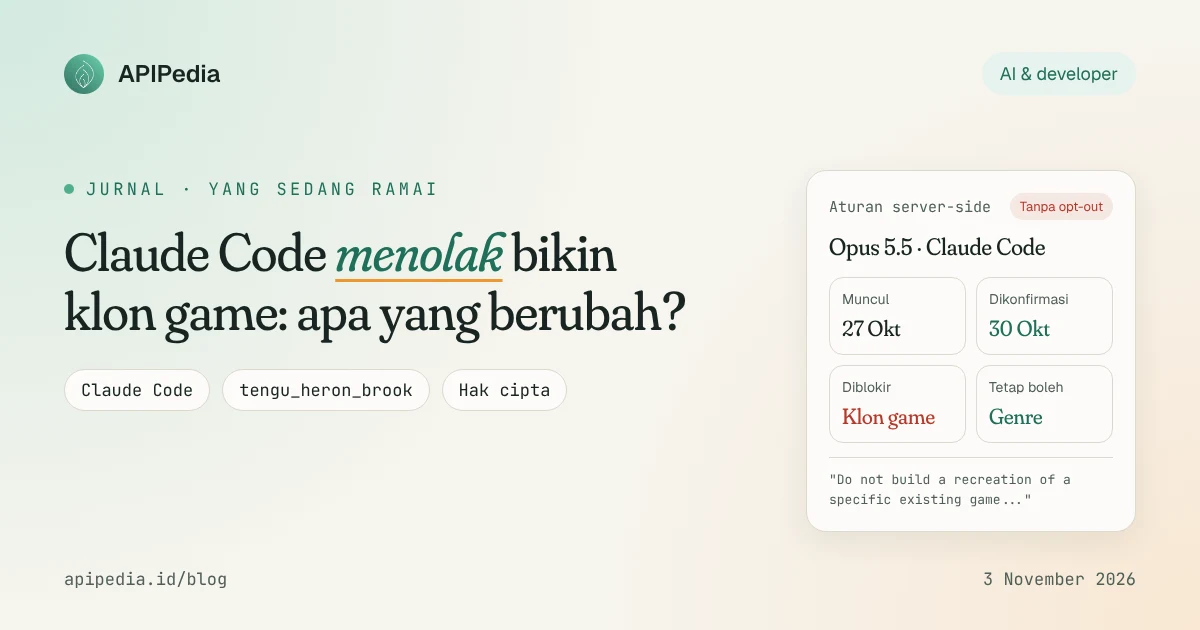
Claude Code is now directed to refuse to recreate certain existing games, even if the name is changed or claimed to be "original". This two-sentence rule appeared around October 27 2026, went viral on X on October 30, and was then confirmed by Anthropic. For developers, this is a clear example that AI agent behavior can change server-side without you updating anything.
This article summarizes what happened, why it's being talked about so much, how rules like this work technically, which ones are myths and which ones are facts, and what it means if you use an AI agent for work.
What actually happened?
A user X with the account @chasmmmmmmmmmmm shared a screenshot of Claude Code's configuration. There is a section called tengu_heron_brook containing two new rule sentences. According to Game Developer and Kotaku quotes, it contains:
"Do build original games, games in a genre, and games from the user's own designs and assets."
"Do not build a recreation of a specific existing game, even if it is renamed or called original."
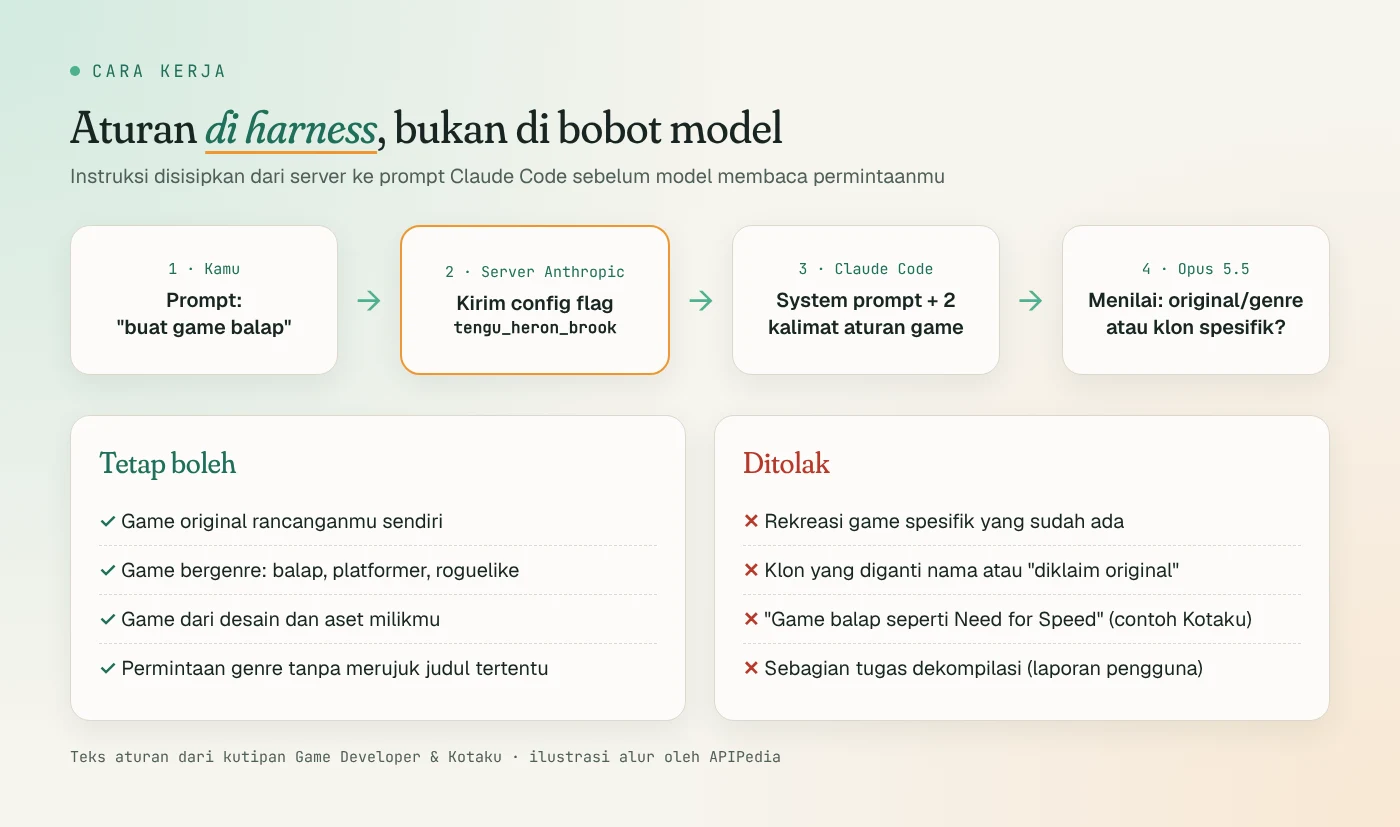
This means: original games, genre games, and games based on user-owned designs and assets are still allowed. What is rejected are recreations of specific games, including simply renamed clones.
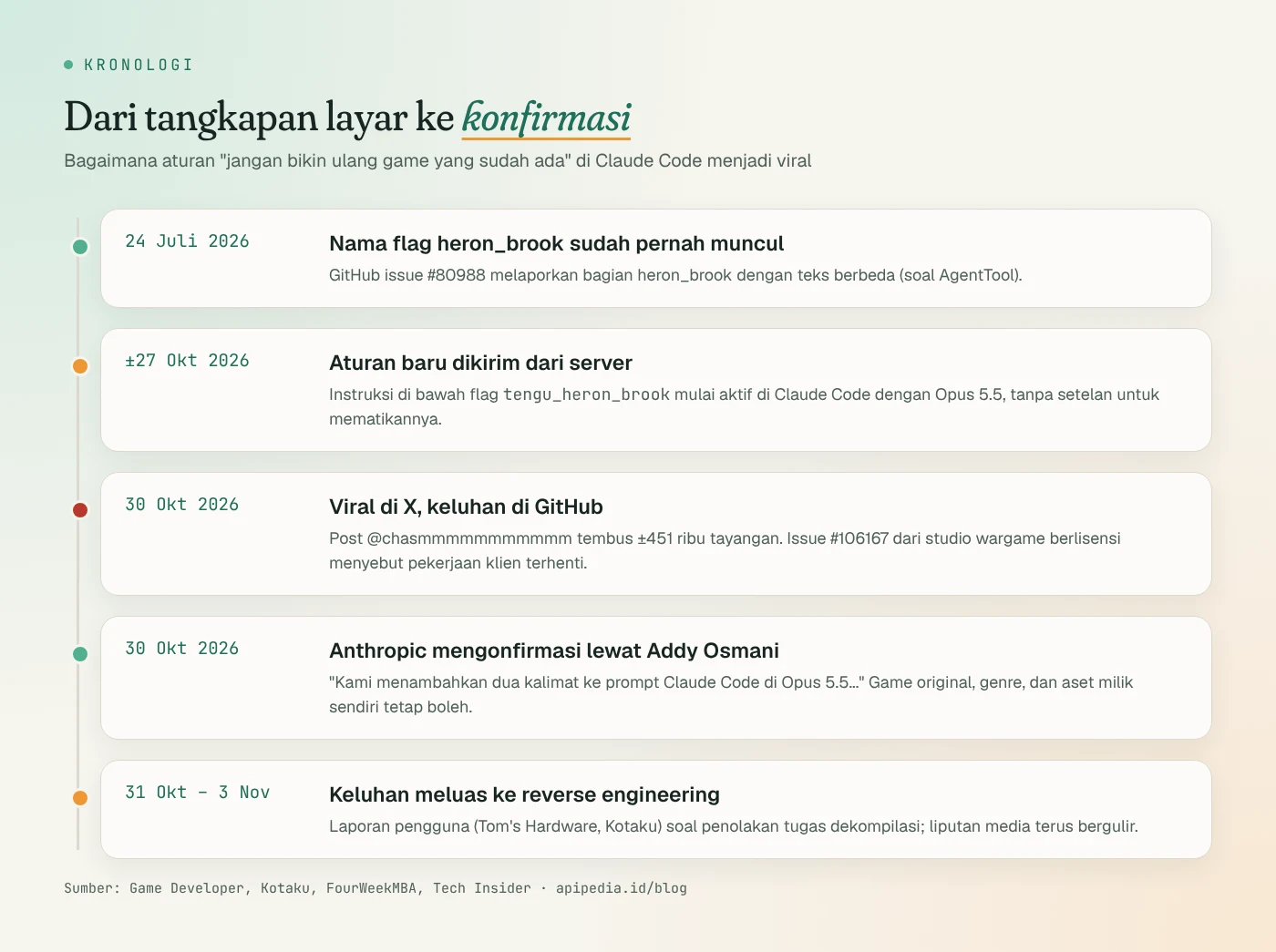
The uploader said the rule arrived "around Oct 27" and "There's no setting to turn it off". The post, according to FourWeekMBA, had been viewed around 451 thousand times as of October 30 afternoon (UTC).
Has Anthropic confirmed it?
Yes, but through informal channels. Game Developer reports an Anthropic spokesperson directed them to Addy Osmani, a member of Anthropic's technical staff, who wrote in X:
"We added two sentences to Claude Code's prompt on Opus 5.5 to steer it away from recreating someone else's specific game."
Osmani also wrote that using Claude to violate intellectual property (IP) is prohibited by the usage policy, that "original games, genre games, and games built from your own designs and assets are meant to keep working", and that Anthropic will continue to adjust to get the balance right. It invites users to submit cases if Claude refuses something that actually belongs to them.
It should be noted there are differences between sources. Kotaku, Tech Insider, and FourWeekMBA stated at the time of writing that there had been no official confirmation, and Claude Code's changelog (latest entry 2.1.314 according to FourWeekMBA) did not contain any notes about the game. The new confirmation is listed in the Game Developer article update on October 30th.
Why is this issue so popular?
The timing fits with anxiety in the indie gaming community. Game Developer notes some studios are canceling public playtests out of fear of their games being "fast-followed" by AI-generated clones before release. Digital Sun Games canceled the ReVamp playtest, and developer Moonlighter postponed the game's next playtest. Developers are also putting pressure on Valve to prevent AI clones from flooding Steam.
On the other hand, there are developers who feel disadvantaged. GitHub issue #106167 of Conflict Simulations LLC, a studio that makes digital versions of licensed board wargames for clients, calls their paid work stalled. Anthropic's support bot reportedly responded that the policy "applies to all customers without exception", and the studio appealed to the Safeguards team.
Additionally, Kotaku and Tom's Hardware posted user complaints that Claude is now also rejecting some reverse engineering and decompilation tasks. This is still a user report, not confirmed as part of the same rules.
How does a rule like this work?
The key is in the word "harness". Claude Code is a program (harness) that wraps the model. Before your request reaches the model, the harness creates a system prompt containing instructions, a tool list, and project context. Rule tengu_heron_brook is an additional text in the system prompt, sent as a configuration from the server, not a change to the model weights.
The consequences are quite important to understand:
- Not tied to client version. Because they are sent from the server, rules cannot be pinned or avoided by downgrade, and can be changed without a new client release (Tech Insider).
- Not a keyword filter. The model itself assesses context, so the results depend on how you describe the request. Example from Kotaku: "racing games" are fine, but "racing games like Need for Speed " may trigger resistance.
- The model cannot verify ownership. Game Developers question how the software determines whether an idea or asset truly belongs to the user. The case of the licensed studio above shows this loophole.
- It can be tricked, but that's not the point. Prompt-based restrictions can generally be bypassed with rhetorical tricks, and open-weight models do not have this rule. So this rule is more about stopping low-effort copycats than stopping clones completely.
Conceptually, the arrangement is something like this. Here's an illustration to explain the remote config pattern, not Anthropic's native format:
{
  "flag": "tengu_heron_brook",
  "source": "server",
  "user_toggle": false,
  "inject_into": "system_prompt",
  "text": [
    "Do build original games, games in a genre, and games from the user's own designs and assets.",
    "Do not build a recreation of a specific existing game, even if it is renamed or called original."
  ]
}
Myth vs fact
| Outstanding claims | Status | Explanation |
|---|---|---|
| The Claude Code now prohibits all game creation | Myth | The text of the rules explicitly allows original games, genre games, and games from user-owned assets. |
| Rules can be turned off via settings | There is no evidence yet | Uploaders and some media outlets report there is no option to turn it off. |
| Downgrading the Claude Code version can avoid the rules | Most likely not | The rules are reportedly sent from the server, not part of the client packet. |
| Anthropic has never acknowledged this rule | It's no longer accurate | Addy Osmani confirmed the addition of two sentences to the Claude Code prompt in Opus 5.5 (Game Developer, October 30). |
| The model is retrained to reject game clones | Not exactly | What changes are the instructions in the harness prompt, not the model weight. |
| Anthropic's usage policy has a game-specific clause | Myth | According to FourWeekMBA, the Usage Policy only prohibits infringement of third party IP rights in general. |
What does this mean for developers in Indonesia?
If you're making an original game or just learning, almost nothing changes. But there are some practical lessons that apply to all AI agent users, not just game developers.
1. Explain context and ownership from the start
Since the model judges from context, write clearly that the design and assets are yours, and avoid referencing other game titles as a benchmark. You can put it in file CLAUDE.md in the project root, which Claude Code reads as the project context:
# Konteks proyek
- Game original "Pasar Malam Rush" (arcade, genre time-management).
- Semua desain level, karakter, dan aset di /assets dibuat oleh tim kami.
- Dokumen desain: docs/gdd.md. Jangan merujuk atau meniru game komersial lain.
Note: this helps the model understand the context, not the "key" to bypass the rule. For licensed projects that are still rejected, the official route is to appeal to Anthropic as the wargame studio did earlier.
2. Note changes in agent behavior in your pipeline
Changing behavior of the server can cause automation that was working yesterday to suddenly fail. Save versions and session logs for easy tracking:
# catat versi klien Claude Code di setiap run CI
claude --version | tee -a logs/agent-version.log

# jalankan tugas non-interaktif dan simpan output untuk audit
claude -p "jalankan unit test dan ringkas yang gagal" \
  --output-format json > logs/run-$(date +%Y%m%d-%H%M).json
Remember, the same client version does not necessarily mean the same behavior, because instructions like this come from the server. Log output is more useful than version numbers alone.
3. Prepare alternatives if your work is critical
For paid work that relies on a single vendor, consider a backup plan, such as a do-it-yourself open-weight model like the one we covered in the Mistral Large 4 open-weight. Keep in mind that creating clones of other people's games is still a legal risk, regardless of the tool.
4. Stay alert to the “rules-free version”
Whenever there are restrictions, it usually comes up with an offer of an extension or “no restrictions” app. Just last week there was a Yoba malware campaign masquerading as the ChatGPT and Claude desktop apps on GitHub, and before that a fake Claude Code extension that planted an SSH backdoor. Download only from official sources.
FAQs
Can I still make platformer or RPG games with Claude Code?
Can. The rules text allows for genre games and original games. What is rejected are recreations of specific games that already exist.
What is tengu_heron_brook?
The name of the internal configuration flag in Claude Code where this rule is reported to be located. The name heron_brook has appeared in GitHub issue #80988 on July 24 2026 with different text about AgentTool.
Does this rule apply to Claude.ai or the API?
Existing sources only mention Claude Code as Opus 5.5. There is no official information about other products yet, so don't assume.
What if my project is officially licensed but rejected?
Explain the licensing context at the prompt or CLAUDE.md. If it is still rejected, Addy Osmani asks users to report such cases, and an appeal route to the Anthropic Safeguards team is also available.
Does this rule also block reverse engineering?
There are user reports of decompilation tasks being rejected, but the rules text cited only mentions recreation of the game. The relationship between the two has not been confirmed.
Want to connect Claude or another AI agent to Indonesian data such as regions, holidays and exchange rates? See the guide to connecting APIPedia to Claude via MCP or start at console.apipedia.id.
Source
- Game Developer: Anthropic orders AI tool Claude to stop remaking video games
- Kotaku: Anthropic nerfs Claude to stop users from recreating existing games
- FourWeekMBA: Claude Code users report a new rule against recreating games
- Tech Insider: Claude Code blocks existing game recreation (tengu_heron_brook)
- Check Point Research: 2nd November Threat Intelligence Report (Yoba campaign)
Topics: #claude code #anthropic #ai #game development #hak cipta
${c.about}
Tim APIPedia — Tim Engineering APIPedia
Tim engineering di balik APIPedia yang membangun dan memelihara API data Indonesia - ongkir, OCR KTP, data wilayah, BMKG, hingga server MCP - dan menulis panduan integrasinya dari pengalaman langsung.