Puppet Server Vulnerability CVE-2026-115731 Has Been Exploited: How to Check, Mitigate, and Update
By Tim APIPedia, Tim Engineering APIPedia · Published · 10 min read
Puppet Server vulnerability CVE-2026-115731 (CVSS 9.4) has been exploited and is in CISA KEV. This is how to check versions, mitigate autosign, and update safely.
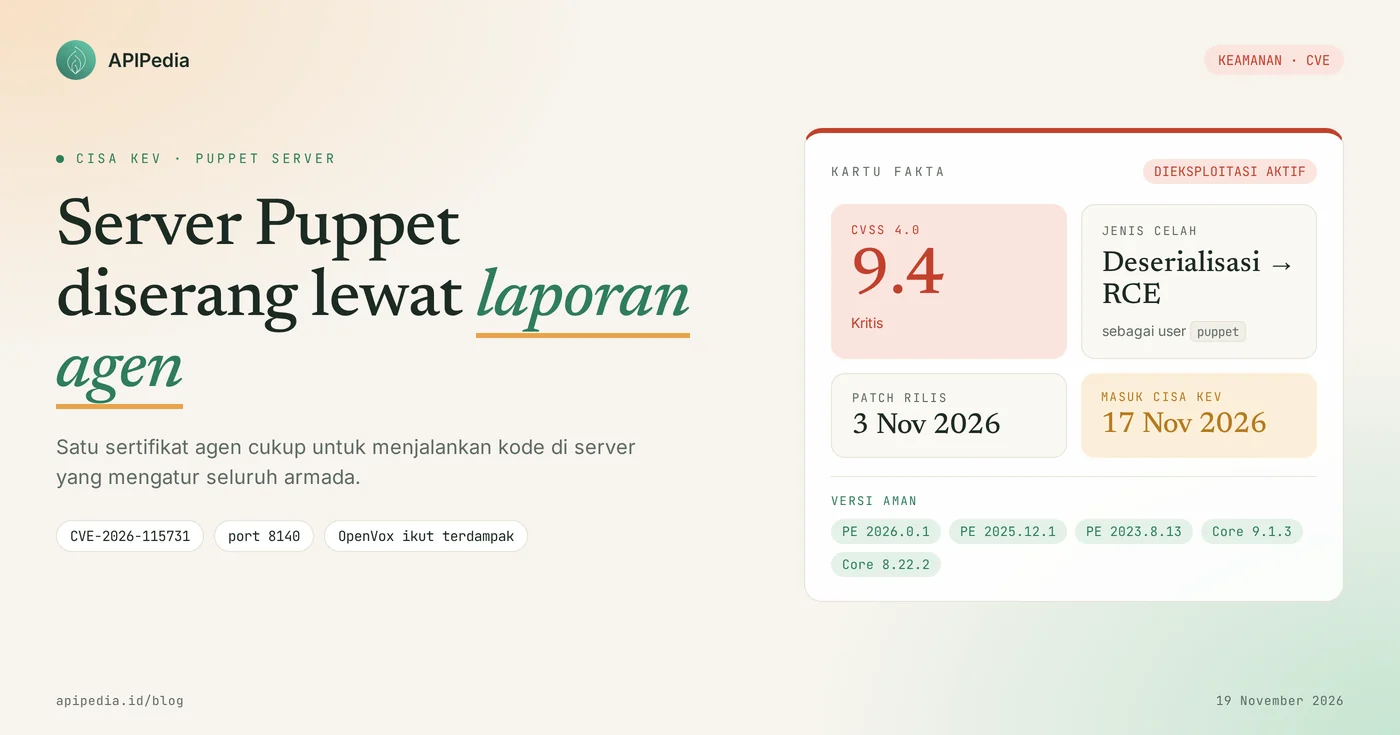
CVE-2026-115731 is a critical vulnerability in Puppet Server that allows agent certificate holders to run code on the server via manipulated reports. It scored 9.4 on CVSS 4.0, the fix was released November 3, 2026, and CISA included it in the Known Exploited Vulnerabilities (KEV) catalog on November 17, 2026 because it had been used in a real attack.
The Puppet server holds the configuration of all the nodes it manages, so one server crash could mean the entire fleet is at risk. This vulnerability concerns Puppet Enterprise, Puppet Core, and OpenVox. This article discusses how the vulnerability works, who is affected, safe versions, version check scripts, temporary mitigations, update steps, and how to look for signs of a breach.
Quick summary
| Items | Details |
|---|---|
| CVE | CVE-2026-115731 |
| Product | Puppet Server on Puppet Enterprise, Puppet Core, and OpenVox |
| Gap type | Untrusted data deserialization in agent report processing, leading to remote code execution (RCE) |
| Severity level | Critical, CVSS 4.0 score 9.4 |
| Attack conditions | CA Puppet signed agent certificate. If autosign is loose, attackers can obtain it without logging in |
| Access rights resulting from attacks | Service user puppet on the server |
| Safe version | Puppet Enterprise 2026.0.1, 2025.12.1, 2023.8.13; Puppet Core 9.1.3, 8.22.2; OpenVox Server 9.2.0, 8.18.0 |
| Patch release | November 3, 2026 |
| Exploitation status | Enter CISA KEV November 17, 2026, US federal agency deadline December 1, 2026 |
| Reporter | Alain Rödel of Neodyme |
How does the CVE-2026-115731 vulnerability work?
This flaw works via legitimate channels: the Puppet agent does indeed send a report to the server after every configuration application. The server then rebuilds the object from the contents of the report without safely checking the data type. Specially crafted reports cause the server to run the sender's code.
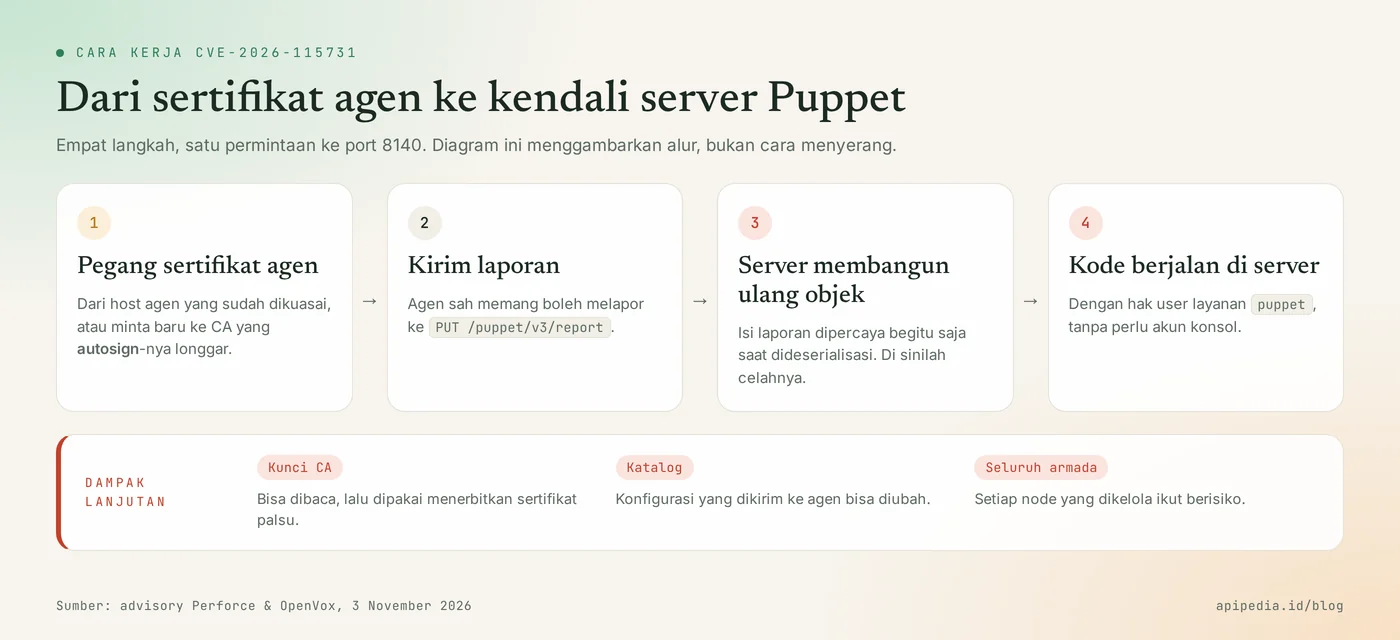
The request goes to report endpoint PUT /puppet/v3/report on port 8140. The code runs with service user puppet privileges, not root. That right is enough to read the CA signing key and the data the server uses to catalog it.
What are the conditions for the attack?
One requirement: CA Puppet signed client certificate. There are two common ways attackers obtain them.
- From an agent host that has been controlled. Every node that Puppet manages holds a valid certificate. One node that breaks becomes a stepping stone to the server.
- From a loose autosign. If a CA signs a certificate request automatically without strong verification, anyone who can reach port 8140 can register as a new agent. In this condition the attack practically does not require a login.
The same fix release also closes CVE-2026-115732 (CVSS 9.0), a vulnerability in certificate name checking that allows one agent to impersonate another agent. This article intentionally does not discuss how to structure an attack.
Who is affected?
Affected are all Puppet servers that have not yet adopted the November 3, 2026 fix release, regardless of distribution.
- Puppet Enterprise 2026.0.0.
- Puppet Enterprise 2025.0.0 to 2025.12.0.
- Puppet Enterprise 2023.8.0 to 2023.8.12 (LTS branch).
- Puppet Core 9.0.0 to 9.1.2 and 8.x under 8.22.2.
- OpenVox Server up to 9.1.0 and 8.17.0, and OpenVox Agent up to 9.2.0 and 8.31.1.
- Old open source Puppet (e.g. series 6 and 7). The OpenVox Project says all known Puppet implementations are affected, and the legacy series is no longer receiving fixes.
The highest risk is on servers with autosign = true or wide autosign patterns, and servers whose port 8140 is open to the wide network or internet.
How serious is this loophole?
It's very serious: the score is 9.4 out of 10, the attack is over a low-complexity network, and CISA has recorded real exploits two weeks after the patch went live.
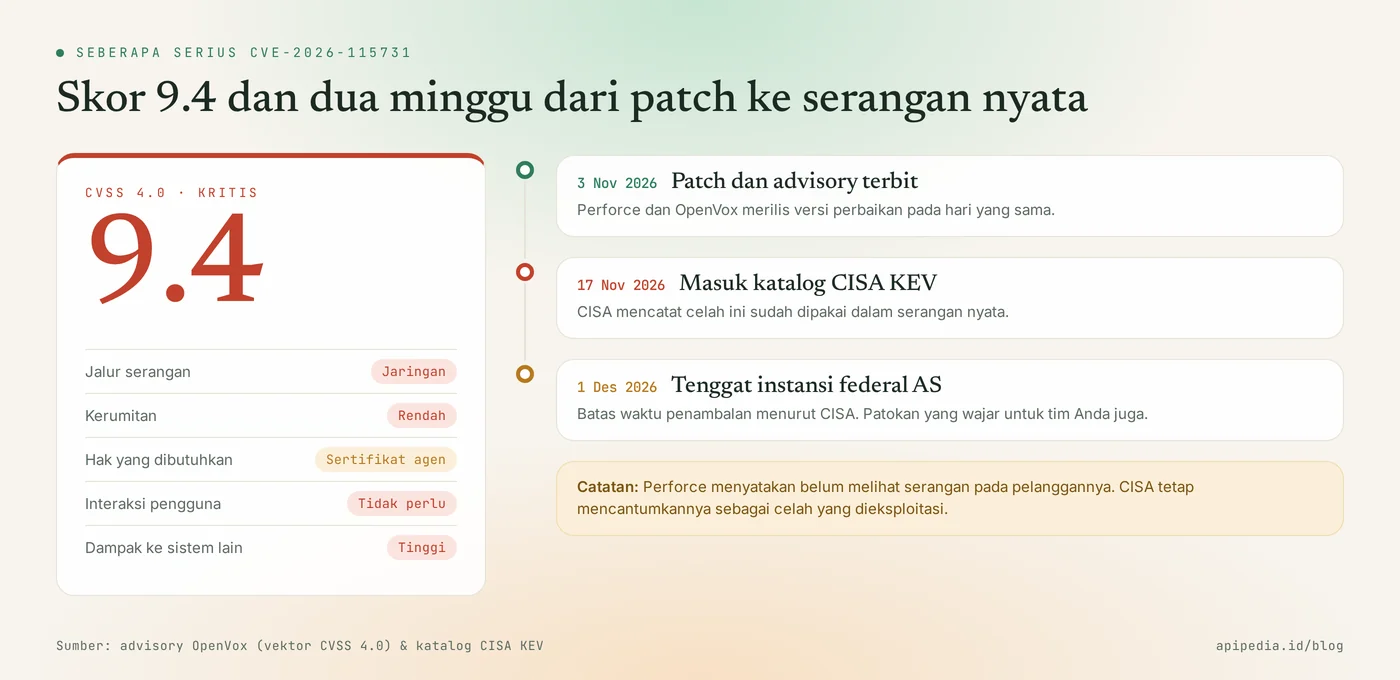
- CVSS 4.0 score 9.4. The vector is
AV:N/AC:L/AT:N/PR:L/UI:Nwith a high impact on the server and on other systems that depend on it. - Entering CISA KEV on November 17, 2026. US federal agencies are required to patch by December 1, 2026.
- Details of the attack have not been released. CISA did not name the perpetrators or the number of victims. Perforce said it was not aware of any attacks on its customers.
- The CA key is also threatened. An attacker who reads the signing key could issue a fake certificate and impersonate another host.
- The catalog can be changed. The configuration that the server sends to the agent is executed with elevated privileges on each node.
Which version is safe?
The safe version is the November 3, 2026 release or later on each of the following branches.
| Product | Impacted version | Safe version |
|---|---|---|
| Puppet Enterprise 2026 | 2026.0.0 | 2026.0.1 |
| Puppet Enterprise 2025 | 2025.0.0 to 2025.12.0 | 2025.12.1 |
| Puppet Enterprise 2023.8 (LTS) | 2023.8.0 to 2023.8.12 | 2023.8.13 |
| Puppet Core 9 | 9.0.0 to 9.1.2 | 9.1.3 |
| Puppet Core 8 | 8.x under 8.22.2 | 8.22.2 |
| OpenVox Server | up to 9.1.0 and 8.17.0 | 9.2.0 and 8.18.0 |
| OpenVox Agent (on server) | to 9.2.0 and 8.31.1 | 9.3.0 and 8.32.0 |
| Old open source Puppet | All versions | There isn't any. Move to OpenVox or Puppet Core |
How do I check if my server is affected?
Check two things on the Puppet server: the installed version and the autosign settings. The following script is read only, and its logic has been tested in the sandbox with mock output for each version branch.
#!/bin/sh
# Cek paparan CVE-2026-115731 di server Puppet / OpenVox. Hanya membaca.
lt() { [ "$1" != "$2" ] && [ "$(printf '%s\n%s\n' "$1" "$2" | sort -V | head -n1)" = "$1" ]; }
PEFILE=/opt/puppetlabs/server/pe_version
PATH=$PATH:/opt/puppetlabs/bin
fix=""
if [ -r "$PEFILE" ]; then
  ver=$(cat "$PEFILE"); produk="Puppet Enterprise"
  case "$ver" in
    2026.*) fix=2026.0.1 ;; 2025.*) fix=2025.12.1 ;; 2023.8.*) fix=2023.8.13 ;;
  esac
else
  ver=$(puppet --version 2>/dev/null)
  [ -z "$ver" ] && { echo "Puppet tidak ditemukan di host ini"; exit 0; }
  if (rpm -q openvox-agent || dpkg -s openvox-agent) >/dev/null 2>&1; then
    produk="OpenVox (agen di server)"
    case "$ver" in 9.*) fix=9.3.0 ;; 8.*) fix=8.32.0 ;; esac
  else
    produk="Puppet Core / open source"
    case "$ver" in 9.*) fix=9.1.3 ;; 8.*) fix=8.22.2 ;; esac
  fi
fi
echo "Produk  : $produk"
echo "Versi   : $ver"
if [ -z "$fix" ]; then
  echo "HASIL   : cabang ini tidak punya rilis perbaikan. Anggap rentan dan rencanakan migrasi."
elif lt "$ver" "$fix"; then
  echo "HASIL   : RENTAN. Update minimal ke $fix."
else
  echo "HASIL   : versi sudah memuat perbaikan (minimal $fix). Pastikan puppetserver sudah di-restart."
fi
echo "Autosign: $(puppet config print autosign --section server 2>/dev/null || echo 'tidak terbaca')"
How to read line Autosign:
true: CA signs all requests. This is the most dangerous setting.- Path
autosign.conf: autosign based on name or pattern. Check the contents, wide patterns like*.contoh.co.idare still risky. - Path to executable file: policy-based autosign. Its strength depends on what the script checks for.
false: each request is waiting for manual approval.
How to update safely?
Safe order: narrow the exposure first, update the primary server, then the compiler and replica, and finish with a service restart.
Step 1: temporary mitigation
This mitigation reduces exposure but does not close the gap. Hosts that already hold valid certificates can still send malicious reports, so updates are still mandatory.
# 1. Matikan autosign di server CA, lalu restart
puppet config set autosign false --section server
systemctl restart puppetserver

# 2. Batasi port 8140 hanya untuk jaringan agen (contoh ufw)
ufw allow from 10.10.0.0/16 to any port 8140 proto tcp
ufw deny 8140/tcp

# 3. Cek dari luar bahwa 8140 tidak lagi terbuka
nc -zv puppet.contoh.co.id 8140
Match the IP range to your agent's network. If automatic provisioning relies on autosign, replace it with policy-based autosign that verifies tokens or instance data, not hostname patterns.
Step 2: update and verify
# Puppet Core (RHEL, AlmaLinux, Rocky)
dnf update puppet-agent puppetserver && systemctl restart puppetserver

# Puppet Core (Debian, Ubuntu)
apt update && apt install --only-upgrade puppet-agent puppetserver && systemctl restart puppetserver

# OpenVox (ganti dnf dengan apt di Debian/Ubuntu)
dnf update openvox-agent openvox-server openvoxdb && systemctl restart puppetserver

# verifikasi
puppet --version
puppetserver --version
systemctl status puppetserver --no-pager | head -n 5
For Puppet Enterprise, download the installer package version 2026.0.1, 2025.12.1, or 2023.8.13 from the Perforce portal and run the upgrade process on the main server according to the official documentation. After that check cat /opt/puppetlabs/server/pe_version. Restart puppetserver is important: if only packets are up without a restart, the old code is still loaded in memory.
How to detect attempted attacks?
There is no official indicator of attack (IOC) for this vulnerability, so detection relies on three things: unknown certificates, unknown report senders, and strange user activity puppet.
# 1. Daftar semua sertifikat. Cari nama host yang tidak Anda kenal,
#    terutama yang terbit sejak awal November 2026
puppetserver ca list --all

# 2. Siapa saja yang mengirim laporan (IP pengirim dan jumlahnya)
grep 'PUT /puppet/v3/report' /var/log/puppetlabs/puppetserver/puppetserver-access.log* \
  | awk '{print $1}' | sort | uniq -c | sort -rn | head -n 20

# 3. Proses milik user puppet selain Java puppetserver
ps -u puppet -o pid,ppid,etime,cmd | grep -v 'puppet-server-release.jar'

# 4. Berkas baru milik user puppet dalam 20 hari terakhir di lokasi umum
find /tmp /var/tmp /dev/shm -user puppet -mtime -20 -ls 2>/dev/null
The report from the agent is normal traffic. What should be suspect are senders from IPs outside the agent's network, certificate names that are not in the inventory, and child processes such as shell or curl under the puppetserver Java process.
If you find signs of a burglary?
- Disconnect the server from the agent network and stop
puppetserverso that catalogs are no longer sent to the node. - Assume the CA key has been leaked. Rebuild the server from clean sources on the patched version, then reissue the CA and all agent certificates.
- Rotate all secrets ever shared via catalog or Hiera: database passwords, API keys, tokens, and SSH keys.
- Compare the manifest and module code on the server with your Git repository, then check for configuration changes in node since early November 2026.
Frequently asked questions
Does the Puppet agent on regular nodes also have to be updated?
The first priority is the server, because the gap is in the report processing on the server side. Agents on fixed nodes should be upgraded to the same release on a later schedule to ensure uniform versions.
My autosign is dead. Is it still risky?
Still. Turning off autosign only closes the path of new agent registration by outsiders. Any node that already holds a valid certificate, including nodes that are already controlled by an attacker, can still trigger this vulnerability until the server is updated.
My Puppet server can only be accessed from the internal network. Need to rush?
Need. The internal network reduces the chance of attacks from the internet, but one infected laptop or internal server is enough to reach port 8140. Puppet servers are high-value targets for lateral movement.
I'm still using open source Puppet 7. What should I do?
Plan migration. Older open source series do not have a fix for this loophole. The options are moving to OpenVox 8.18.0 or later, or to Puppet Core 8.22.2. While waiting, turn off autosign and restrict port 8140 as tightly as possible.
Are Ansible, Chef, or Salt impacted?
No. CVE-2026-115731 exists in the report processing code of Puppet and its derivatives. Other configuration management tools have their own code and gap history.
Other server vulnerabilities you need to check this month: the critical Apache mod_http2 vulnerability CVE-2026-119618, the Apache Shiro vulnerability CVE-2026-129349, and the OpenSSH sshole vulnerability in Alpine Linux.
Source
- Perforce: Puppet security vulnerabilities CVE-2026-115731 and CVE-2026-115732
- OpenVox security advisory GHSA-ffr6-rwpm-p5wq
- oss-security: OpenVox Server RCE and client impersonation vulnerabilities (November 3, 2026)
- CISA: Adds One Known Exploited Vulnerability to Catalog (17 November 2026)
- The Hacker News: Hackers Exploiting Critical Puppet RCE Flaw
Topics: #keamanan #cve #puppet #devops #cisa kev #linux
About the author
Tim APIPedia — Tim Engineering APIPedia
Tim engineering di balik APIPedia yang membangun dan memelihara API data Indonesia - ongkir, OCR KTP, data wilayah, BMKG, hingga server MCP - dan menulis panduan integrasinya dari pengalaman langsung.