What is Jev? TypeSafe's AI Model that Answers with Numbers, Not Words
By Tim APIPedia, Tim Engineering APIPedia · Published · 6 min read
Jev from TypeSafe AI answers with type decisions, not text. Here's the manufacturer, how it works, price, independent test results, and limitations.
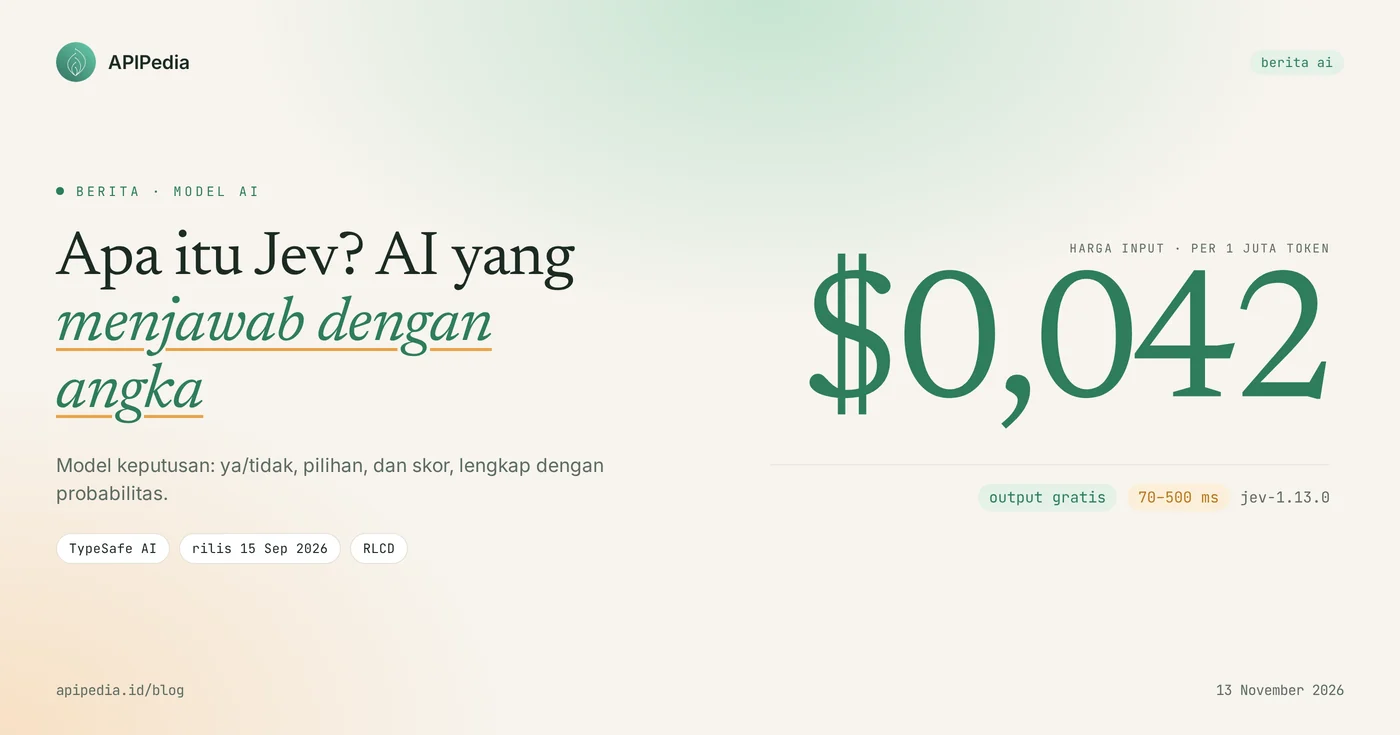
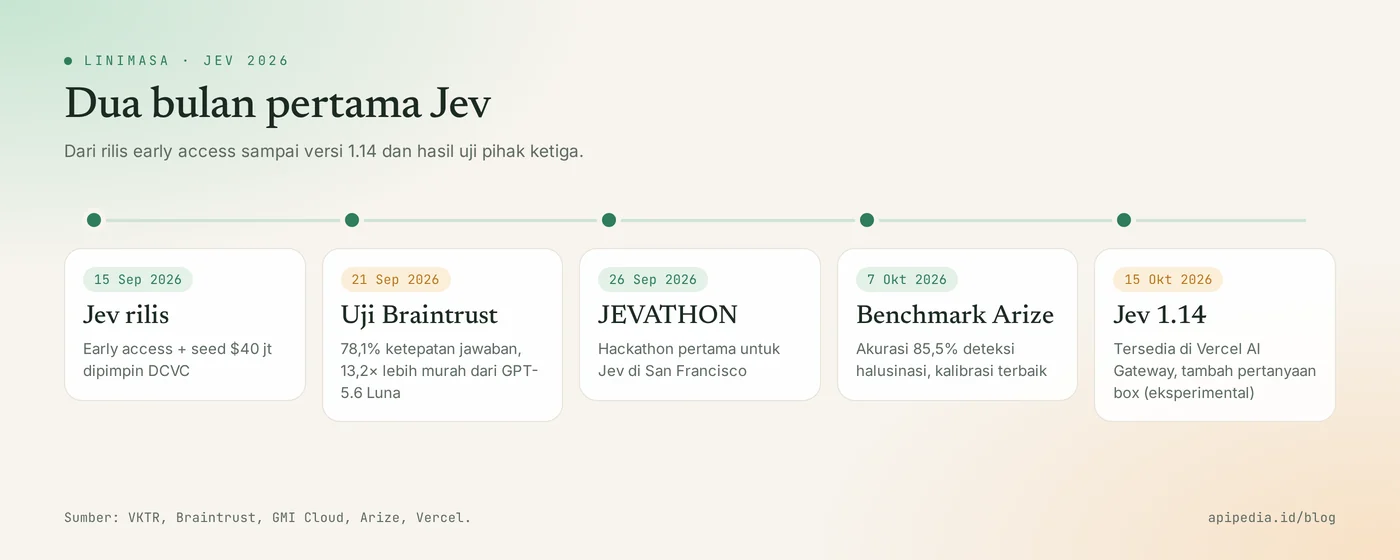
Jev is the first AI model from San Francisco startup TypeSafe AI, which does not write text, but returns typed decisions (yes/no, choices, or scores) with calibrated probabilities. Jev was released in early access on September 15, 2026, after two years of TypeSafe work in secret. The company was founded by Diogo Almeida, a former OpenAI researcher who co-developed RLHF.
This model attracts attention because it dares to "discard" writing capabilities for speed and much lower costs. This article discusses who makes Jev, how it works, price and access, independent test results, and limitations.
Quick summary: What is Jev?
Jev is a pay-per-token input decision model from TypeSafe AI, released September 2026, and only available via API.
| Items | Details |
|---|---|
| Maker | TypeSafe AI (San Francisco), founder Diogo Almeida |
| Release | 15 September 2026, early access with waitlist |
| Funding | The $40 million seed round was led by DCVC |
| Category | System One model (decision model), not LLM |
| Version | jev-1.13.0 on release; jev-1.14.0 available on Vercel AI Gateway from October 15, 2026 |
| Training method | RLCD (Reinforcement Learning for Calibrated Decisions) |
| Price | Input $0.042 per 1 million tokens, output free |
| Latency | 70–500 milliseconds (TypeSafe claims) |
| Model weight | Not released, only via API |
Who made Jev?
Jev created TypeSafe AI, an AI lab in San Francisco led by Diogo Almeida. Almeida is a former OpenAI researcher who co-developed RLHF, a method that allows ChatGPT to follow instructions. TypeSafe went public with $40 million in seed funding led by DCVC.
Jev's name refers to economist William Stanley Jevons and the "Jevons paradox": when something becomes much cheaper, people actually use it much more. Logically, if one AI decision is almost free, the application will use more AI decisions. One note not to get confused: TypeSafe AI is not related to the Scala company called Typesafe (now Lightbend).
How does Jev work?
Jev works like a function call: send state and a question of type, then receive all the answers in one parallel process. State can be text or JSON. TypeSafe mentions three new things behind Jev:
- The architecture of the new model, the details of which were not published.
- Parallel sampler, not one-by-one token generation like LLM.
- RLCD, a training method that pursues truthful probabilities rather than human preferred answers (RLHF).
There are three types of questions, namely noul for yes/no, choice for selecting an option, and score for rating on a sequential scale. In the Vercel AI SDK, the yes/no type is called boolean. Version 1.14 also adds experimental question box to return a single bounding box on an image, but it is only available in the live TypeSafe API. Complete code examples for the cloud and on-premises versions are in the Jev on cloud, Jev on-premises, and Qev guides.
How much does Jev cost and where can it be accessed?
Jev's price is $0.042 per 1 million input tokens, while output is free because Jev does not generate text. This means the cost depends only on the length of the data you send. Access is available via:
- TypeSafe API in
api.typesafe.ai/v1/systemone, key fromconsole.typesafe.ai. - DigitalOcean Serverless Inference, model
typesafe-jev-1.13.0. - Vercel AI Gateway, model
typesafe-ai/jev. - Other API aggregators that support the System One format, with their own rates.
The developer community is also moving quickly. On September 26, 2026, eleven days after release, GMI Cloud along with TypeSafe and The AI Collective held JEVATHON, the first hackathon built on Jev, in San Francisco.
How good is Jev according to independent testing?
According to independent tests, Jev is much cheaper and faster, but its accuracy fluctuates depending on the task. TypeSafe's official claim is that it is 20–200 times faster and 40–400 times cheaper than LLM for decision-form tasks. This figure was measured by TypeSafe itself, mostly from laptops on the West Coast of the US. Third-party test results are more varied:
| Examiner | Task | Jev's results |
|---|---|---|
| Arize (Oct 2026) | Hallucination detection, 8 decision models | Accuracy 85.5% (highest), $0.045 per 1,000 decisions, smallest calibration error |
| Arize | Jev vs LLM judge | Once the threshold is set at 0.80, the Claude Opus 5 equivalent is at 87%, at a cost of about 1/300 |
| Braintrust (Sep 2026) | Accuracy of answers | 78.1%, below GPT-5.6 Luna with reasoning (88.6%), but 13.2× cheaper |
| InfiniSynapse (Sep 2026) | Summary of some tests | Accuracy ranges from 62.6% (phishing) to 95.4% (email classification) |
In conclusion, this model is much faster and cheaper, but its accuracy really depends on the type of task. Test it first on your own data before using it automatically.
What are Jev's limits?
Jev's main limitations: the model can't write, doesn't reason, and can't run itself.
- Can't write. Jev does not produce text, explanations, or code.
- Didn't give a reason. You get numbers, not explanations, so the decisions are hard to audit without additional logs.
- Could be wrong for sure. The answer format is always valid, but the content can still be wrong.
- Limited input. Images and long context are still experimental, audio is not yet supported.
- Closed. The weight and architecture are not released, so it cannot be run independently.
Frequently asked questions
Is Jev a chatbot?
No. This model cannot be chatted with or greeted. Jev is a component in the software that answers questions of the type with numbers.
Is Jev free?
Not free, but very cheap: $0.042 per 1 million free input and output tokens. If you want no API costs, there are community alternatives that can be run yourself, with different accuracy.
Can Jev be used from Indonesia?
Yes, via the TypeSafe API or partners such as DigitalOcean and Vercel. Also calculate the network latency from Indonesia, because the figure of 70–500 ms is measured from the United States.
What's the difference between Jev and ChatGPT or Claude?
ChatGPT and Claude are LLMs who write answers verbatim. Jev simply chooses answers from a list that you have specified. A complete comparison is in the article differences between Jev and regular LLM.
Want to understand the concept behind Jev? Also read what the System One model is and what the decision model is.
Source
- DigitalOcean: What is Jev (2026)? TypeSafe AI's System One model
- VKTR: ChatGPT co-creator launches TypeSafe AI with Jev
- TestingCatalog: TypeSafe AI launches Jev for structured AI decisions
- The New Stack: TypeSafe launched Jev, a System One model
- Vercel: What is Jev, TypeSafe AI's System One model?
- GMI Cloud: Hacking on Jev, notes from JEVATHON
- Arize: Decision model benchmarking
- Arize: Jev vs. LLM-as-a-Judge, accuracy and cost benchmarks
- Braintrust: When Jev holds up as a judge
- InfiniSynapse: Jev benchmark, accuracy, calibration, cost, latency
Topics: #ai #jev #typesafe #model keputusan #berita #llm
About the author
Tim APIPedia — Tim Engineering APIPedia
Tim engineering di balik APIPedia yang membangun dan memelihara API data Indonesia - ongkir, OCR KTP, data wilayah, BMKG, hingga server MCP - dan menulis panduan integrasinya dari pengalaman langsung.