Difference between Jev and Ordinary LLM: Different assignments, different bills
By Tim APIPedia, Tim Engineering APIPedia · Published · 7 min read
Jev chose answers with probabilities, LLM wrote the text. Compare the output, cost, speed, accuracy, and when to use each.
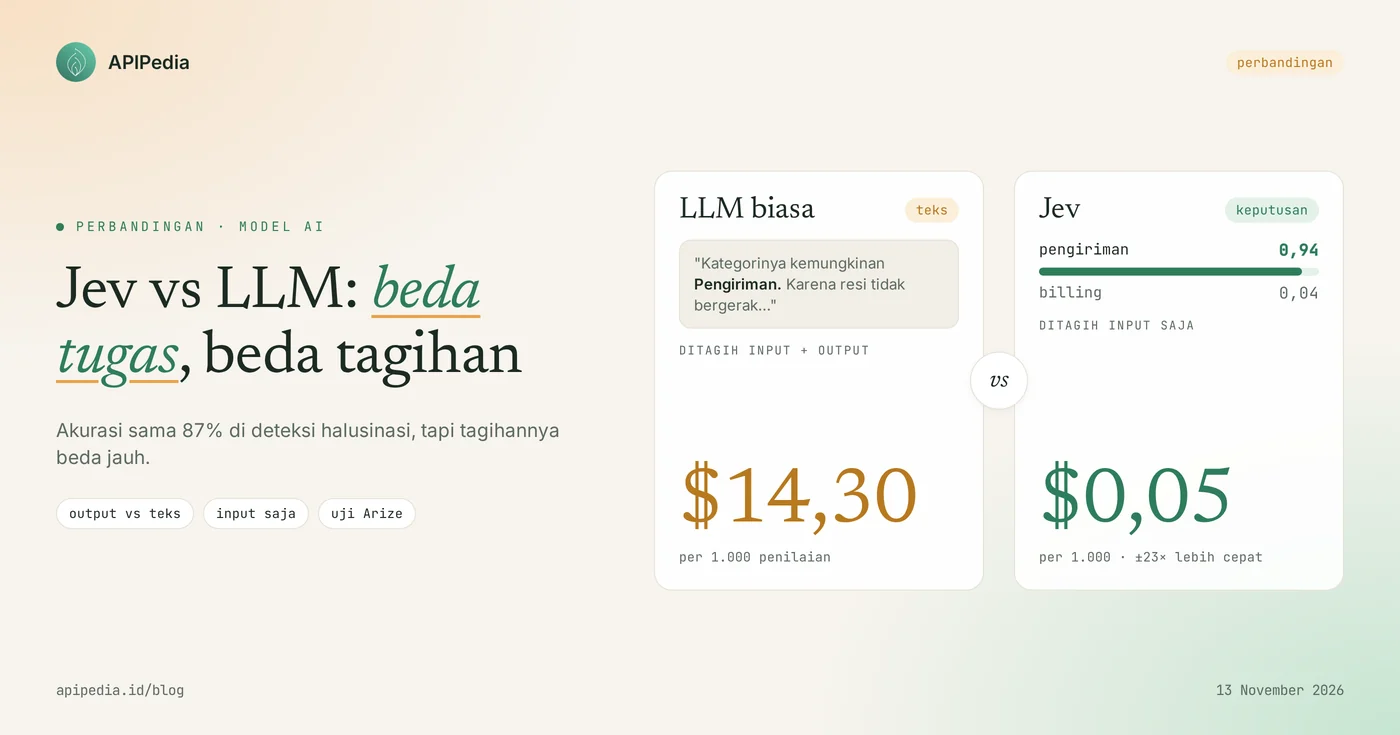
The difference: regular LLMs like ChatGPT or Claude write the answers word for word, whereas Jev just chooses answers from a list you've specified and gives them probabilities. Jev is therefore much faster and cheaper for decision tasks, but cannot write, explain, or reason at length. The two are not replacements for each other, but rather tools for different jobs.
Many teams use LLM for everything, including simple tasks like "what category does this ticket fall into?". This article compares Jev and LLM in terms of output, cost, speed, accuracy, and error types, then helps you choose when to use which.
Quick summary: Jev vs regular LLM
The differences between Jev and LLM are most noticeable in the form of output, how to bill, and the types of errors.
| Aspect | Jev (System One models) | Typical LLM (ChatGPT, Claude, Gemini, etc.) |
|---|---|---|
| Outputs | Decisions are of type + probability | Free text, can also be JSON via structured output |
| How to earn | All questions are answered parallel in one process | Token by token, in order |
| Bill | Input only ($0.042 per 1 million tokens), output is free | Input + output, output is usually several times more expensive |
| Latency | 70–500 ms (TypeSafe claims) | Seconds to minutes, especially with reasoning mode |
| Error type | Choose the wrong option with confidence | Fabricated content, inconsistent formatting, or off-label labels |
| Reason | Nothing, just numbers | Can explain why |
| Suitable for | Routing, classification, moderation, mass scoring, automated gateways | Writing, summarizing, replying to customers, coding, long analysis |
What is the difference between Jev and LLM output?
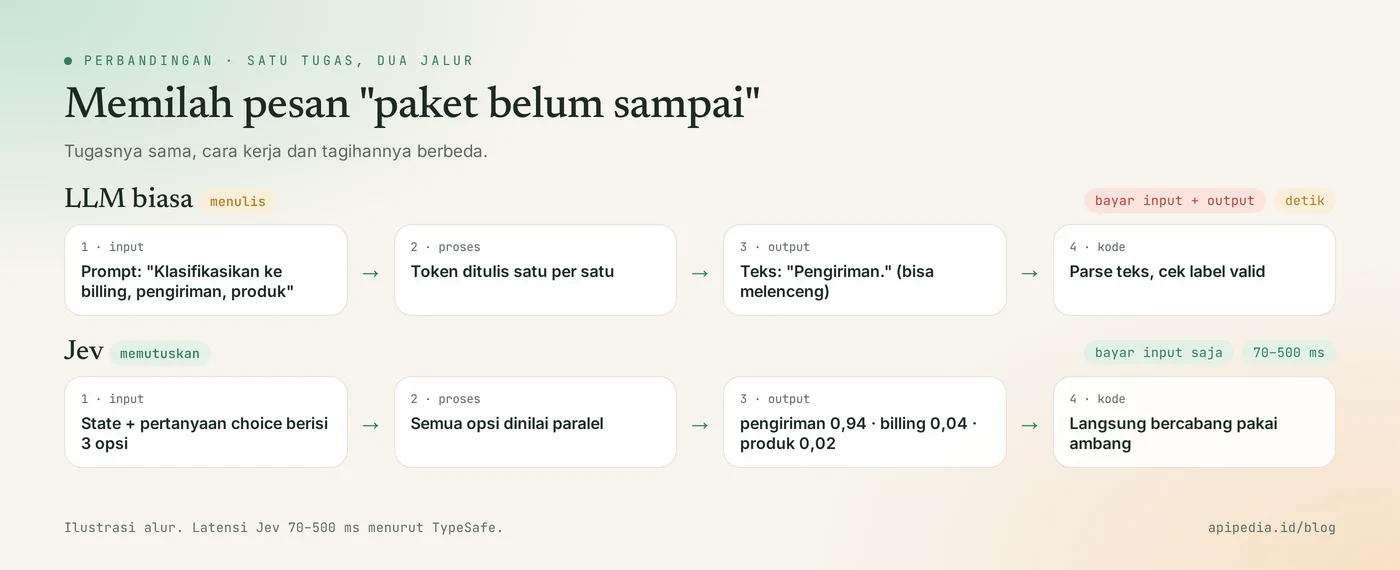
Jev's output is always the value you have defined, while LLM's output is text that must be read or parsed again. For example, you want to sort out the message "My package hasn't arrived, the receipt hasn't moved for 5 days."
With LLM, you write the prompt "Classify this message into billing, shipping, or product. Answer in one word." Usually the answer is correct, but every now and then the LLM will write "Delivery." with a period, "shipping/logistics", or adding an explanatory sentence. The structured output feature reduces this problem, but you still pay for the output token and wait for the text generation process.
With Jev, you send a question of type choice containing three options. The answer is always one of the three labels, complete with the probability of each option, for example pengiriman: 0,94. There is one more subtle difference: according to the Vercel documentation, the LLM structured output adapter usually combines all questions in one prompt, whereas Jev grades each question separately. The same form of results does not necessarily mean that the assessment behavior is the same.
What is the difference in cost and speed?
The difference in cost and speed is huge. For decision assignments, Jev is generally tens to hundreds of times cheaper than LLM. The cause is structural: Jev only charges for input, whereas LLM also charges for output and, in model reasoning, thinking tokens. Some third party test results:
- Arize, hallucination detection: after Jev's threshold was set at 0.80, Jev and Claude Opus 5 both achieved 87% accuracy. The cost is $0.05 per 1,000 ratings for Jev, versus $14.30 for Opus 5, about 23 times the speed.
- Braintrust, answer accuracy: Jev reached 78.1%, while GPT-5.6 Luna with reasoning reached 88.6%. GPT-5.6 Luna is more accurate, but costs 13.2 times more and takes 23.3 times longer.
- TypeSafe claims: 20–200 times faster and 40–400 times cheaper for decision-form tasks, measured independently by TypeSafe.
The pattern is consistent: Jev wins hands down on cost and speed. Regarding accuracy, Jev can be equal on some tasks but lags behind on other tasks, especially those that require deeper reasoning.
Example of calculating costs for your application
Let's say your online store sorts 100,000 customer messages per month, about 300 tokens each. With Jev, the total input is 30 million tokens × $0.042 per 1 million = about $1.26 per month, with no output fees. For LLM, calculate the input and output rates of the model you use, plus output tokens for each answer. The formula and example for calculating tokens are in the article AI tokens like credit.
What errors commonly occur in each?
The usual mistake in LLM is hallucinations, whereas in Jev it is wrong choice with confidence. LLMs can hallucinate: making up facts, creating new labels, or calling the wrong tool. Jev can't make things up outside the list of answers, but can still choose the wrong answer with confidence. Vercel gave the example of a ticket directed to a team that sounded reasonable, but was actually the wrong team.
The important difference is in probability. Jev is trained so that the probabilities are calibrated, so you can use those numbers as gates: above the threshold it is run automatically, below the threshold it is passed to a human or LLM. The LLM can also be asked to state a "confidence level", but the number the LLM writes is part of the text, not a measured probability.
When to use Jev, when to use LLM?
Use Jev for iterative decisions where the answer can be determined in advance, and use LLM when you need text or reasoning.
| Need | Choice |
|---|---|
| Sort tickets, emails, or chats to the right team | Jev |
| Flag comments or reviews that need moderation | Jev |
| Determine whether the prompt should be answered by a small model or a large model | Jev |
| Assess thousands of AI answers (LLM judge) at low cost | Jev, with tested thresholds |
| Reply to customers with friendly language | LLM |
| Summarize documents or meetings | LLM |
| Write or improve code | LLM |
| Complex decisions that require written reasons | LLM, or Jev for initial screening then LLM |
Best pattern: combine the two
The most economical pattern is cascade: all requests are Jev assessed first, those with high confidence are processed immediately, and only the rest are forwarded to the big LLM. One independent study summarized by Amplitude found a cascade with a threshold of 0.80 could match the accuracy of a frontier model with about a quarter the cost and half the latency. These results need to be retested in your data, but the pattern is worth checking out.
Frequently asked questions
Is Jev smarter than ChatGPT?
Cannot be compared directly. Jev only does type decisions, and for some of those tasks his accuracy is equivalent to a large LLM at a much lower cost. For writing, explaining, or reasoning, LLM is clearly superior because Jev can't do it.
Is LLM's structured output the same as Jev's?
Similar in terms of results, different in how they work. Structured output forces LLM to write JSON according to the schema, but LLM still creates tokens one at a time and bills the output. Jev assigns probabilities to each option in one parallel process.
Do I need to replace LLM with Jev?
No need to replace. Move only the decision part, such as classification and routing, to Jev. Let the LLM do the parts that really need text.
How to try Jev?
Create an API key in the TypeSafe console or through partners such as DigitalOcean and Vercel, then send a request to endpoint /v1/systemone. Complete examples are in the Jev in the cloud, Jev on-premises, and Qev guides.
Don't know Jev yet? Starting from what Jev is, then understand the concepts in the System One model and decision model.
Source
- Arize: Jev vs. LLM-as-a-Judge, accuracy and cost benchmarks
- Braintrust: When Jev holds up as a judge
- Vercel: What is Jev, TypeSafe AI's System One model?
- Amplitude: An analysis of Jev, faster and cheaper, but watch the accuracy
- TestingCatalog: TypeSafe AI launches Jev for structured AI decisions
- The New Stack: TypeSafe launched Jev, a System One model
Topics: #ai #jev #llm #perbandingan #model keputusan #biaya ai
About the author
Tim APIPedia — Tim Engineering APIPedia
Tim engineering di balik APIPedia yang membangun dan memelihara API data Indonesia - ongkir, OCR KTP, data wilayah, BMKG, hingga server MCP - dan menulis panduan integrasinya dari pengalaman langsung.